
Business
On a gravy train
A spanking new building and state-of-the-art machinery will enable Aatash Foods to increase the market share of their ready-to-cook products
If Aatash Food’s ready-made pastes have made life easier for the people who have to cook meals at home, more assistance is on the way. A whole new range of masala gravies has been introduced, part of the expansion plan of Dinshaw and Khursheed Variava who run the enterprise.
With 50 lakh rupees funding over several phases from the Bombay Parsi Punchayet (BPP) backed Zoroastrian Investment Corporation Private Limited, the Variavas expanded the scope of their processed food manufacturing unit converting their 2,500 square foot factory in New Bombay to an over 8,000 new structure on the same plot purchased by the company in 1992. The new building was inaugurated with a jashan on May 27, 2007 before a gathering of over 100 well-wishers.
"I expect the turnover to increase tenfold,” said a buoyant Variava when asked how the new premises and equipment would contribute to the business. "We’re going to distribute our products on an all India basis. Right now our sales are in Bombay, Poona and to a negligible amount in Delhi. We will be signing contracts with a marketing company to distribute products in five north Indian states.”
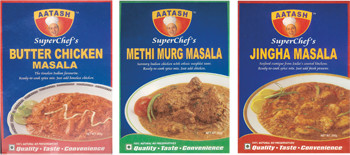
Prepared from totally vegetarian ingredients the new products with a shelf life of one year are methi murg masala, jingha masala, butter chicken masala and dhansak dal masala especially popular with Parsis and Christians. None of the items require refrigeration. The gravies can be used with vegetables, cottage cheese and other vegetarian foods as well, says the entrepreneur.
The new reinforced cement concrete structure and state of the art equipment will also help ensure that required hygienic conditions for food processing are met. A proposed ISO 9000 tag and a food hazards clearance certification (HACCP) "will give us an edge over others… a lot of paper work is involved.”
As advertising the products is expensive, the 55-year-old Rustom Baug resident is counting on retail outlets to display his products while at the same time offering buy-one-get-one-free type of consumer retail benefit schemes.
"I want to get the market back, I’m too late… because I didn’t have the money” earlier. He is extremely grateful to the venture fund and especially to BPP chairman Minoo Shroff. "He had faith in me,” says Variava.
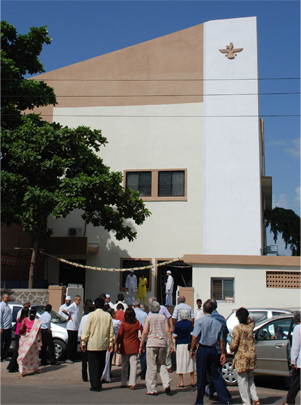
The new factory building: "I expect the turnover to increase tenfold”
"I’ve already started paying back,” he states. Equated monthly installments will be made over the next five years. "As soon as I pay off everyone I can buy back the shares from the Punchayet venture capital fund at a premium.” The fund invested 20 lakh rupees as equity and 30 lakhs loans.
The company is still in the red financially but Variava says he hopes to break even by end 2007. He needs to achieve a turnover of Rs 20 lakhs a month. The total project is pegged at 2.5 crore rupees, says Variava. The Government of India will offer a subsidy of 50 lakh rupees as they consider food processing a sunrise industry and wish to encourage it while the Union Bank has loaned 55 lakhs, he notes. The remaining one crore rupees was put in by the entrepreneur and his family.
"Khursheed looks after the factory and finance, I look after sales,” says Variava. The factory has around 15 workers and two staff with the machinery valued at around 90 lakhs to a crore, notes the businessman.
He credits his wife, a former Union Bank of India employee who opted for voluntary retirement as the initiator of the new products. "Khursheed knows how to cook. I don’t. We sit together and formulate ideas and strategy.”
The raw material for the products is sourced from the Agricultural Products Marketing Committee wholesale market in New Bombay. "I personally go and source the material.” To ensure a good product "the best quality raw materials have to go in for the best quality to come out,” he observes.
The packets are sealed in pouches of 40 to 300 grams depending on the product. The gravies are packaged in retortable four ply pouches consisting of aluminum foil, polyester, nylon and a special poly. The half cooked gravy is put in the pouch, sealed and then heated in a special boiler to 130° centigrade for 45 minutes to one hour depending on the product. All the bacteria are thus destroyed and no new bacteria can enter as the pouch is sealed. The carton containing the pouch mentions the support extended to the company by the Government of India and the Zoroastrian Investment Corporation.
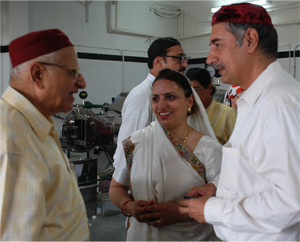
Above (L to R): Minoo Shroff, Khursheed and Dinshaw Variava
Ginger and garlic
A student of St Mary’s and the Sir Jamsetjee Jejeebhoy Parsee Benevolent Institution, Variava graduated with a BA in economics from Burhani College, Mazgaon. Even during his college days he started supplying packaging material. One of his first customers was his father’s cousin, the late Freni Variava of Blaze Advertising. He then supplied corrugated boxes to W. G. Forge headed by the late Shapur Rao. Variava sourced the work to others on a job basis. Later he supplied plastic carry bags to the Taj Group of Hotels but finally pulled out when granule prices shot up and competitors offered substantially lower rates than what Variava found financially viable. He had already purchased the plot at Rabale, New Bombay with loans from his father Framroze and his ex-father-in-law Murzban Unwalla and was on hard times.
Around that time an aunt in Hyderabad, Dolly Dastur and her husband Dinshaw, sent him a packet of ginger and garlic paste manufactured in the twin cities and asked him to market it in Bombay. A basic food additive, the product turned out to be a best seller and soon Variava began manufacturing the product in Bombay.
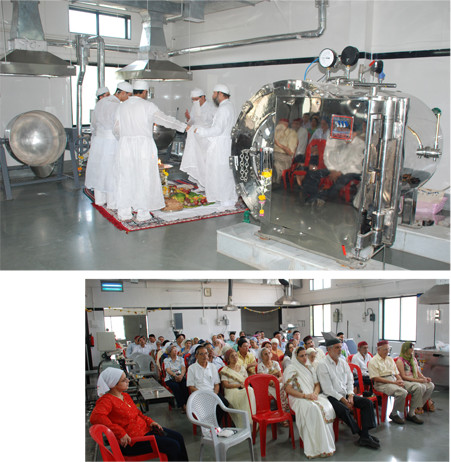
Top: Jashan at the new premises Above: Well-wishers at the inaugural
He availed of the services of a food technologist P. Kumar from the Food Corporation of India, who offered knowhow on preservatives. Variava then roped in Dara Ichhaporia to design the packets and Firoze Treasurywala to take the photographs, neither of them charging for their services. The smiling chef on the package is Variava’s former tutor Behramsha Engineer.
Aatash also markets English and French mustard. The clients for these products are mostly Parsis, Christians and those who’ve lived abroad and know about the product. "Mustard tastes better with non-vegetarian food,” says Variava.
Variava had 80 percent of the ginger and garlic paste market in Bombay. "I was the pioneer in Bombay. I was very lucky.” But when giants like Dabur and Mangal entered the market they cut into his market share.
Looking for finance to increase his production capacity, Variava casually met BPP trustee Dinshaw Tamboly at a Rustom Baug event. Tamboly told Variava of the BPP’s venture capital initiative and advised him to contact the late Khushrooh Byramjee, a prominent and philanthropic businessman. Byramjee approved the idea. Variava took time to prepare a project report which was finally put together by Farhad Fozdar, a chartered accountant (who has not billed him to date).
Variava is keen that other Zoroastrians enter the food processing industry and says he will offer advice and guidance. "You must have a project report.” What about the chickoo farmers in Dahanu, could they enter the business? we asked. Variava cautioned that a single item would not attract distributors. "You need a range of products,” he says. And perhaps as in Variava’s case, a gamut of community well-wishers as well.
◆ ◆ ◆
From the archive