
Observation
A life story
A nonagenarian reflects on his years and proffers advice
I am now by the grace of Ahura Mazda 91 years old and would like to presume that a century is within my grasp. I have had a variety of life experiences and believe that I should share these as my humble legacy to the community.
I was born in Karachi on July 13, 1913. My paternal grandfather was panthaky of the Minocher Homji Agiary in Navsari; a very strict individual, standing atop his staircase at home, who would question my incoming father about his school report. If bad, he would kick him down the stairs. My maternal grandfather, Sir Kavasji Katrak, Order of the British Empire (OBE), was president of the Karachi Parsi Anjuman, and a great admirer of the British Army and Civil Services. His firm, Katrak and Company were contractors for food and drinks as well as transportation for the incoming and outgoing British civilians and army personnel in north-west India up to its boundaries in Iran and Afghanistan. He had many British sales agencies for food and alcoholic drinks. Encouraged by the British, he donated a women’s hospital in Karachi and earned the title of Khan Bahadur.
My father was initiated as a priest in Navsari but ambition drove him to Rawalpindi and Peshawar where, having served in a Parsi firm, he became a canteen contractor for the British Army in its three expeditions into Afghanistan. He carried an army revolver in his belt and sold used automobiles. He acquired oil agencies for both Burmah Shell and Standard Oil, sending truck loads to Afghanistan for their oil lamps and wagon loads up to Agra.
My first nine years were in Peshawar (then a typical wild west country) and I attended a convent run by Christian sisters. As father started suffering very seriously from asthma, doctors advised him to move south near the sea. There in Karachi, I matriculated from B. V. S. Parsi High School, standing second in English language but failing in Persian. While in school, on a casual suggestion from the headmaster, I took a side step to the J. J. School of Arts in Bombay in 1938 and got my ‘scale’ drawing reproduced in its annual report. Graduation was from D. J. Sind College where I made many girl friends. I drove a 5 H. P. Triumph motorcycle and on two occasions suffered near fatal accidents.
Since Sir Kavasji’s son Soh-rab (who later became mayor of Karachi) had no interest in business, I was recruited by grandfather to take charge of his firm’s accounts and inventories of the stores, till such time as my cousin Jamshed graduated and took charge of the firm. I was then redundant and asked grandfather to approve my transfer, requesting the British Army’s commanding general to appoint me in the Royal Army Ordnance Corps as a civilian gazetted officer. My services as the stock-taking officer for the entire ordnance depot were much appreciated, and I was rewarded with a silver platter inscribed by the commanding officer.
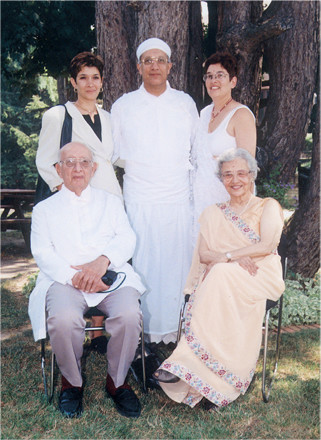
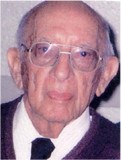
Homi Minocher Homji (above) and with family (from left) Rashna Homji Jefferies, Kavasji, Coombi Karanjia and Villie
At the Partition of the country, Pakistan had very few trained civil servants and in a series of successful interviews with the Public Service Commission, I scored very well and landed with the Pakistan ministry of economic affairs as under and deputy secretary in charge of technical affairs. I was responsible for planning and operating the national Village Agricultural and Industrial Development program (V-AID).
I had specialized in financing of the V-AID program and in a regional council on rural development, presented my paper at the Economic Commission for Asia and the Pacific. The UN headquarters’ representative was very vastly inpressed and on the spot offered me a job with the UN. I served there for 10 years as division chief of social and economic development in Bangkok, as advisor to the Middle East and Far East countries, retiring at the mandatory age of 56. Within that time I toured 52 countries around the world, and published a report thereon, later applying it to the Parsi Punchayet under the title "O Whither Parsis.” This was an admonition to our community councils to smarten up on a strictly approved pattern of public administration. I followed it up with a pamphlet, "A Basic Perception.” In course of time I authored Pocket Avesta for free or charitable distribution, in the hope that people who are too busy to undertake longer prayers could use it to soar in spirit to higher spiritual levels.
At the Partition of India, many families migrated to USA and Canada... so too my family, and we established our roots in Tor-onto. My wife’s sister and brother-in-law helped in introducing us to the local community, which later on elected me as chairman of the Zoroastrian Society of Ontario (ZSO). This enabled me to offer my experience in running a charitable institution. In 1996, the Federation of Zoroastrian Associations of North America (FEZ-ANA) at its annual general body meeting in Los Angeles awarded me an etched stained glass souvenir in recognition of being the "Outstanding Zoroastrian of the Year.” Rather than stick to a seat, at the end of my term, having helped in establishing an atash dadgah, I made way for my successor.
My wife Villie took up the cudgels as member of the bi-weekly Zoroastrian Seniors Committee which brought new life to seniors spread out far and near from the Darbe Mehr. And so the Ontario community of some 6,000 flourished. Now funds are being sought to build a bigger Darbe Mehr on the spot with more prayer and meeting rooms as well as car parking areas and discussion venues. Buildings are but bricks and mortar, but they can assume an aura of piety and dignity by induction, through prayers, rituals and faith. To break down an existing temple, is inexcusable; to evolve it into a new and magnificent structure is pleasing to the angels, when used for the glory of Ahura Mazda.
Our personal prayers like the Gathas, are to be sung in a low but audible voice without disturbing the neighboring devotees. But do we know the meaning of the prayers we recite? Should we not reach out and initiate efforts to attain a communion with high heavens? Normally, before starting any activity, one Ashem and one Yatha should be recited; so too as you get out of bed. That activates the mind towards the true path of wisdom and piety.
In praying our Khordeh Avesta, every effort must be made to understand the meaning of what we pray — not necessarily its translation, but the essence, and soon you will catch up with its significant phrases and use them as your battery chargers during night and day. For example: Banamé Yazad, Banamé Khuda; Ashoi is good, it is the best thing, it is happiness; greatest happiness is achieved when you practise Ashoi for the sake of achieving the highest level of Ashoi. Just as the king is all-powerful in his kingdom, so is the spiritual guide all-powerful in the spiritual world because of his piety; wisdom is granted to the individual who works for Ahura’s mission to purify the world. Recite the names of all Amesha Spentas and Yazatas and do so to the extent possible with the quality of blessing each is assigned to provide. Your physical body and all its parts can last 100 years, barring any accidents. It is your innate duty to keep it that way. Only your carelessness or greed can mar its operative efficiency. Hence the necessity of leading a pure and simple life with good diet and regular exercise of all body parts.
Regarding diet, no over-eating. Keep regular hours and avoid strong spices. No white sugar or white bread. Limit the use of cattle and goat meat but favor chicken, whole-wheat bread, or roti. A drink, softly alcoholic with wafer chips puts you in the right mood for dinner. A dose of yoghurt after dinner settles any acid or wind. Avoid snacks between the three (or two) major meals. If there is a problem of internal movement, powdered Metamucil can settle it. Off the bed early morning, gentle exercise should cover all body parts, limbs, joints, organs and muscles. Tea with honey or brown sugar and a biscuit is good. Discuss your bodily malfunctions with your doctor. Periodic blood reports should be carefully scanned and recorded. No over use of vitamins unless prescribed. Sleep soundly for eight hours. Do not drive your car if you are not in a good mental or physical frame. Play down any strife in the family. Be compassionate and generous. Serve your community by active participation. Never lose your temper. This is my life story. Learn what you can to attain your century.
◆ ◆ ◆
From the archive