
Cover Story
Of fear and Fortitude
Caught in the political and religious crossfires of Pakistan, the Zoroastrian cohabitants uncertainly soldier on
"Karachi no jamaano hato, avé nathi (Karachi had its time, now it’s gone),” says Rohinton Golwalla who works in the accounts department of the Karachi Parsi Anjuman Trust Fund (KPATF). "Make arrangements for all Parsis to go to Canada,” says Dilshad Chowna, a teacher. She recalls how a friend of hers who worked in the Sheraton Hotel luckily escaped a bomb blast that killed several French engineers.
When speaking to a cross section of Karachi Zoroastrians differing views emerged on the merits of staying in this political cauldron. The nationwide developments this November which saw yet another emergency being declared and institutional norms brushed aside in Pakistan, raises the question of how safe is it for a religious minority to reside in a tumultuous Islamic state.
Dilshad’s husband Cyrus who supplies medical devices to hospitals spoke of the "uncertainty” Parsis feel rather than "fear.” Emigrating meant "a better future for our children,” he said. Pakistanis "know and respect” Zoroastrians but the Chownas did not want to feel "we missed the bus” to a better life by not migrating. He complained of the "deceit and corruption” in Pakistan. "Professionalism is lacking,” he lamented. "We are living in a substandard society.” The Pakistan economy is stronger now. Under former Prime Minister Nawaz Sharif "the economy was in the doldrums,” he says. There was hardly any economic development between 1993 and 1999. "Hospitals never got their budgets,” so his business suffered.
"Help us to migrate, guide us,” says Shernaz Bharucha, a teacher at the Washington International School. She wants to leave "for the sake of the children.” There is "no future (here). Times are getting worse… previously it was not so bad. (But) after the Afghanistan war,” things deteriorated. Her husband Pervez who works at Standard Chartered Bank is more philosophical about the outcome: "It’s in His (God’s) hands, if it’s better to stay here, we’ll stay.”
There is "no commercial entertainment” available as such, say Roshni and Cyrus Dinshaw. "Eating out with friends or visitors,” is the only alternative. "At one time (Karachi) had night clubs and even cabarets,” but now all that is past.
Adil Khajotia who is in the pest control business states, "We’re happy here. I would like to stay.” "Times are changing,” say Homai Minwalla and Zarin Kakalia. The navjotes of interfaith married couples are being performed. But there is no civil law for people of different faiths to wed. So most marry abroad and then either return to Pakistan or stay overseas.
"Additionally the custom in Pakistan requires that anybody marrying a Muslim also has to convert to Islam,” notes prominent Pakistani businessman and chairman of the KPATF Byram Avari.
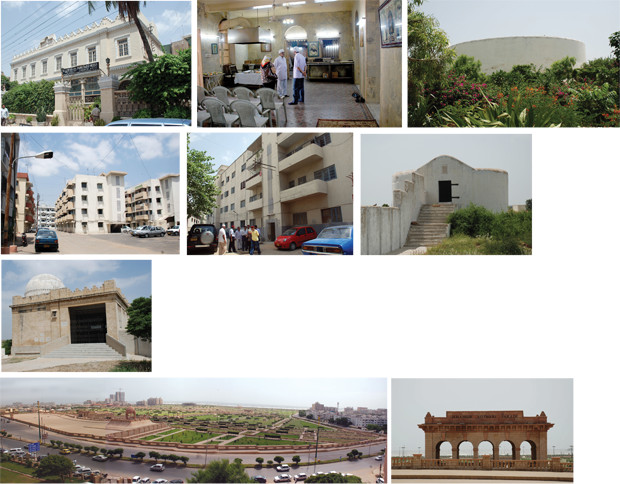
From left (top row): Seth Hirjibhai Jamshedji Behrana Parsi Fire Temple, Hall of Seth Dossabhoy Merwanji Wadia Dar-e-Meher, Anjuman Dakhma (Second row): Buildings at Anjuman Baug, Ghadialy Dakhma, Sagdi (4th row): Jehangir H. Kothari Parade and Promenade
He believes that many of those who migrated "want to come back. Life (in the developed world) is so hard. People don’t know their neighbors… they have to work 18 hours a day to survive… (even) Muslims (who migrated) have come back. People go for two weeks for a holiday in the summertime. They don’t realize the rigors” of life in the West.
Dhunjishaw B. Ghadialy, a trustee of the KPATF for the past 13 years, whose family has been in Pakistan since 1843 says, "Everything is here. There is nothing wrong for the Parsis. We are not involved in politics. I told Byram to leave (politics). Jaan chhooté (life will be spared). He’s very happy with his business.” The Karachi Zoroastrian Calendar by Jehangir Framroze Punthakey published in 1919 refers to a Hormusji Dadabhoy Ghadialy "who enjoyed great fame in Karachi...
"During the First Afghan War, he had come as a contractor for the whole British Army. It has been said that he used to buy the jewels of the Mirs of Sind of that time, and resell them. From this he collected a considerable fortune. Seth Hormusji… came to Karachi when it became the headquarters of the Commissioner of Sind… He used to ride about the city on his horse and many times officers from the cantonment used to walk beside him.
"After his own arrival, he gradually settled many of his family members here, too. Seth Hormusji had taken a leading part in every project of the Anjuman here. The Ghadialy Dakhma… had been built by him and he gave away substantial sums in other charitable works. At that time large areas for building houses were given for the settlement of Zarathushtis who had come to Karachi. Seth Hormusji was in charge of distributing these lands on the condition that a house was to be built on one-tenth of the land and a wall had to be built all around it. Parsis thought the land to be too extensive, and being unable to bear the cost of the boundary wall, used to shift their boundary stones overnight thereby decreasing the area. In spite of that, the Parsis used to own a lot of property, and at the time the whole of Saddar (a locality in Karachi) belonged to the Parsis, and most of them were engaged in business.”
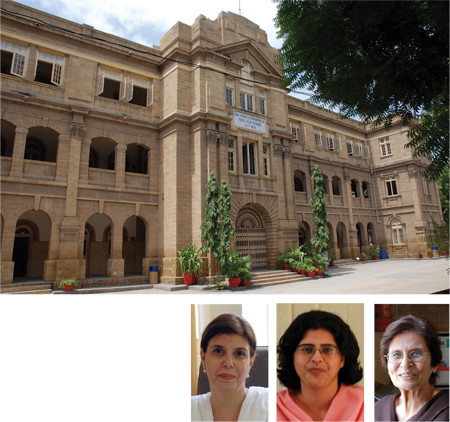
The Bai Virbaiji Sopariwalla Parsi High School (above). Alongside (from left): Principal Kermin Parakh, headmistress Diana Randeria and teacher Mehroo Khambatta. Mama Parsi Girls’ High School was closed on the day delegates were taken to visit community institutions
Noting that there were around 4,500 Parsis in Karachi 20 years ago, Ghadialy lamented that "today there are hardly 1,800… naturally homes are empty.” According to The A & T Directory Quetta has 21 Zoroastrians, Lahore 54, Rawalpindi 21, while Multan and Peshawar have two each. The Edulji Dinshaw Rustam chawl property may soon be sold for over Pakistani Rs 70 crores. The existing tenants will be moved to anjuman housing. The funds generated may be used for community, health and education purposes, housing being sufficient for the resident Karachiites.
He blamed migration and fewer births for the decline. "Fifty die, births are hardly 20 to 25… every year 100 go abroad… There are 15 to 20 marriages in a year. Few intermarriages.”
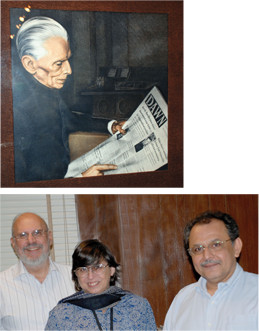
Top: Jinnah with first issue of Dawn Above (from left): Hoshang Master, Niloufer Patel and editor of Dawn Abbas Nasir
Karachi has a crematorium for the Hindus but not for the other communities, he notes. There is a general cemetery ground but few Parsi burials. The KPATF has two dakhmas both "working very well. Rains are scarce and the sun shines throughout the year.” A corpse is consigned "once every 10 days.” There is "no smell” from the towers of silence, he avers.
In the KPATF chairman’s review for the year ended June 30, 2004 Avari notes: "It was found that the installation of the reflectors to be imported from India for the dakhmas was not feasible. The manufacturers wanted that the pavi of the dakhmas be increased in height by seven feet. This would have caused the inside of the dakhma to be viewed from the adjacent residences and also as increasing the pavi was not feasible, the idea of installing reflectors was scrapped.
"Instead the suggestion of Naval Vakharia, as supported by other trustees is being considered. The new proposal is to install, with the help of existing nassessalars and other dedicated young Zoroastrian members of our community, stainless steel sheets in the inner periphery of the dakhmas. The belief is that this would have the same effect as the reflectors and (there) will not be unbearable heat for the nassessalars to go inside....
"There is an opposition to this ...that the number of deaths is reducing per annum with the decrease in the population and there are not more than three bodies being interred per month on an average in the dakhmas and as the dakhmas are operating successfully without any additional action to be taken, it is advisable not to incur further expenses.”
Finally a decision was taken in favor of installing stainless steel sheets.
There is, however, "a shortage of mobeds,” Ghadialy observes. He believes mobeds in Karachi earn between Pakistani Rs 30,000 to Rs 34,000 a month. Their children’s education is provided free of cost, free residence is also provided as well as medical assistance. Jobs are found for the priests’ wives if they desire to work.
The income tax slabs in Pakistan are far more favorable than in India. Farrokh Mavalvala, KPATF manager, provided Parsiana with income tax schedules which show the topmost tax slab to be 25 percent for non-salaried tax payers and 20 percent for salaried individuals. A person earning Pakistani Rs 5,00,000 (equivalent to 3,00,000 Indian rupees) per annum pays only 10 percent tax. Avari notes that Zoroastrians are so much in demand and draw such high salaries that there is little incentive to venture into business.
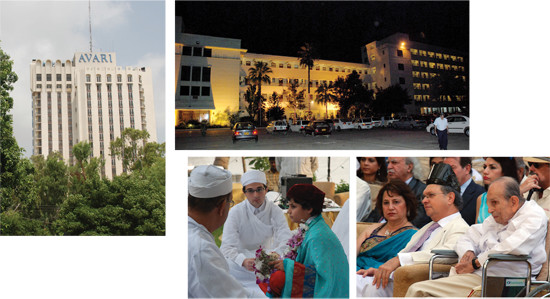
Above: Beach Luxury Hotel. Far left: Avari Towers Below: Goshpi and Byram Avari with family and guests at grand- daughter Nadine’s navjote
KPATF trustee Soli Parakh, a partner in A. F. Ferguson and Company (a member firm of Price Waterhouse Coopers) does not believe the community will dwindle to a handful in the near future. "People may come back if things improve,” he says optimistically. Funds are not a problem for the KPATF, Parakh states. One-third of the corpus is invested in shares listed on the stock exchange. "We’re very careful” in investing, he observed.
Surplus monies accrued "can’t just be sent out” to other countries that may require assistance due to the rules and regulations governing the trusts, he says. Seychelles, Sri Lanka and Macau face the same problem, he added.
The total assets of the KPATF as per their balance sheet for the year ended June 2006 is Pakistani Rs 9,15,37,109 while the income for the year was Rs 71,66,843 and expenditure Rs 25,10,737 leaving a surplus of Rs 46,56,107. The "accumulated surplus carried to (the) balance sheet” is Rs 4,64,76,280. The market value of the KPATF properties would of course be worth thousands of crores.
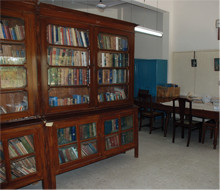
Dastur Dr Dhalla Library located at the Dinshaw B. Avari Colony
The trustees and office bearers of the KPATF are Avari, Ghadialy, Parakh, Nergis S. Jamasji, Deena M. Mistri, honorary secretary Rustom T. Sethna and honorary treasurer Homi B. Khambatta.
In the chairman’s review, Avari singles out Ervad Godrej Sidhwa for "the selfless and devoted services to the Parsi community for Humbandagi prayers and Zoroastrian religious classes conducted by (him) for the last 50 years.” Mention is also made of panthaky Sorabji N. Mogul and nassessalar Dinshaw Bharucha.
Amongst others whose services were recognized are: "Mavalvala (who) in his capacity as manager is taking the brunt of the community’s problems and shouldering them with true Zoroastrian spirit and is dedicated to looking after the community... Grateful thanks go to him as well as to the three other stalwarts — Sidhwa, Keki R. Dastur and Vakharia — whose contributions cannot be matched for looking after community affairs.”
The August 2007 issue of The Herald, a monthly publication from the Dawn Group, asked 60 questions on "what Pakistanis really think” on the 60th anniversary of the country’s independence (Pakistan became independent on August 14, 1947, a day before India).
In response to a question "given the choice would you stay in Pakistan or emigrate to another country,” 87 percent opted to "live in Pakistan.” In the younger age group, 18 to 24 years, 82 percent opted to stay while in the 45 plus age group the figure varied from 91 to 94 percent. More men (88 percent) than women (85 percent) wanted to stay in Pakistan.
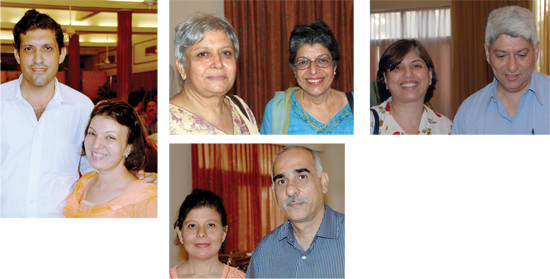
Clockwise from top left: Cyrus and Dilshad Chowna; Homai Minwalla and Zarin Kakalia, Roshni and Cyrus Dinshaw, Pervez and Shernaz Bharucha: mixed feelings
As to whether "your children will have a better quality of life than yourself,” 85 percent said yes. Whether the present generation was "better off than your parents,” 69 percent agreed. To "will Pakistan survive the next 15 years” 86 percent replied positively. Did Pakistan founder Mohammed Ali Jinnah perceive the country as "a religious state or a modern democracy,” 43 percent said religious state, 44 percent opted for democracy and 12 percent stated they "don’t know.” [Jinnah who founded the Dawn newspaper was married to a Parsi, Ruttie Petit. His house in Karachi (see cover) was bought from a Parsi. The house is preserved as a national monument.]
Sixty-six percent believed "Pakistan has been harmed by the periods of martial law.” Seventy-eight percent felt "democracy is the right political system for Pakistan.” As to what the next five years hold for Pakistan-India relations, 74 percent foresaw "continuation of the status quo.” As to whether "the rights of minorities (are) effectively protected in Pakistan,” 67 percent said yes.
Incidentally the publisher of the Dawn publications including the daily and The Herald is a Zoroastrian, Hoshang S. Master. His wife Zenobia assists the "Dawn in education” division of the group. Their daughter Ava studies in a college in California. Will she return? we ask them. "We don’t want her to,” comes the reply. The Dawn group’s circulation general ![]() manager Niloufer Patel voiced the "insecurity” people feel. "What if the Taliban come (they have made advances in the North West Frontier provinces of the country). There will be more restrictions. I realize everyone thinks the grass is greener elsewhere (and) I’d be the last person to leave (but) Karachi is not like before.”
manager Niloufer Patel voiced the "insecurity” people feel. "What if the Taliban come (they have made advances in the North West Frontier provinces of the country). There will be more restrictions. I realize everyone thinks the grass is greener elsewhere (and) I’d be the last person to leave (but) Karachi is not like before.”
The first arrivals
The early days of the community in Karachi can best be gleaned from The Karachi Zoroastrian Calendar, a record of important events in the growth of the Parsi Community in Karachi compiled by Jehangir Framroze Punthakey, 1919, translated into English and reprinted in 1989 and again in 1996, gifted to Parsiana by Ardeshir Cowasjee. Two extracts from the book reproduced here refer to the establishment of the first Parsi business and the benevolence of Jehangir Kothari:
From the notes of Parsi Prakash it can be substantiated that there was a Parsi community in Sind in the year 916... An Arab historian by the name of Masudi wrote in 916 "Up to this time (304 Hijri), the religious people of Iraq, Pars, Kerman, Sajestan, Khorasan, Tabristan, Jabal, Azerbaijan, Iran, Hindustan, Sind and in different parts of China, give great respect to atash (fire).” After this, for some 250 years, no record is available about the Parsis of Sind. But in the (Parsi Prakash) a short memorandum is noted thus: "In the year 1184 near the banks of the Sindhu river (Indus river) it seems there was a Zoroastrian habitation, because, from a city named ‘Oocha,’ on the banks of Indus, a priest, Ervad Majhar went to Seestan city to learn the rituals and customs of the Zoroastrian religion.”
From these notes another important question arises, as to whether our ancestors, fleeing from Iran, first landed in Sanjan and then gradually dispersed to different parts of India, or did they come directly this way too? This inference cannot be completely wrong, because it is certain that our elders (were) acquainted with Sind from the beginning, and it is possible that some Zarathushtis, fleeing from Iran, came this way...
The Parsis started settling in Sind between 1820 and 1825. How correct this inference of mine is, will be proved by some of the following notes reproduced from the Parsi Prakash.
From what I can gather, the Jassawalla Company seems to be the first Parsi business firm in Sind, and many branches of the firm, under different names, seem to have been established here. In the Parsi Prakash, the death (in 1850) at the age of 55 years of Seth Ardeshir Jeejeebhoy Mukadum, is mentioned, and there is also an interesting note: "He, as the chief manager of the firm of Messrs Jehangirji Nusserwanji Jassawalla Company used to travel to Kabul, Hyderabad Sind, and Multan, and he died in Multan.” Now if we presume that Seth Mukadum had joined Messrs Jassawalla Company between the ages of 25 and 30 years, then it is certain that the Jassawalla Company must have been in Hyderabad Sind in 1820 or 1825. With reference to Seth Mukadum, there is another note: "In the year 1839, when the British Army invaded Kabul, on the recommendation of Sir Alexander Burns, the firm, Jehangirji Nusserwanji Jassawalla Company, sent two representatives (Seths Ardeshir Jeejeebhoy Mukadum and Burjorji Nanabhoy Billimoria or Kabuli) to sell considerable merchandise. After the establishment of the British authority in those areas, Seth Jehangirji opened shops in Sukkur, Jalalabad and Kabul.”
In the same volume, the mention of Seth Nusserwanji Khurshedji Jassa-walla’s death is to be found, and it is mentioned: "In the year 1826, after the death of his father, he, together with his uncle (father’s brother) Seth Jamshedji Cooverji Jassawalla, and his cousin Seth Jehangirji Framji Jassawalla, used to manage their family’s old established shop, the Jehangirji Nusserwanji Company. Many branches of this large shop were established at Karachi, Sukkur, Ferozepur and Hyderabad, etc and later they greatly enlarged the business.”
Jehangir Kothari’s largesse
The favorite place for Karachiites to get some fresh air is Clifton. The cool sea breeze during the summer has made Clifton a blessing. However, there were not enough facilities for the people to enjoy themselves, because a large part of this hill was a part of the property of Seth Jehangirji Hormusji Kothari, and only a small part was available for use by the public, which was insufficient for the great number of carriages and people who visited it and so had become overcrowded. For several years the Karachi Municipality was debating the Clifton improvement scheme, so that it could be a show piece of the city. In June 1917 (it) appointed a powerful committee to plan a proper scheme. The chairman of this committee, Mr Misham Lee, who was also the chief officer of the Munici-pality, prepared a scheme. In this scheme it was planned that in the extreme northwest of the hill a promenade and terraces be built along with an overhead covering. Also included in it was a high hill, from which the views of the harbor and Manora could be seen clearly from afar. In addition, parking space was kept for carriages near the concrete walk. To implement this scheme, it was found necessary to take over an existing bungalow and 12,000 sq yds of surrounding land. This was the property of Seth Jehangir Kothari. The Municipality was thinking of buying this land, but before it could do so, Seth Jehangir Kothari examined the scheme in detail and gave it his enthusiastic support. He was very fond of his seaside bungalow, and although he was planning to erect a build-ing on the vacant land lying to the northwest, with great enthusiasm and benevolence agreed to give to the Municipality his bungalow, including the land, as well as the surrounding plot, valued at Rs 1,25,000 for the successful implementation of this scheme.
The Municipality accepted this offer gratefully on behalf of the citizens of Karachi and resolved to name the promenade "The Jehangir Kothari Parade” which will be constructed in the center of the front portion of the shelter. It was also decided that a marble plaque will be affixed with the following inscription: "The benevolence of Mr Jehangir H. Kothari, O. B. E., who, by giving his valuable bungalow, its land and the surr-ounding land, has made the construction of the Parade possible.” The cost of construction of this Parade will be Rs 1,30,000 which will be borne by the Municipality.
The foundation laying ceremony of this Parade was done by the Honorable Governor of Bombay Sir George Lloyd on 10th February 1919 during his visit to Karachi... Seth Kothari... was personally invited by Sir George and Lady Lloyd, and profusely congratulated. This Parade will be completed next year. Furthermore, to entertain the people visiting Clifton and add to their pleasure, another generous citizen of Karachi K. B. Kavasji Hormusji Katrak has offered to have a bandstand built there at his own cost.
Minority Rights
Extract from The Herald, September 2007:
Three days before August 14, people from various religious minorities gathered at the Minar-e-Pakistan (in Lahore) under the leadership of All Pakistan Minorities Alliance (APMA). They demanded that August 11 be declared Minorities’ Day to honor the speech made on that day by Mohammed Ali Jinnah in Pakistan’s first Constituent Assembly. In this address he had declared that all citizens of the country enjoyed equal rights, regardless of their religious beliefs.
Thousands of Christians, Hindus, Sikhs, Bahai’s and Parsis, present at the occasion, demanded that all constitutional provisions, which give Pakistan an exclusively Muslim character be repealed; the minority members argued that such provisions go against Jinnah’s vision of a modern, democratic and secular state, as outlined in his August 11, 1947 address, in which he said that no one in Pakistan would be discriminated against because of creed, caste, color or ethnicity.
Going beyond their demands to point the way forward, the Alliance unveiled a 30-point charter, which included suggestions such as repealing the discriminatory laws and the constitutional provisions that deny religious minorities the same rights as enjoyed by Muslim citizens. "Discriminatory laws, such as the blasphemy law or the ones governing the dissolution of Christian marriages or those that ascribe unequal status to witnesses from the minority communities in courts of law are a negation of Jinnah’s vision and should be withdrawn,” said Shahbaz Bhatti, head of the APMA. The charter also demands that people from religious minorities should be allowed to contest the highest political offices in the country since, as Bhatti added, "this discrimination jeopardizes national solidarity,” and is therefore unacceptable.
◆ ◆ ◆
From the archive