
Zoroastrians Abroad
Across the border
"In 1939 when I had my navjote there were nearly 300 Parsis staying in Lahore,” 80-year-old Rati Cooper recalls the heydays of the community in the city known as the "Paris of India” before partition. Seventy years later in 2009, Parsis number barely 35 with no child left to be navjoted, she states.
Referring to their "aging, dwindling” yet "very closely knit community,” Rati’s 67-year-old sister Perin Boga adds, "Most of us are retired. We lead simple lives but are self sufficient. There are only two families with school and college going children.”
Managing the affairs of the community are four trusts. Boga is joint managing trustee along with Dr Dara Hormasji of the Bai Avabai A. Cooper Agiary Trust. Additionally there is the Lahore Parsi Anjuman, The Golbaugh Trust which runs the cemetery and The Jariwala Trust which extends educational and medical aid. Functioning in an informal set-up, some of the trustees serve on more than one trust which means an overlap of responsibilities.
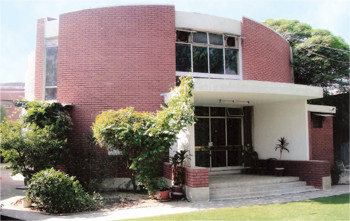
Avabai A. Cooper Agiary
The Anjuman has a residential complex, well maintained by Billy Engineer, where stay most of the community members, with some others residing at the Defence Housing Society, a 15-minute drive from the Agiary. The venue for community gatherings is often the courtyard of the anjuman complex, or the Club hall if the weather is unfavorable or the lawns of the Agiary. On a rare occasion members decide to meet up at a restaurant. Also looked forward to are get-togethers hosted by Byram Avari, president of the Karachi Parsi Anjuman, or attending talks by visiting lecturers sent by him, the distance between Karachi and Lahore being 90 minutes by plane. The dharamshala, which Boga describes as "a modest set-up” is well patronized and financially viable, the charge being Rs 500 per day for lodging that includes a well stocked pantry. "It is the best dharamshala I have seen,” maintains their Bombay based cousin Keki Cooper whom the sisters fondly address as "mota bhai (elder brother).” Although they have a common paternal grandfather, Ardeshir Cooper, who built the agiary in Lahore in 1893 in memory of his first wife Avabai, they have different grandmothers. While Keki’s father Byramji was Avabai’s son, Rati and Perin’s father Faramroz was the son of Ardeshir’s second wife Navajbai. Actually all the children sired by Ardeshir always felt they belonged to one big family, attest the grandchildren. Avabai bore 17 children of whom 11 survived and Navajbai bore 10 more of whom five survived, states Keki. A write-up on the centenary occasion of the Avabai Cooper Agiary was carried in Parsiana (see "Lahore Agiary Centenary Celebrations,” May 1993).
Members of the Cooper family and other long-time residents of Lahore have always felt obligated to maintain the Agiary and in the interim periods when there was no resident mobed in Lahore they would tend the dadgah fire and clean the premises as well. Originally the fire temple was located in a congested locality on Lahore Road but in 1971 when the new fire temple building was inaugurated, the sacred fire was shifted to the dar-e-meher at Gulberg. The Agiary complex has the priest’s quarters as also two other residential apartments. With mounting inflation the trustees have to struggle to maintain the fire temple plus pay the priest’s monthly salary of nearly PKR (Pakistani Rupees) 40,000.
Presently they enjoy the services of Ervad Yazdiee Pavri of Bombay who dared to accept the assignment in a country torn by strife and terror but unfortunately accommodation problems for his wife and son in Bombay have put him in a quandary. On their visit to Bombay, Rati and Perin were hoping to resolve this issue such that Pavri could perform his duties in Pakistan without any mental anguish.
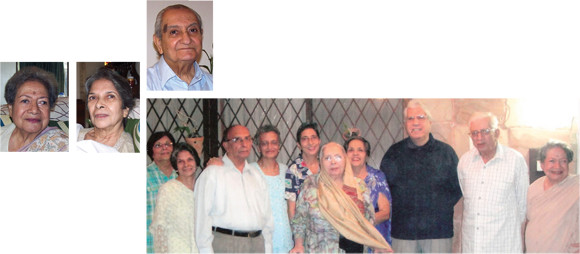
(From left): Rati Cooper, Perin Boga, Keki Cooper, community members in Lahore;
The priest in Lahore is expected to attend to the religious needs of community members residing in neighboring Rawalpindi (popularly known as Pindi), Multan and Peshawar as well. Actually the Zoroastrian pocket closest to the Lahore Parsis is Pindi, a four-and-a-half-hour’s drive away where reside six families, including the well-known Bhandara family of Murree Brewery fame. "Minoo Bhandara who very tragically passed away two years ago did a lot for the (Lahore) Agiary annually, helping with the mobed’s travel arrangements,” states Perin, happy that Minoo’s son Isphanyar is carrying on his father’s legacy. Even Perin’s late husband Jehangir was from Pindi. Multan has a couple of Parsis and Peshawar, none. Just as there is a cemetery in Lahore, there is one in Pindi and Peshawar too. Perin remembers the appeal from the last family in Peshawar "to help with the cemetery.”
Bombay too should have an aramgah, Keki is convinced, referring to the dignified manner in which the body covered with a white sheet is interred in the grave with the help of non-Parsis. The body is laid on a concrete slab and covered with five concrete slabs to facilitate early absorption in the earth and to prevent any form of desecration. The pre-burial prayers are the same as in the case of dakhmenashini, stresses Keki. When Lahore did not have a priest, "on two occasions the Avari family sent their Karachi priest” to recite the funeral prayers, Perin acknowledges "the wonderful help.”
While Perin and Rati prefer not to dwell on the political uncertainty around them, Keki mentions the "community is highly respected there.” After retiring as dean of humanities at the Kinnaird College for Women with which she was associated for 38 years, Perin was made member of the governing body of the College. In fact the College has an amphitheater named after her, declares Keki. He is equally enthusiastic to report that Rati was the first Indian woman principal of Rajkot’s prestigious Rajkumar College (a residential school built in 1870 for the education of the princely order but which opened its doors to the public in 1938). Associated with this institution since 1958 and now, principal emeritus of this College, she enjoys the rare distinction of having a building in the complex — Rati F. Cooper Kala Bhavan — named after her during her lifetime. In fact, these unassuming sisters did not even know that they were to be conferred such honor until the day the facilities were inaugurated.
Rati has now returned to Lahore, to be with her sister, but India does not seem too far considering that Lahore is only 37 miles from the India-Pakistan border.
◆ ◆ ◆
From the archive