
Events & Personalities
Asiatic honors Kamerkar
"Were Parsis Indian? How long does it take for a diaspora community to be recognized as people of the country?” asked emeritus professor of history, University of California at Los Angeles Dr D. R. SarDesai and, alluding to the (then) three Parsi chiefs of the Indian armed forces, added, "When you entrust the security of the country to an individual, it is the ultimate in acknowledging his citizenship.” SarDesai was delivering the first Dr Mani Kamerkar Endowment Lecture, a series established by the Asiatic Society of Mumbai in memory of their longstanding vice president who succumbed to cancer while in the throes of organizing the Society’s 200th anniversary celebrations in 2004.
The subject of the evening on February 23, 2007 was "The contribution of Bombay Parsis in the Nationalist Movement.” Playing the devil’s advocate, former attorney general of India and former president of the Asiatic Society Soli Sorabjee who presided over the event noted, "Quite frankly, my impression was that Parsis weren’t involved with the nationalist movement,” making tongue in cheek reference to the Parsi predilection for "aapri Rani, a grand piano in the living room, English governesses, scotch and soda…” On a more serious note he referred to the "simplicity, honesty and commitment” of Dadabhai Naoroji whose writings "exposed the evils of colonialism,” of the longstanding commitment of Dinshaw Watcha to the Indian National Congress Party (INC) and his "special soft spot” for Sir Pherozeshah Mehta who "enthralled judges with his brilliant advocacy.” He acknowledged the "gutsy, courageous Bhikhaiji Cama,” who gave India her flag, adding, "Time passes, memory fades, pseudo icons come up. It is better to remember them in print, transcribe the knowledge for younger generations (because) statues are only a good resting place for pigeons.”
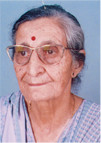
Dr Mani Kamerkar: pos- thumous honor
Giving a background to the Society’s place in the history of Bombay, SarDesai recalled that the proclamation of Queen Victoria taking over the East India Company territories in India directly under the British crown after the war of 1856-57 had been "read out on the steps right here.” Western education burgeoned thereafter and the Bombay University exams were held in the Society’s premises where the numbers of Parsi and Jewish students graduating as doctors, lawyers were always high.
SarDesai spoke of two major groups within the Parsi community — the sethias led by the baronets and knights who felt that "if the British were not here they couldn’t make it, who felt that their children’s first duty was fidelity to the British crown.” And there were the reformists like Naoroji, Mehta and Behram Malabari who felt their future lay with India. "They were constitutionalists; 99 percent of Parsis were for reform, not revolution, except for Cama, the mother of all Indian revolutionaries in Europe.”
"Theories of nationalism abound: Were Parsis collaborators? Did they give (opium) money for titles?” SarDesai touched briefly on critiques of the community, dismissing them as "the professional need of historians to keep (controversies) alive” as much as changes in the perception of history. "The Indian Presidency Association was established in 1885. It had five Parsi presidents… It was not until its seventh or eighth year that a Hindu became president of the INC. By 1915 there were 90 Parsis in Congress… Dinshaw Watcha remained its secretary for 18 years… After 1915 the reformists and the Parsis went into the background, except for Vir Nariman who accused British engineers of bribery and corruption. Later, there were Rustom Masani, Homi Mody, Homi Taleyarkhan and others but they were not comparable to the first phase.” But there was Jamshedji Tata audaciously creating India’s industrial base, J. B. H. and Homi Wadia who created the Indian film industry, Mehta who had been India’s first barrister. "Parsis missed out on a Parsi prime minister because of their orthodoxy!” smiled SarDesai in an implied reference to the late Rajiv Gandhi.
The lecture series was the outcome of a donation of Rs 6.5 lakhs for lectures on the history of Maharashtra and Gujarat given by Kamerkar’s family, Vimal Shah, chairperson of the public and endowment lectures committee informed the audience. Kamerkar had secured a first class in her BA and MA exams, had been a research guide for PhD students and had been principal of various colleges.
On behalf of the family Anant Kamerkar thanked Sorabjee and SarDesai and the Society’s current president B. G. Deshmukh for cherishing his mother’s memory. Remarking on her passion for history, he noted, "If objective history is made accessible to everybody, it would have a salutary effect.”
Arnavaz S. Mama
◆ ◆ ◆
From the archive