
Books
Soonamai's free spirit
The autobiography of Soonamai Desai of Navsari reveals the beliefs and ideas by which Parsis lived and worked a century ago
"I have hated being a woman almost throughout my life. It has laid too many restrictions on me…I was never at home with members of my own sex until much after I was married and had domesticity forced on me.”
Soonamai Desai’s rebellious words could have been uttered by Scarlett O’Hara in Gone with the Wind or by Desai’s contemporary, Madame Bhikaiji Cama, in the real world.
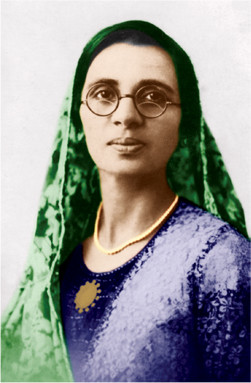
The almost histrionic quality of Soonamai’s life (November 21, 1884 — November 25, 1983) and work was brought to the community’s consciousness by the release of an 86-page monograph — Soonamai Desai of Navsari — penned by Aban Mukherji and published by the K. R. Cama Oriental Institute.
A fine English rendition of Soonamai’s own miniature autobiography, written in a small but steady hand in Gujarati on the back of old calendars in response to urgings from novelist grandson Boman Desai when she was all of 98 years old, the book also draws upon taped conversations with her daughter-in-law Vera Desai in a separate chapter. Some of the experiences Soonamai has narrated plus her own personality find a place in Boman’s novels. At the launch, presided over by KRCOI president Muncherji Cama on March 16, 2007 at the Dr Sir J. J. Modi Hall of the Institute, the audience was privileged to hear Boman read the relevant excerpts from both publications.
"Soonamai was part of an elite club, known by her first name,” recalled Boman. He remembered her sending food items to him during his first decade in the US. He had asked her for a contemporary photograph and she had dressed up for it with the medals she had won for her work — reproduced on the back cover of the book. "She would tell us (Boman and his younger brother Rohinton) stories from the Shahnameh, Panchatantra and Ramayana. She told them very well and always left us with a cliff-hanger!” Allowing that "there is no straight line between fact and fiction,” Boman noted that the "Bapaiji” section in his first book, A Memory of Elephants as well as the character Dolly Dalal in the later work Servant Master Mistress were modeled on Soonamai.
Mukherji (née Lalkaka) later spoke to Parsiana about the need to retrieve the women’s voices of the age that has passed. It was thanks to her mother Perin Lalkaka’s friendship with Vera Desai that gave her access to Soonamai’s papers, working on them intermittently over the years. A sample of Soonamai’s jottings has been reproduced in the book. So minute was the script, Mukherji says, she had to use a magnifying glass to read it before rewriting it in her own hand. Having been educated at the New Era School in Gujarati medium in her early years, the knowledge of the language eased Mukherji’s task.
With photographs provided by Vera and by KRCOI joint secretary Dr Nawaz Mody, the little book illustrates not only a special life but the mores, values and concerns of the community, now so radically altered.
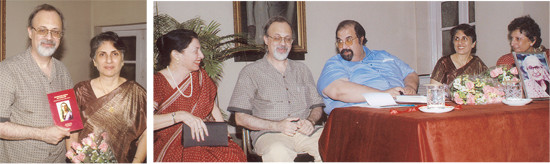
At the launch of the book (L to R): Boman Desai and Aban Mukherji; Homai Modi, B. Desai, Muncherji Cama, A. Mukherji and Nawaz Mody Above: Soonamai Desai
Soonamai’s saga
Soonamai’s free spirit stands out in strong relief against the inhibitions of Navsari Parsi society of her time as she carved a place for herself in the social sphere after having fulfilled all duties as wife, mother and daughter-in-law in a fractious, feuding family. Without a real working knowledge of English she toured Britain and Europe, albeit with her son; became the first woman to be nominated — and later elected — to the Municipal Corporation of Navsari; and went on to establish institutions for the uplift of women. Nor did she fail to enshrine her experiences in published work: two travelogs — one on her foreign travel, the other on a trip to Kashmir and Darjeeling with her ever supportive husband Bomanji — and a history of the Shri Maharani Chimnabai Mahila Vishram of which she remained president to the end of her life.
That Navsari then was a part of the kingdom of the Maharaja of Baroda and that the then ruler Maharaja Sayajirao and Maharani Chimnabai were particularly forward-looking and benevolent rulers gave Soonamai a fillip from time to time, including a chance to represent her school and perform a folk dance before the viceroy. "I was eager to do everything my four brothers did, including wearing pants, killing stray snakes, playing gilli-danda — everything dear to the heart of a boy,” though she was a bright student and she won a monthly scholarship — of two rupees in the seventh and eighth standards which reflected the value of money when the juniormost teacher in the school earned seven rupees per month and the headmaster Rs 32!
Writing about the household economy in which she grew up, she notes that Rustomji Bana, her father, a chemist and apothecary who taught himself to manufacture and sell eau de cologne, sold one phial for six annas and three bottles for a rupee and six bottles for two rupees. He earned Rs 50 and brought up a family of seven but then "two to two-and-a-half seers of really pure ghee could be obtained for a rupee. It is impossible to find that same purity today. Six eggs used to cost four paise. Nowadays they cost three to three-and-a-half rupees!... In these hard times I wonder how one breadwinner with a large family can make both ends meet! No wonder people stoop to thieving and looting. Prices have risen beyond all limits.” For much of her early married life she had to juggle with a much smaller budget.
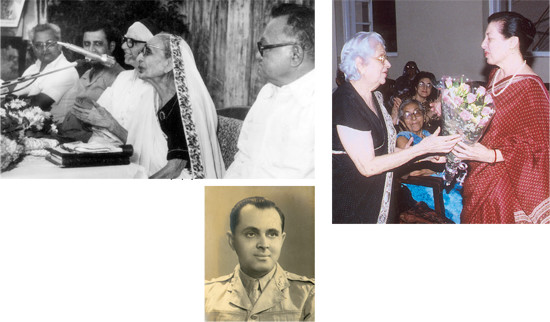
(Above, left) Soonamai acknowled-ging the birthday felicitation (and right) Vera Desai and H. Modi (bottom) Phiroz Desai
She speaks of her happy familiarity with her intended in-laws — a wealthy family in Navsari with four brothers and a sister. The pleasant situation ended when her mother and future mother-in-law fell out over a trivial matter. Soonamai was piqued with her mother for her broken betrothal and staged a fast against the match with Bomanji Desai that her mother then set up. "But my mother was not to be denied. She was not deterred by my action and waited to see how long I intended to carry on. My defiance lasted three days. I finally had to capitulate and agree to marry the man of her choice and resume my meals,” she notes candidly.
But the quiet, gentle, retiring school teacher (later principal) she was forced to marry, 10 years her senior, became the backbone of her development and she missed him dearly when he died in Bangalore. However, life in the matrimonial family was marked by a series of hurdles. The navjote of their only child Phiroz was devoid of joy, a modest affair marred by bickering in the family. Bomanji, wanting to make a civil engineer out of him, sent Phiroz to Karachi and Edinburgh and Soonamai joined him in Britain for a tour of Europe ere he returned. Ending the conflict with his father over the place of employment, Phiroz joined the army and in the course of his transfers met Vera Saklatvala in Karachi. Their union remained harmonious and though in later years Phiroz and Soonamai were often in conflict, the relationship between Soonamai and Vera seemed to have remained unaffected. In the end it was only Vera and a trusted maid Pemmy who remained with Soonamai, Phiroz having predeceased her by three years.
"The most applause”
Jamsetji Tata’s sister Ratanbai Bamji, a philanthropist in her own right, decided to set up an institution where the ladies of Navsari could pass their spare time in useful pursuits. "She was willing to donate the money, if a man of integrity could be found who could put her ideas into practice. Her choice fell on my husband (Bomanji)…He was a law graduate and knowledge of the law was necessary in drawing up its constitution and bye-laws. He was overjoyed to be given the opportunity and decided to involve me in the project as well…The Mahila Vishram …wrought enormous changes in my life and connection with it was lifelong. Even today I am its president, elected for life.” At one of the annual shows when the handiwork of the students was exhibited, Soonamai’s humorous skit was staged and much appreciated.
"I sat for the Hindi examination at an advanced age alongside children young enough to be my grandchildren. At the prize giving ceremony, though I passed in the third class, it was I who got the most applause,” writes Soonamai with obvious satisfaction.
As Maharaja Sayajirao wanted women to play an active role in society, the governor tried to induce women to join the Municipal Corporation of Navsari but few women were willing to take it on, including the redoubtable Soonamai. Finally, persuaded by her husband, she agreed on the condition that she would not be the only female member. A 14-year-old wife of an advocate was bamboozled into joining too. "In the two years she remained a member, she uttered not a word,” notes Soonamai who by then was up to the task. She remained a nominated corporator for 12 years and an elected one thereafter for another six, throughout the rest of her tenure the only lady on board. She introduced the system of ballot vote, hammered through her contention that women should constitute 50 percent of the trust boards of women’s organizations and ensured that the portraits of Madame Cama and Gandhian Mithuben Petit were hung on the walls of the Corporation building — the only ladies so honored apart from members of the royal family. As chairman of the sanitary committee she astonished the rioting Hindus and Muslims by turning up on the scene and asking them to suggest a solution to the cause of conflict. She was past 70 when she decided to retire from the Corporation.
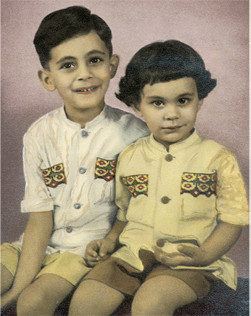
Grandsons Boman (left) and Rohinton Desai
She also joined and became chairman of the Mahila Parishad — a pure Hindu organization where she was the only Parsi until she induced Vera to join the committee in order to help her with official duties in the later years. At the age of 81 she was appointed district commissioner for Girl Guides.
"In my long and otherwise very fulfilling life I have found this event (the death of Phiroz) one of the hardest blows life has dealt me. But I have tried to keep up my courage and accept the will of God…There is only one request I have left to make to my Maker and I have an intuition that He will grant it. I want to die in my own home, on my two feet, not bedridden, not a burden to anyone in my last days. I believe strongly in the power of thought. Many a times I have willed that it be so and it has been so. I believe it will be so on this last occasion too.”
Three days after she had been felicitated on the start of her 100th year, Soonamai passed away. On that day she had received Boman’s letter saying how he was going to celebrate her birthday in Chicago. "Her free spirit literally flew out before dawn on November 25, 1983 just as she had wished — perhaps she even willed it,” records Mukherji. Boman called it "an almighty exit.”
◆ ◆ ◆
From the archive