
In Memoriam
Humble historian
Died: Dr Mani Padmakar Kamerkar, 78, historian, scholar and author who was the vice president of the Asiatic Society of Bombay, on October 11, 2004 in Bombay following cancer of the gastrointestinal tract.
"Soft-spoken, kind-hearted, hardworking and sincere to the core, she will be missed by the members and the staff of the Society... Dr Kamerkar exuded rare charm and all those who came in contact with her remained her friends till the end,” noted the condolence resolution passed by the Asiatic Society where she was vice president since 1993 and had chaired many sub-committees with skill. Describing her as a "versatile person,” the resolution commended her "scholarship, learning, compassion and zeal.” The annual youth seminar that she organized for the Asiatic Society used to be very successful year after year.
A member of the governing body of the K. R. Cama Oriental Institute for 10 years, Kamerkar had "greatly helped in the development of the Institute’s activities and promotion of research work. She was a dynamic personality and we at the Institute will greatly miss her presence,” conveyed the condolence letter from the K. R. Cama Oriental Institute.
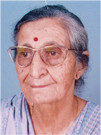
Kamerkar: scholarship and civility
Professor of history at Bombay’s S. N. D. T. Women’s University from 1972-1990 and president/principal of Maniben Nanavati Women’s College for 13 years she is known to have molded many students and guided research students. Referring to her as "an epitome of civility and nobility,” former sheriff of Bombay Mohan Patel added, "Her interest and deep study in whatever she took to hand made her one of the best academicians that I have known. She was totally devoted to learning and sharing of knowledge.”
Former chairperson of the India History and Culture Society, she was also a Fellow of the International Centre for Asian Studies, Hongkong, and of the Institute of Historical Studies, Calcutta. She had spent time at Delhi’s National Council of Historic Research too. Well traveled, Kamerkar had presented papers at different conferences. She was invited as Benedict Distinguished Visiting Professor of Women’s Studies, Carleton College and as Kirk visiting lecturer at Agnes Scott College, Decatur. Author of four books, her last book, co-authored with Soonu Dhunjisha, was From the Iranian Plateau to the Shores of Gujarat — The Story of Parsi Settlements and Absorption in India.
A recognized scholar of modern Indian history, in the last decade the subjects of her research work were Parsi trade unionists; Parsis in maritime trade on the western coast of India from the 17th to the 19th centuries; Indo-Iranian religious fusion — the Magas in civilizational and cultural cooperation; Parsis in Aden; Parsi advent into western India; Parsi women as catalysts of change; Mithuben Petit: Freedom fighter to rural construction worker.
Kamerkar too was active in the freedom struggle. In fact, she and her husband Padmakar Kamerkar, a lawyer by profession, were active in the Quit India movement, according to her son Anant, who gives corporate training in film-making. Daughter Jyoti is married to well known orthopedic surgeon Dr Rajveer Chinoy. Having married outside her religion, she was a supporter of all progressive Parsi movements. She nevertheless was a devout Parsi who continued wearing her sudreh and kusti and would never miss her daily prayers.
On the archeological projects related to the early Parsi settlers in Sanjan and Bahrot, conducted under the auspices of the World Zarathushti Cultural Foundation, she had collaborated with Dr Homi Dhalla. "Ever willing to shoulder responsibility, she was flexible in her approach. We miss her supportive and cooperative attitude,” declared Dhalla who valued her efforts in liaising with the government departments which sanctioned grants.
The third of the four children of Framroze and Najamai Vasunia, Mani’s schooling was partly in Japan and subsequently at St Mary’s School, Poona. After her MA from Elphinstone College she completed her PhD in history from Bombay University. In fact she completed her doctorate in 1976, nearly two and a half decades after doing her postgraduation in history. The same year she earned a United Nations Human Rights Fellowship to study equality between men and women in USA and Canada.
A conscientious citizen, she worked for the handicapped as also the street children through Avehi, an audiovisual resource center disseminating material to schools and adult education centers. She had left her imprint on the Altrusa Club of Mumbai as also the Women Graduates Union, having served as president of both these organizations.
The humble historian is survived by her son Anant, daughter Jyoti Rajveer Chinoy and sister Homai Bilimoria.
WZO founder president
"Bailey had a grand vision of a united and vibrant world-wide Zoroastrian community. He worked hard for Parsi-Irani unity under a common Zoroastrian banner. He was the first Zoroastrian to visit the United Nations Organization in New York and to initiate recognition for our community. Fittingly, he became the founder president of the World Zoroastrian Organisation (WZO).” On the first death anniversary of Behram (Bailey) Rustom Irani (80), former trustee of the Zororastrian Trust Funds of Europe (ZTFE) who died of cancer in London on April 28, 2004, Parsiana culls this tribute from a report which appeared in the ZTFE newsletter (July 2004) and supplements it with a character sketch provided by his daughter Zerbanoo Gifford.
Humor was an Irani trademark: he defused many a tense moment on the managing committee and board of trustees with a timely joke. His humility and commonsense approach also endeared him to his colleagues and whosoever he came into touch with. ZTFE trustee Kersey Jasavala "could scarcely hold back his tears as he recalled Bailey’s enormous contribution to the community during the past five decades,” notes the newsletter reporting on the condolence meeting at Zoroastrian House, London on April 30, 2004.
Gifford, a Liberal Democrat councilor who had the gumption to stand for election to Parliament in the early 1980s, had faced a traumatizing innings at the hustings with threats of kidnapping of her two sons, name calling and vile accusations. She says her telephone line had to be monitored by the police because she had been number four on the hit list of the reactionary British National Party which was outraged that any colored woman can aspire to go to Parliament. Uncertain whether she should give up politics, Gifford had turned for advice to her father who had been one of the founder members of the Social Democratic Party. "No one would think badly of you if you did,” he told her. "But remember you are an ‘Irun junglee’ (a semi derisive, semi affectionate term used by the Parsis of India for their Irani coreligionists). You can’t give in to a bunch of fascists!” With his support she says she hung in to show the British public, "‘We can do it.’ But I couldn’t have done it without him.”
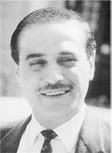
Irani: played the game
One of the most successful Zoroastrian businessmen in the UK in the field of property and hotels, as notes the newsletter, Irani had an uncanny assessment of people who came for rooms at his Heritage and Baron hotels, which he inculcated in his daughter. "It helped me in politics,” she acknowledges the debt. "We were brought up to work. He was keen to give us the best education and not miss any opportunity.” For Zerbanoo that meant the exclusive Roedean Girls’ School. But he came to meet her at school in a broken down car. "He said, ‘I’m educating you and now I’m de-educating you. You get the wrong priorities when you get educated!’ One thing he taught us was to treat everyone the same, whether dustman or king. He never changed his behavior with anyone, never bragged about money or privilege.” Zerbanoo hoots with laughter as she recalls an occasion when a hoity-toity lady asked him why he had opted for the Roedean and her father had nonchalantly cited a casino in the neighborhood as the reason! He used to take part in the fathers vs daughters cricket match at Roedean. Zerbanoo says her old headmistress sent a condolence letter remembering the event.
He was wont to help people quietly. When he died, people spoke of money he had given them. But his most concerted help had been for the people of the Chagos archipelago in the Indian Ocean. They had been uprooted in the late 1960s by the Harold Wilson government, transported and dumped in Mauritius. The British government accepted no responsibility for their property or wellbeing, says Zerbanoo. Irani looked after them in his hotel when they came to fight their case in court where they were represented by Zerbanoo’s husband, solicitor Richard Gifford. The Chagosians, who follow the Roman Catholic church, reciprocated by arranging a private audience for Irani with the Pope, says Zerbanoo.
Born and educated in Poona, Bailey was married to Ketayun (Kitty) Mazda of Calcutta. They migrated to the UK in 1952 when Zerbanoo was two years old. Rustam, Nuswan and Genie were born there. A man who loved beautiful, well-dressed women, Bailey disliked women wearing trousers, says his daughter. Always immaculate himself, he urged her to be well dressed, stand out of the crowd. He enjoyed boxing and swimming, and continued to ski until his 70s. He climbed Ben Nevis, Scotland’s highest mountain, for a special charity party — the oldest man to do so. He was at heart a traveler and would go everywhere by train to see the country first hand, using the old age pensioners’ travel card, and shopped for bargains, even for fruits and vegetables, says Zerbanoo. "He would stay in a single room in the YMCA when he traveled. He could always charm people to get what he wanted. He was never impressed by people throwing money around,” she adds.
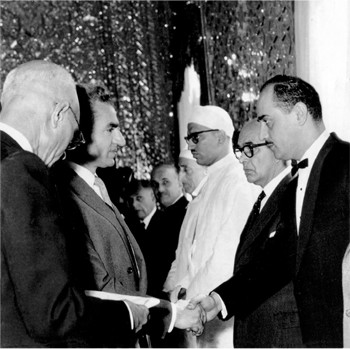
Irani (extreme right) with the Shah of Iran (second from left)
An expert on all aspects of World War II, Zerbanoo tells us that Bailey could have gone on a Mastermind program. "He couldn’t stand fighting and jealousy. He had none of it in his nature. He couldn’t understand small-mindedness.” A staunch believer in the Zoroastrian faith, he prayed morning and night. He was also very orthodox, very concerned about the community dwindling in number. "When I married out, he said Richard would have been perfect if he had been a Zoroastrian. He said we can’t afford to have people marrying out. He mellowed later, realized the need to be flexible, but didn’t change his views.”
When the Giffords’ son Alexander grew up, his parents put him through university at Oxford, but it was grandfather Bailey who paid for years of his training to be an actor and was delighted to see him acting in King Lear, says Zerbanoo. "In his late 70s he was game to go to Hollywood with Alexander,” she laughs.
In agony with cancer he never complained. He refused to go into a private room at the hospital, preferring the public ward because he said he liked to be with people. "What was good enough for others, was good enough for him! When we went to see him at the hospital, he sent us to visit the others who were lonely.” To the last, Irani’s philosophy was, "You play the game, win or lose. People remember you for your behavior, for what you stand for...”
Irani is survived by his wife Ketayun, daughters Zerbanoo Gifford and Genie Stuart Ranchev and sons Rustam and Nuswan.
Arnavaz S. Mama
◆ ◆ ◆
From the archive