
Welfare
A mission to serve
To serve and be ready to accept change form the bedrock of Capt Hormazdiar Desai’s philosophy of life
"I very firmly believe that change is the essence of living. Change is inevitable and we too as a community must change with the times,” says Capt Hormazdiar J. M. Desai.
A 92-year-old epitome of old world civility, chivalry and charm, Desai’s voice is soft, his tone gentle but firm. A brief tenure in the army followed by 37 years in the Indian Administrative Service (IAS) and 34 years thereafter in social and community service, Desai has a rich harvest of experience but does not boast of it. His most recent contribution and ninth book is the History of the Parsis of Navsari which was launched on June 12, 2008 at the Dr Sir J. J. Modi Memorial Hall of the K. R. Cama Oriental Institute (KRCOI).
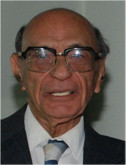
"If I live for four more years, my time as a pensioner will equal my years of government service!” smiles Desai. Even while pursuing his career in government where he rose to be joint secretary and financial advisor to the government of Maharashtra, Desai, a gold medalist in Persian at the bachelor’s and master’s level, had served the Bombay High Court as translator and interpreter. He was still very much in service when he co-founded the National Association for the Blind (NAB) in 1952 with others of like mind and served as its honorary secretary general for 40 long years. "There was good Parsi involvement with the institution in those days,” he notes, especially recalling the service of its "totally blind” founder president Rustom Alpaiwala. A barrister, Alpaiwala was said to be practicing in the Bombay High Court when he "suddenly apologized, saying he couldn’t see.” He never recovered his sight, recalls Desai, adding that he was an "excellent president, very understanding. (On any problem under discussion) he would take my views, give his views, then leave it to me to decide the course of action.”
Desai’s exemplary devotion to the cause of the blind won him a month’s observation tour of parallel institutions in the UK from the British Council and a three-month invitation to tour similar institutions in 14 different states of the US issued by the Federal Department of Health, Labor and Welfare. It also led to other awards: the Takeo Iwahashi Asian Award, honorary life membership of the World Council for the Welfare of the Blind and the World Blind Union, being presented a gold medal in Riyadh in October 1984, the AICB-CBM (All India Conference for the Blind — Christopal Blinden Mission) Centennial Award for pioneering work as a voluntary worker for the blind in India, the B. J. Modi Foundation Award 1991 for leadership as a voluntary worker for the disabled by the National Society for Equal Opportunities for the Handicapped, India. These were crowned by the Padma Shri in the field of social service presented by the President of India on Republic Day 1987.
It was many years earlier that Desai was initiated into blind welfare work. He tells us how his father Jamshedji was the superintendent of the David Sassoon Reformatory at Matunga, training 500 juvenile offenders at a time. After retirement, John Bowman who was chairman of the Victoria Memorial School for the Blind at Tardeo, inducted him there. The commitment was thus imbibed by his son.
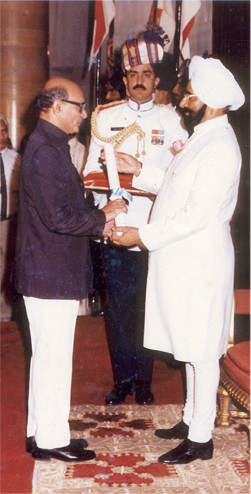
Capt Hormazdiar Desai (top) and (above) with President of India Zail Singh (right)
From 1966 to 1974 when Desai retired from the IAS, he served as a Justice of the Peace (JP). It was in this capacity that Dastur (Dr) Kaikhusroo JamaspAsa, then into his first term as trustee of the KRCOI and as chairman of the Ranji Agiary knew Desai as a fellow trustee there, sought the latter’s help in the endorsement of certain documents in 1974. When a vacancy arose on the board of trustees of the Institute later that year, JamaspAsa recommended Desai and another long innings began that only ended in 1997 when Desai, who was then functioning as joint honorary trustee with Homai Modi, retired. "At 82+ one makes a lot of mistakes. It is better you get out before people ask why he hasn’t cleared out!” he notes matter-of-factly.
When he joined, "there was a very good atmosphere at the trustees’ level though one or two had differences. JamaspAsa pushed me in as a peacemaker!” recalls Desai. "All the trustees were scholars of eminence, also on the governing body,” he notes. Though he is full of praise for Modi’s sense of balance and dynamism and the way she "manages the show,” Desai rues the fact that the level of scholarship in the community is declining. "We don’t have scholars like Rustom Masani who had been an officebearer in various capacities over 55 years. I can’t think of anyone else who has done that!”
Desai’s view of the community in lighter vein is that no two Parsis agree and the third one agrees to disagree with both. More seriously he notes that this scenario means that the trustees of the Punchayet and other trusts have a very difficult task to perform. He believes that Minoo Shroff, chairman of the Bombay Parsi Punchayet, has done a marvelous job of man management in his own mild way. "He emphasizes only people’s good points, ignoring their weak points and thereby maintains harmony. The Parsi community should be very grateful to him for the way he handles problems. He is truly an ambassador of peace.”
Appreciating that change is ubiquitous in human affairs, Desai says it is no use being orthodox. A case in point is the community’s pet topic — Doongerwadi. "It worked well as long as vultures were there. Now that vultures are not there, there is no point in sticking to the disposal of the dead as per existing norms,” says Desai, adding, "I honestly believe — and many Parsis may disagree with me — that it would be advisable on the long term to have a bungli with a crematorium for those who prefer that system.”
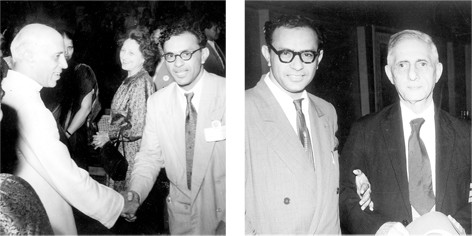
Left: A youthful Desai greeting Prime Minister Jawaharlal Nehru and (right) with Rustom Alpaiwala
Though Desai is not in favor of intermarriage, he does not believe in ostracizing intermarried couples. As for accepting those who voluntarily choose to join the faith, Desai notes that "the ancient Iranian and Indian cultures have contributed most to the culture and civilization of the world…The simple philosophy of Zarathushtra — good thoughts, good words, good deeds — is today universally approved. Those who may not be born Zoroastrian but by their beliefs and at heart are firm believers in Zarathushtra’s philosophy, (practice the faith).”
He mainly attributes the population decline in India to "youngsters migrating, falling prey to the lure of foreign lands, settling there because of better income and lifestyle.” For the declining level of tolerance in the community he holds the bulk of Parsi males responsible and feels that community leadership needs to be strengthened. "There are several potential leaders, but the orthodox camp would not let them develop,” he states, emphasizing the need to build up a cadre of leaders good at man management.
Referring to his book on Navsari based on the writings and observations of his paternal uncle Sorabji Mancherji Desai, especially the Tawarikh-e-Navsari, the nephew tells us that his kaka was the head clerk in the collector’s office in the town. "All collectors depended on him for information… Sayaji Rao Gaekwad would first alight at his house when visiting Navsari. He had a huge library and a collection of old coins which had been framed. His home was a gathering place for high ranking government officials and intellectuals of all communities.”
Desai does not have a very rosy view of the community over the next quarter century: "Parsis have set the trend in all professions. They have been leaders in all faculties. But now we are not likely to have Parsis of that caliber to spearhead and lead the rest of the country. For several decades the best doctors, lawyers, administrators were Parsis.” He considers the late A. D. Gorwalla as the ablest of the administrators he had worked with. He recalls their first meeting in a train coupe while he was still in the army. "Later, when he was finance secretary and I was in the finance department but very junior, he remembered our brief meeting on the train, picked me up from the finance department and put me as permit officer in the civil supplies department.”
The affection for Navsari notwithstanding, Desai had been born in Kirkee, the cantonment town near Poona where his mother was staying with her father’s brother. The second of Jamshedji and Dinbai (née Merchant)’s seven children, Desai smilingly describes himself as "a boy in a hurry.” Married to Perin (née Bulsara) they have two children, son Jamshed and daughter Dinci, named after her grandmother as the latter had been known in school, and two grandsons — Dinci and Nadir Karanjia’s boys, Kiyanush and Dariyush. Hormazdiar speaks of his late elder brother who was very good in maths and had worked out a system for crosswords and football pools, winning Rs 24,000 for a crossword on one occasion. Desai himself preferred Persian literature and had been an honorary fellow of the Ismail Yusuf College in Jogeshwari. "Persian poetry is the best poetry in the world. Even today I can recite many verses in Persian.” We ask for his opinion on the Rubaiyyat of Omar Khayyam: how does the original compare with Edward Fitzgerald’s scintillating translation? "If you’ve never read Persian, Fitzgerald is good,” he notes diplomatically.
◆ ◆ ◆
From the archive