
10WZC
Stories from the Shahnameh
Sponsored by Union Press, Cafe Universal, the World Zoroastrian Organisation Trust, Peekay Wines and Curiosity Furniture
THE KAYANIAN DYNASTY
More than half of the Shahnameh deals with the Kayanian dynasty, and so it is natural that Firdausi considered it the most important of all the Iranian dynasties.
The word Kayanian means ‘royal.’ All the kings of the Kayanian dynasty, who ruled before the advent of Prophet Zarathushtra, were temporal as well as spiritual heads of their country and hence their names were prefixed by the title ‘Kae’ before their names. This title indicated royalty coupled with spirituality. In the Avesta they are called paoiryo-tkaesha, that is, forerunners of Prophet Zarathushtra.
The Kayanian dynasty is well known for its spiritual royal personages like Kae Lohrasp, Kae Gushtasp, Kae Khushroo and above all Prophet Spitama Zarathushtra. It is also known for the escapades of the hero Rustam whose career spanned the reigns of most of its kings.
The last four rulers of the Kayanian dynasty in the Shahnameh seem to have been confused with those of the Achaemenian dynasty, whose downfall was brought about by Alexander the Macedonian, who is referred to as Eskandar the Roman over here.
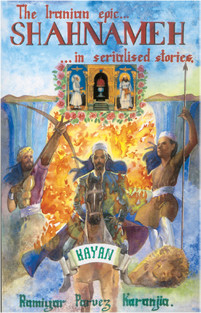
KING KAE KOBAD
The search for a new king:
After the death of King Kersasp, the last king of the Peshdadian dynasty, there was no heir to the throne of Iran. Zal and Rustam took it upon themselves to find a suitable royal monarch for Iran. Zal came to know, through King Zav, that a des-cendant of King Faridun was living somewhere in the Alburz mountain in the care of holy men. Rustam himself went there to look for that descendant, who by now may have become a grown-up man.
The child, who had grown up to be a responsible man, had realized his mission in life after having dreamt about his symbolically being chosen as the king. In the dream, he saw two eagles, indicating divinity, coming to him and placing a crown on his head. Hence it came as no surprise to him when Rustam came looking for him. Rustam was surprised at the readiness and confidence shown by Kobad to come to Iran, and when Kobad related the dream to him, he was assured that this man was the next divinely ordained king of Iran.
With Kobad, Rustam set off for Iran. On the way he met the Turanian spy Kalun who was on his way to Iran to gather secret military information. Rustam challenged Kalun to a duel in which the latter was killed. Rustam triumphantly marched off to Iran with Kobad where Zal received him. All priests, wise men and warriors of Iran unanimously accepted Kobad as their king.
Kobad is coronated
Kobad was coronated as the first King of the Kayanian dynasty in the presence of great Iranian warriors like Karan, Keshvad, Kharrad and Barzin. The name of the king was prefixed by the title ‘Kae’, and henceforth he came to be known as Kae Kobad. There was feasting for seven days. King Kae Kobad had his treasury situated in Pars and made Istakhra his capital.
War with Afrasiyab
As soon as the feasting was over, King Kae Kobad prepared for war on a gigantic scale against the Turks (Turanians) led by Afrasiyab. The Iranian side had eminent warriors like Rustam, Zal, Mehrab, Gastaham, Karan, Keshvad and Barzin. The Turanian side had Shamasas, Karsivaz and Viseh.
The Iranians went into the war with the Kavyani flag by their side. In the course of the war the Turanian warrior Shamasas was slain by Karan. Inspired by this, Rustam promised his father Zal that he would defeat Afrasiyab and drag him by his waistband to the king. He challenged Afrasiyab in the battlefield and the two fought for some time. He seized an opportunity and valiantly lifted up Afrasiyab from his waistband and was about to take him prisoner when luckily the waistband snapped and he fell to the ground.
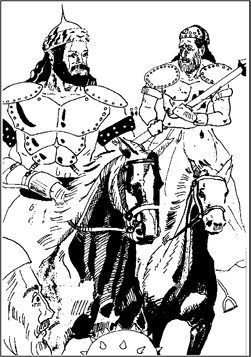
The great Rustam valiantly lifting Turanian King Afrasiyab from his waistband
Illustration: Gulshan Paghdiwala (née Dalal)
Rustam tried to grab him with the other hand but all he could get in his hand was Afrasiyab’s crown. The other Turanian soldiers watching the spectacle rushed to the rescue of their king. Afrasiyab escaped by the skin of his teeth and Rustam greatly regretted missing this unique opportunity. Later Rustam sent the crown of Afrasiyab as a trophy to King Kae Kobad.
Terrified by this incident, Afrasiyab left the war and fled into a forest. The Turanian army could no longer take the onslaught led by King Kae Kobad under the powerful trio of Rustam, Zal and Mehrab. Soon thereafter, the Turanian army was routed back from Moghan and they retreated towards river Jaihun.
King Kae Kobad celebrated this success by liberally giving gifts to his soldiers and warriors. He honored Rustam and Zal by seating them on either side of his throne.
Afrasiyab fled from the scene of the war and spent seven days in the wilderness near the banks of river Jaihun. On the eighth day he went to his father Pashang and requested him to sign a peace treaty with King Kae Kobad as there was no way he could face or fight Rustam. Afrasiyab had broken the treaty he had signed with Peshdadian King Zav, and was now paying the price for it as he had lost many of his brave warriors like Gulbad, Barman, Kharjavan, Shamasas and Kalun. He repented before his father for his callous attitude and the thoughtless killing of his brother Agreras, and requested him to write to King Kae Kobad.
Pashang requests for peace
Seeing his son feeling sorry, Pashang was happy that wisdom had at last dawned on his son. He made his scribe write a letter to Iran in which he desired to revert back to the division of the two countries as done by their ancestor King Faridun, with river Jaihun as the dividing line. He requested an end to the war and sent his trusted warrior Viseh with the beautifully written illustrated letter along with several gifts to King Kae Kobad.
In his reply King Kae Kobad stated that the Turanians had always begun the war. He emphasized that though he was well equipped to lend a crushing blow to them, he would let the war end for the sake of peace and welfare of the people of both countries.
Rustam averse to the treaty
Rustam, however, did not approve of this treaty because he realized that it was nothing but ruse to escape defeat, as the Turanian army was on a brink of defeat. He told his king that the Turanians would break the treaty and attack once again, as they had done several times in the past. However King Kae Kobad explained to Rustam that he desired peace and was against warfare, and hence he had accepted the offer of a treaty.
King Kae Kobad gifted land from Zabulistan to the river Sind to Rustam, and Kabul to Mehrab for their services during the war. He also bestowed rich gifts on Zal, Karan, Keshvad, Barzin, Pulad and other warriors.
King Kae Kobad abdicated his throne in favor of his son Kae Kaus, traveled around the world for about 10 years and thereafter passed away peacefully.
Reprinted from the book Serialized Stories from the Iranian Epic Shahnameh.
◆ ◆ ◆
From the archive