
Tradition
Painting with a needle
UNESCO-Parzor organized a symposium and its third workshop to sensitize the community to the beauty of its textile heritage
"Everything must start with a dream. Our dream is the revival of the art of Parsi embroidery for contemporary usage.”
Member of the National Commission for Minorities and chairman of the UNESCO-Parzor committee for the documentation and revival of the community’s cultural heritage Lt Gen Adi Sethna (retd) pitched for the support of the people of Bombay for the project the way public support had helped the revival of the famed chikan work of Lucknow.
Sethna’s welcome address at the Experimental Theatre of Bombay’s National Centre for the Performing Arts on April 25, 2006 marked the start of a symposium and exhibition on Parsi embroidery, "Painting with a Needle,” followed by a five-day (April 26-30) workshop at the Muncherji Khareghat Hall. Sponsored by the Government of India (GOI) Development Commissioner, Handicrafts, this was the third workshop organized by Parzor, the two earlier ones having been held at Ahmedabad and Navsari where women from 17 to 82 years of age demonstrated an enthusiastic response, as noted sociologist and textile consultant Ava Khullar. Parzor director Dr Shernaz Cama, who chaired the day’s proceedings, recalled with pride that 15,000 people from 160 countries had visited their stall — set up at the India pavilion of the International Industrial Technology Exhibition at the invitation of the GOI — and shared the Parzor hope to hold a nine-month workshop in Navsari if funds are forthcoming. She also sought inputs from the audience, notably, curved needles which so far they had been unable to find.
Against a backdrop of beautiful garas and jablas, each an heirloom item lovingly displayed with captions denoting the type of textile base as well as the meanings of the embroidered motifs, speakers recounted the history of hand-woven Indian textiles, the evolution of Parsi embroidery and efforts to revive the dying crafts.
Putting the event in historical perspective Sethna suggested that while the 19th and 20th centuries were epitomized by the advent of steel and information technology respectively, the 21st century could be marked by the reflowering of arts and crafts. "Think of entrepreneurship,” he nudged the assembled audience. "We Parsis could hope to be catalysts for the community and the country,” he noted, acknowledging the support of the GOI, the Wadia Group who provided subsidized air transport, the Travel Corporation of India — "(the late) Adi Katgara had supported us ever since we started,” the Paramparik Karigars’ leader Kekoo Gandhy of Gallery Chemould, Sir Ratan Tata Industrial Institute which provided free hostel facilities for the ladies from SEWA (Self Employed Women’s Association) and Muslim karigars (artisans) who came to train interested individuals in the art of embroidery. While the seminar attendance was by invitation, there was no bar on who could avail of the instruction during the workshop.
In an address titled "Reviving a past: Back to the future?” textile researcher Rahul Jain, who has been credited with placing the khadi fabric on national and international fashion consciousness, noted, "Revivalism is not a modern phenomenon.” He recalled that Duarte Barbosa, a Portuguese agent in the 16th century, had documented trade names and described Indian textiles with which we are still familiar: the complicated weaving techniques of court silks; the metallic brocades dominated by floral motifs used for pyjamas, sashes and furnishings in Aurangzeb’s time; the Kashmiri shawl, a woven textile initially, an embroidered one later; the Bengal muslin, so fine "it could only be compared to air or water.” But everything needed to be reoriented, re-engineered because traditions had died out. Behind the sophisticated weaving techniques of Banaras, Gujarat and Bengal lay the meticulous spinning of the yarn. It is "so excruciatingly important for the quality of the textile, it took us five years to produce fabric comparable to past examples,” noted Jain, an alumnus of the Philadelphia College of Textiles and consultant officer to the World Bank. But it cannot be blind reproduction, he maintained. For the revival to be successful, the craft must address the needs of contemporary sensitivity, provide motifs from modern usage, he noted.
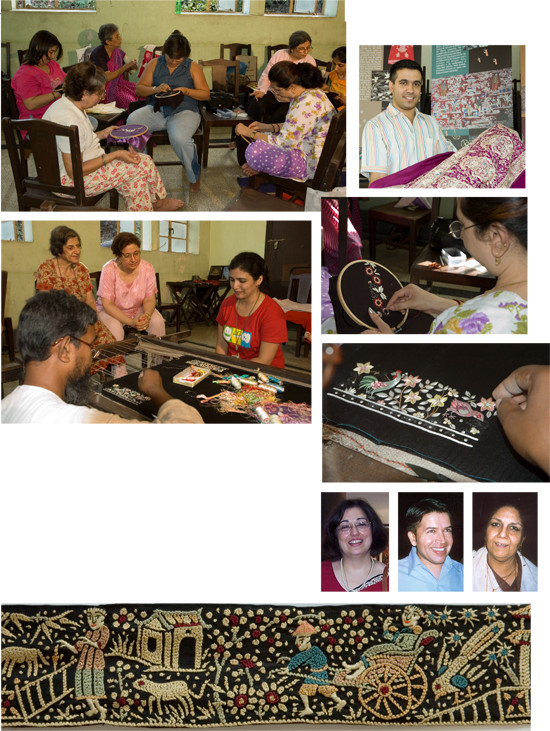
Clockwise from above: Asifbhai and onlookers (Extreme left: Ava Khullar) Novices under instruction; Ashdeen Lilaowala; creating motifs. Alongside L to R: Shernaz Cama, Rahul Jain and Rita Chisti. Below: A khakha border
How does one train and equip such craftspeople? According to Jain they "need high security and self-worth, wages two to three times those in industry.” While he was working on the revival of textiles at the national level Jain says he found patrons to create a private trust to provide a captive source of funds. They rebuilt homes, bought agricultural land, established workshops but the result was "extreme dependency on me and the trust.” Moreover, what they produced was not a contemporary repertoire, he noted and asked, "Is revivalism a private compulsion? Are we seeking the comfort of nostalgia? Who decides the needs of craftspersons?” According to him one can only "sharpen the skills and perceptions of craftspeople, may be some day to take the craft into the future.” Till then it remains a private obsession.
"The world’s multicultural history lies in the cupboards and trunks of Parsis. Parsi embroidery is an amalgam of Iranian, Chinese, Indian and European traditions,” noted Ashdeen Lilaowala whose association with Parzor began as researcher on the kusti module while he was studying at Ahmedabad’s National Institute of Design. He addressed the gathering as director of the embroidery workshop.
"Place and relevance of textiles in the world of globalization” was the theme addressed by textile researcher Rita Kapur Chisti who said she had been learning the arts from weavers and printers for the past 20 years, in the context of something fast disappearing. A self-professed Gandhian, Chisti noted, "We may be the only people in the world to still have hand-spun textiles. In 2006 there is no other place (for the artisan) to run away to!”
Chisti, who in the 1980s had spent a lot of time with the late Bombay based Parsi designer and embroiderer Piroja Narielwala, said she had gone to Persia to research the subject and see if she could unearth dormant skills and traditions. But she says she was told, "‘Whatever is lost in the world may be found in India!’ That is because we allow the culture of self-worth to exist,” she rationalized. "A large base is required to get skilled artisans. Sustain it on usability... Every great achievement has a humble origin. That humble origin has to be fed first.”
Describing the sari as an "intermittent phenomenon,” Chisti noted that the contemporary wearing style of the sari in Indian cities evolved from contact between a Bengali lady and the Parsis and began with a sari-wearing school in Calcutta. "In 1982 we thought that the sari was here for a 100 years to come. Now it’s (not so popular)! But in Assam the tradition of weaving your own garment for your wedding is intact,” Chisti traced the evolution of tradition, fashion and social need.
Documenting texture, color, design of Parsi embroidery with the wholehearted cooperation of Parsi ladies has been a rich hunting ground for non-Parsi researchers, said Khullar. Hitherto there had been no serious effort to understand the message and significance of design motifs. The first effort to record and revive this unique art form before it was lost forever had been undertaken by Parzor researcher Priya Mani. "As the research progressed, the connections between Iran, India, China and Europe became evident,” noted Khullar, acknowledging the government grants for workshops to train karigars, help them become economically independent and raise the level of Parsi sensitivity.
Detailing the difficult and time-consuming khakho stitch, the four variants of the satin stitch, some with cotton padding under the silk embroidery, which were the staples of traditional Parsi embroidery, Khullar noted sadly, "The complexity and beauty of the work has not been soaked in by the community.” Referring to a happier past Khullar said, "I still remember Parsis looking down on gold jewellery. The garas were custom made to go with the pearl and diamond jewellery that Parsis wore.” Noting that the ‘sali gaaj’ was the textile which could take the weight of gara embroidery — an estimated five kg — Khullar noted that the fabric was definitely a product of Surat: "The Parsis were acknowledged as accomplished weavers prior to the arrival of the British.”
With a dream to set up a school to make Parsi embroidery a force to reckon with, Parzor is struggling with problems en route: the need to sustain the training process between workshops, the need for strong sustaining institutional and long-term financial backing. With an invitation from the UN to set up an exhibition of Parsi textiles and embroidery, Shernaz Cama says, "The whole aim is to tell the world, ‘We created this; this is ours.’ Art and craft is in our blood. We need to get back to it to sustain it. People come and say ‘Give us this, we’ll pay anything.’ We have to create awareness that it’s a unique craft, it shows great love of life.” In the meanwhile, Roshan Cama of Baroda, who is known to have preserved her heirlooms in mint condition, advised the gathering on how to maintain their garas. The gara, she said, must never be hung but folded lengthwise with an interleaving of mulmul in every fold. Then there will be no need to iron it.
The workshop
At the Khareghat Hall the following day Shernaz Cama traced the similarities between Parsi embroidery and feng shui in a chat with Parsiana. The divine fungus and Srosh motifs on children’s jablas protected them until the investiture of the kusti. Similar signs were painted, woven around the house for its protection. "Weaving and embroidery were part of a sacred tradition. You always started the craft with a prayer like you started the weaving of the kusti, with a nirang,” she noted.
"It is a false impression that all gara embroidery was imported from China. The style and color of Chinese work differs from that of the Parsis. Parsi embroidery is not imported. It is a hybrid of many traditions. We have become a forgotten strand in the mosaic of Indian arts and crafts,” says Cama.
When the first workshop was held in Ahmedabad, Cama admitted, "We didn’t know how to hold a needle!” Beginning the training of Hindu tribal women and Parsis by Muslim artisans, Cama felt the program was a part of the cultural continuity, a giving back to India in a small way.
Shoes were always removed at the entrance of craft workshops where karigars and students sat around in groups on daris, using pure silk material provided by the government, using pure silk floss, twisted and untwisted. The troupe included Asifbhai, a Muslim master craftsman and Dolly Bhesania who has been teaching embroidery in Ahmedabad for 25 years but says no Parsis come to her classes because Parsi women are not interested in becoming seamstresses. Bhesania works for the Zoroastrian Ladies Industrial Cooperative Society which offers technical courses in cutting, embroidery, leatherwork and culinary preparations. Kahmira Palia of Surat was also present to share her skill and knowledge. She spoke of the Alpaiwala Classes in embroidery and cooking which were once a prominent institution in Surat. Leading the SEWA ladies was Kantaben who has been embroidering since the past 15 years in association with SEWA, the institution founded by social worker Ela Bhatt. Specializing in ‘aari’ work which is a form of embroidery using a cobbler’s needle, Kantaben recalled that the response to the workshop had been maximum in Navsari.
Patterns with punctured holes were transmitted on cloth by an application of zinc oxide powder mixed with kerosene. The onlookers were demonstrated how a fabric is mounted on the embroidery frame, emphasizing that it must be done lengthwise because a widthwise mount would lead to puckering of the fabric. They were also instructed in how to maintain a steady tension.
Parzor is required to give a report of the workshop it orchestrates to the Development Commissioner (Handicrafts) as the GOI provides approximately Rs 1.45 lakh towards the cost of each workshop which ranges in toto between two and two-and-a-half lakhs. The cost includes the silk cloth as well as the yarn, needles, wages of the master craftsman as well as the SEWA workers comprising approximately 30 women who are recompensed in tune with their normal earnings with an envelope gift at the end of the event. Also included is the cost of their stay and travel as well as that of the research consultants. And Cama is not counting the personal effort before, during and after the event that she and her volunteers donate with cheerful optimism. Says she happily, "Everybody sitting on the floor – Hindu, Muslim, Parsi, Sikh – that’s the Parzor contribution. It makes me very proud.”
◆ ◆ ◆
From the archive