
History
"Neighbor's envy, owner's pride"
A PARZOR project to document and revive traditional textiles interests Rohini Sakhalkar
Some are born Parsis, others acquire Parsipanu through spouse or social friends and still others have Parsidom thrust upon them.
Rohini Sakhalkar belongs to this last category.
"Till two years ago, I had scant knowledge of Parsis and next to no knowledge of a garo. At best I could link the word to the Garo and Lushai hills of North East India,” laughed the schoolgirl-like Sakhalkar, who looks even younger than her 24 years.
Today, her work revolves around Parsis and their unique textiles.
A postgraduate in clothing and textiles from Punjab University, Sakhalkar is a research associate with PARZOR, the UNESCO funded project whose aim is to document the rich heritage of Parsis, including its art, before it is lost to the world forever.
As garas and Parsi borders are becoming known and coveted outside the Zoroastrian circle, their value in terms of money and as a heritage possession is going up. There is a real danger of these priceless possessions leaving the carved cupboards of the Parsi community and the country.
Sakhalkar’s brief is to identify rare garments and to document in minute detail the history, technique, stitches, motifs and fabrics used, along with supporting sketches and photographs. While Parsi garas and kors form the major part of this research, sudrehs, ejars, jhablas, jackets and topis are not forgotten.
Pure chance led to Sakhalkar’s involvement with the Parsi community and its famed garas. After graduation she did a diploma in fashion designing. For a seminar at the end of the course each student was given a region or ethnic group to research. She got "Parsi Garas”— a topic she had only vaguely heard of. Not deterred by her lack of knowledge of the subject, Sakhalkar took her plunge into Parsidom. So interested and involved did she become in her topic that by the time she decided to do her Masters in clothing and textiles, the obvious choice for her thesis was "Parsi Garas — Revival Of A Legacy.”
In the course of researching her thesis, Sakhalkar came upon PARZOR and its efforts to document Parsi garments. On completing her postgraduation, she e-mailed Dr Shernaz Cama, offering her services to the UNESCO funded foundation and was immediately signed up.
Thus started her journey into Parsi baugs and bungalows. While Bombay is the hub and the heart of the Parsi community, Sakhalkar’s work has taken her to New Delhi, Navsari and Nagpur. Letters or phone calls of introduction and her own credentials gave her easy access to the treasure trove of saris, borders, jhablas and other antique textiles owned by Parsi families.
Ask Sakhalkar for her impressions, both positive and negative, of the community and she responds, "The generosity and hospitality of Parsis across all strata of society leaves me amazed. Once they take you into their homes, they also take you into their hearts.”
"Their civic consciousness is another admirable trait I notice among Parsis,” she continued. "If things are not working, it moves them to do something about it. Just a few days ago, I was waiting in the queue to buy my train ticket to Nagpur. It was a long queue with only one window servicing it. People were getting restless and angry. A Parsi lady ahead of me in line, instead of merely venting her grievances, went and found the supervisor and requested that another window be opened. This was soon done and everyone was happier for her initiative,” said Sakhalkar. "I have repeatedly noticed this proactive attitude.”
On the negative side Sakhalkar finds that by and large it is a very closed, inward-looking community. That is not unusual in minority cultures, she opines, where there is a fierce desire to protect and preserve one’s identity.
"Initially ladies would be hesitant to show me their collection. It would take a lot of persuasion from me to convince them why I wanted to see and photograph their treasures. But that is understandable since these textiles are expensive family heirlooms and no one wants them copied. But now, having interacted with so many Parsi families, I have come to understand them and have become increasingly appreciative of their culture and their religion.”
Sakhalkar hopes that as more and more Parsi women become aware of the work being undertaken for the documentation and revival of their traditional textiles by Parzor, they would preserve their garas with care and wear them with great pride. ‘Neighbor’s envy, owner’s pride,’ should be their slogan!
The prized garas
The original garas, dating back to the late 1880s were made in China. The history of the garas is linked at its earliest to the overland silk route that stretched from Yazd and Kerman in Iran, through Central Asia to Hongkong, Shanghai and Canton in China. Later, intrepid Parsi traders opened the sea route between India and China, trading in cotton, opium and spices. The finely embroidered Chinese silk lengths caught their eye and were bought as gifts for wives and daughters.
The oldest preserved garas are between 120 to 130 years old. The pattern on these is distinctly Chinese and the embroidery so fine, it is hard to tell the right side from the wrong side.
An interesting and possibly little known fact is that most of the silk material used for embroidering garas and ejars was made in Surat and then sent to China for embroidery. Finely worked ejar pieces can be found with ‘Cheen ni banavat’ stamped on them in Gujarati.
Still later, Chinese traders themselves came to India. With their wares on their back, these pherias (hawkers) trudged from Parsi moholla (locality) to moholla, selling their embroidered materials. Parsi connoisseurs were already familiar with their work and needed little persuasion to buy the embroidered garas. At this time Parsi women, specially the more industrious and less affluent, began to learn the art of embroidering garas from the Chinese pherias and soon became adept at it.
Stitches and motifs on garas, saw some changes. The dragons and snakes, popular on the original Chinese garas, gave way to birds of paradise and the rooster motif that represented Srosh.
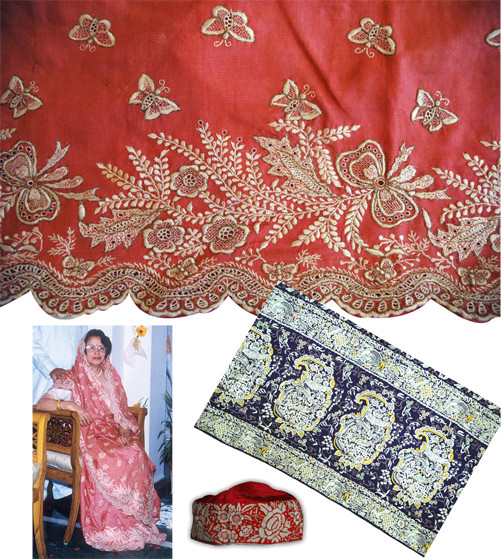
The author in her prized gara; popular gara motifs
The European and more particularly the British influence on gara designs was the natural outcome of the British occupation of India. Scalloped edges, English flowers, bows and butterflies became fashionable motifs on garas and borders.
Asked about the most outstanding and priceless garas she has seen, Sakhalkar described two without hesitation.
"The first,” she says "is a beautiful black gara. It has a wide border and 267 motifs — no two of them alike — embroidered in multicolors. The border repeats the eight precious Tao symbols. The 267 motifs scattered across the sari are finely embroidered figures of Chinese men, women and children, engaged in different activities. Very unique!”
The other unusual and interesting gara shows "fish and sea-life, worked in white on a purple background. It has a border and is embroidered with eel, shrimp, crab, lobster, sea-horses and an endless variety of fish,” sighs Sakhalkar, as she recalls this rarity.
The value of a gara is determined by its age, originality of design and the condition in which it is maintained. Sakhalkar gives readers some dos and don’ts on the preservation of garas:

Rohini Sakhalkar: reviving a legacy
Do not keep garas on hangers, as this will stretch and weaken the fabric. Make a long fold of the gara and lay it wrapped in muslin.
Do not use naphthalene balls to keep away moths and other insects. Instead keep dried neem leaves or peppercorns, in muslin bags, in the folds of the sari.
Do not spray with perfume to remove musty smell. Instead keep a few sandalwood sticks in the folds of the gara for a sweet fragrance.
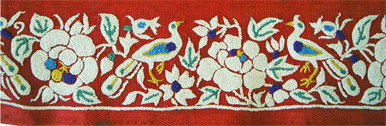
Do not wash or even dry clean old garas. Value them and be careful when wearing them.
Attach a good quality fall of the exact color of the gara, in such a way that the fall extends a centimeter below the border of the gara. This will prevent the (usually white) embroidery on the border from staining. It will also protect the fabric from wear and tear in case you step on it with your high heels.
Zari borders or garas edged with zari must not be exposed to the air while in storage. They must be well wrapped in muslin.
◆ ◆ ◆
From the archive