
Cover Story
Adult franchise at last?
The Bombay Parsi Punchayet trustees intent to move the Bombay High Court with a proposal for direct voting of trustees
After almost 350 years the trustees of the Bombay Parsi Punchayet (BPP) are to move a petition in the Bombay High Court to introduce universal adult franchise for the election of trustees.
The new scheme could become a reality in a year or a year-and-a-half, says noted lawyer and The Bombay Samachar columnist Berjis Desai who initiated the move.
Terming the proposal "a move in the right direction,” BPP chairman Minoo Shroff in an interview on September 20 in his Dadabhai Naoroji Road office said "the community does not need a guided democracy (a term popularized by the late Pakistani dictator Gen Ayub Khan).” The Parsis have "become alert enough to exercise their franchise,” Shroff added.
The scheme as envisaged by the six trustees gives direct voting rights to Parsi Zoroastrians over the age of 21 (18 may also be considered as this is the voting age in most other anjumans). Seniority will determine who becomes chairperson with a provision that if six of the seven trustees unanimously disapprove of the senior most trustee occupying the chair, the trustees can elect a chairperson.
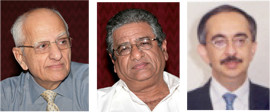
(From left) Minoo Shroff, Dinshaw Mehta and Berjis Desai: a move in the right direction
BPP trustee Dinshaw Mehta believes the petition could be moved early October 2006. But he envisions the election for the vacancy caused by the death of trustee Silloo Kavarana being carried out under the recent scheme sanctioned by Justice R. S. Mohite of the Bombay High Court on August 21, 2006. Noting that the present scheme took almost five years to be heard and with the High Court directing the Anjuman Committee (AC) elections be held by May 20, 2007 and Kavarana’s seat within three months thereafter, the BPP had no choice but to go ahead under the current sanctioned scheme. Shroff had also indicated the proposal for adult franchise would take time.
Desai on the other hand is confident that a stay can be granted on the amended scheme and elections for the vacant seat be contested by adult franchise. Desai intends to get leading lawyers like Tehmtan Andhyarujina to present the proposal.
Donors would be able to vote on the strength of their donor registration and if they also enroll on the general register, they would have a second vote, says Desai. Thus the donors would get more weightage, notes Mehta. A proposal to raise the donor amount to rupees one lakh was turned down, said Mehta. Till September 30, 2006 the donor amount required to register as a voter was Rs 15,000. From October 1st, 2006 the sum was raised to Rs 25,000. The trusteeship term will continue to be limited to three terms of seven years each, says Desai.
The present election scheme recently sanctioned by the Court would have required the community to elect around 3,000 representatives to the AC who along with around 1,500 donor voters would elect the trustees.
With around 10 constituencies earmarked, each general register voter would have to elect around 300 people to the AC from his or her constituency, most of whom they would not even know. If by mistake a voter voted for 301 instead of 300 representatives, the ballot would be invalid.
Shroff said they examined the possibility of using electronic voting machines but were told it was impractical with such a large number of candidates. Mehta estimates the counting of the votes for the AC under the present system would take four to six weeks.
It was the utter absurdity of the election scheme that veered the trustees around to finally accepting adult franchise. Once the adult franchise scheme is implemented, the present six trustees are to resign, said Desai. But they may stand again for election if they so choose.
The Alert Zoroastrians’ Association (AZA) had been lobbying against any of the present trustees seeking a new term of office. Four of the trustees, Shroff, Dinshaw Tamboly, Maneck Engineer and Burjor Antia have indicated they do not intend to stand for reelection as they find all their energies are diverted to tackling crisis rather than to social welfare. But Mehta sees no reason why he should be barred from standing again should he feel the urge to do so. Dadi Engineer may also seek reelection.
Mehta is anathema to the AZA and he in turn sees no reason to give in. Already Mehta has conceded his right to assume the chairmanship of the BPP being the senior-most trustee after the present chairman. Shroff was to step down from office in August 2007 as per the existing scheme without filling out his original 10-year term. Now the trustees will ask the court’s sanction for Shroff to continue till August 2010. Dadi Engineer would be vice chairman, presiding in Shroff’s absence.
Mehta sacrificed the chair because his ascendancy to the post was "the major hurdle” to bringing the warring factions "together after the resignation fiasco,” he states. And as Shroff notes the chairman’s job is an "arduous and painful” one. Still it is a prized plum.
Was Mehta upset at being bypassed? "Na na jarak bhi nahi… aapé tau bi nahi joiyé (No no not at all. Even if they offer it I don’t want it)…I’m not bothered. I’ve no hankering for office. I just want to do the work,” he notes adding that with his late father being a corporator in the Bombay Municipal Corporation he could have sought election to the Maharashtra Legislative Assembly if he wanted but chose not to.
Mehta sees himself as the "biggest thorn in the way of the reformist camp.” He still adamantly opposes the formation of a world body unless it comprises only Parsi Zoroastrians: "I want Parsis to come together, not Tajiks and non-Parsi Zoroastrians.”
Mehta is opposed to any changes in the constitution of the Federation of Parsi Zoroastrian Anjumans of India (FPZAI) which would give more weightage to the BPP and modify the present system of appointing any nominee representatives to the Federation meeting. "The system has functioned well. It should be allowed to continue,” Mehta avers. He says the "BPP has no view” on the proposed amendments. He notes the issue has "first to be discussed in our boardroom. The subject has not been taken at any single meeting of the BPP trustees.” When asked about the infighting at the Federation meetings Mehta says, "It’s not really mara mari!”
With Mehta deeply ensconced in the orthodox camp how was it his closest friend was Desai, one of the leaders of the liberal section? "We’ve been together from 1980 [when the Committee for Electoral Rights (CER) was contesting the AC election against the orthodox Committee of United Zoroastrians combine]. Since then we’ve been good friends.”
Do these radically differing views come in the way of their friendship? "Jarak bhi nahi (not at all),” responds Mehta. Says Desai: "On a personal level we follow Voltaire’s diktat: we agree to disagree. In the past not a day has passed when we have not violently disagreed on most issues… (this indicates) the strength of the friendship.”
The issue of the disposal of the dead is a major point of divergence. Desai believes a prayer hall at Doongerwadi for those opting for alternative methods of disposal "could diffuse… the present controversy.” Subsequently other developments such as burial or a crematorium at doongerwadi could be considered.
Mehta says this is the fear of the orthodox: that the prayer hall is "the thin end of the wedge.” But Desai countered, "We’re not saying dakhmenashini should be scrapped. The system should be strengthened using technology.” Desai is convinced "an overwhelming majority of the community favors cremation,” an opinion Mehta disputes.
Desai says he has good relations with all the six trustees and aside from needling Shroff in his Parsi Tari Aarsi column on past occasions, is on friendly terms with the chairman.
So why did Desai depart from writing on issues to personally becoming involved in them? (Desai initiated the dialogue to resolve the imbroglio following the ill-advised resignation of the four BPP trustees.) "I didn’t want to be just an armchair critic… being a lawyer I wanted to use my knowledge to see if a solution could be found.”
But why now and not earlier?
"Did I do it to rescue Dinshaw?” Desai asks sensing the drift of the question, "No. Dinshaw needs no rescuing.”
Testing times
BPP chairman emeritus Jamshed N. Guzder stated that adult franchise was "a good idea” when asked his opinion during a break in the FPZAI meeting on September 23 and 24.
Bombay University professor of political science Dr Nawaz Mody who had earlier announced her candidature for trusteeship of the BPP for Kavarana’s seat feels that adult franchise "is not such a great idea” for a trust. She is "lukewarm” to the concept. It reduces the outcome to "just numbers.”
She felt that if there was a low turnout then those candidates with dedicated cadres had a better chance of winning. "The more committed a person is the more likely they are to vote.” She notes adult franchise had favorable and unfavorable aspects. Until it is tried in the community "we can’t test it.”
Will she stand for election if adult franchise is adopted? "I have to consider many other factors” before deciding, she responded. People view her as being "strict” and unbending, she says. But she counters managing a trust is serious business. "We’re not there to make hay.”
Kersi Randeria of the AZA is "absolutely for it. It makes no sense to do otherwise.” He believes those interested in voting should register rather than be permitted to vote by merely showing a photo identification. As for big money being required to stand for elections, Randeria queries if large sums of money were not being spent in the past also. If the elections are "free and fair” then everyone should accept the results as they reflect the "need of the community.”
Rustom Hormazdiyar who has been the presiding officer at all the BPP elections for the past few decades said he did not favor adult franchise for a public trust but looking at the "absurdity” of the revised scheme recommended by the trustees and sanctioned by the court, this was the best option. He said when the government election officials were consulted about the present scheme they were "dumbfounded.” The electronic voting machines can accommodate 20 names. But with around 3,000 voters to be elected and 10 constituencies, each ballot paper would have 300 names of candidates, plus the others who may contest and lose.
At the last AC elections in December 1992 Hormazdiyar had to take two months leave to oversee the counting of the votes. This despite a BPP staff of 30 and 15 tables to undertake the counting. The ballots had to be transcribed twice over.
He believes voting under adult franchise should be only over one weekend and at only one centre, the SJJPBI School on D. N. Road. He felt the trustees were "indulging the community too much.” People used to come at 4.30 pm asking for duplicate ballots when the polls were due to close at 5 pm. Eight staff members were assigned the task of checking the records to verify the bonafides of the voters. It took 20 minutes to verify and issue a duplicate certificate, he added.
Parsiana also tried twice to contact Yazdi Desai of the World Alliance of Parsi Irani Zarthoshtis who had also announced his candidature earlier for Kavarana’s seat. But the phone calls made to his office in his absence were not returned. Desai had contested earlier against sitting BPP trustee Tamboly and lost.
◆ ◆ ◆
From the archive