
Tradition
The race to record
Research into the history and culture of Parsis in India could snowball, given the funds
Convinced of the national importance of the material found in the Meherjirana Library (MRL) at Navsari, the National Archives of India and the Gujarat State Archives have recommended a maximum grant of two lakh rupees per annum for three consecutive years to the Parzor (Parsi-Zoroastrian) project which aims to preserve the cultural heritage of Parsi Zarathushtis with UNESCO (United Nations Educational, Scientific and Cultural Organisation) support. The amount covers only a part of the resources required to preserve the material at the Library and to put the manuscripts on a digital format for worldwide access, notes the report of Parzor director Dr Shernaz Cama.
"The MRL is not a Parsi Zoroastrian Library alone. (Its documents form) a part of the history of India from very ancient times to the Moghul days,” emphasizes Lt Gen (retd) Adi Sethna, Delhi Parsi Anjuman president and Zoroastrian member of the National Minorities Commission, who is a core committee member of the Parzor project. Outstanding original documents of interest to the community that are housed in the MRL include the sanad from Moghul Emperor Akbar to the first Dastur Meherjirana granting him lands, letters from Akbar’s erudite Prime Minister Abul Fazal and the song, Mahiyal Khayal. Composed by the immortal bard Tansen the song celebrates Meherjirana’s victory in Akbar’s court when the Dastur, after three days of meditation, recited the Vanant Yasht and demolished the "second sun” floated in the sky by a dread magician, Sethna told Parsiana.
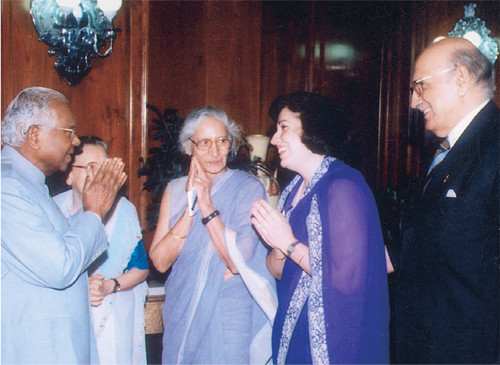
(L to R) President K. R. Narayanan, Jungalwalla (partly hidden), Dr Kapila Vatsyayan, Cama and Sethna
The former military strategist noted that Akbar first came across Parsis during his campaign to conquer Gujarat. Planning to attack Surat from the south, the Emperor had camped in Navsari and was fascinated by Meherjirana. The Persian, Arabic and old Gujarati manuscripts which include the Persian Rivayats, monajats, medical recipes, books on divination and ancient fairy tales, need restoration after years of neglect and careful preservation in future, notes Cama’s report.
With the cooperation of the MRL trustees including Dastur (Dr) Firoze Kotwal and Dastur Meherji Meherjirana, the two advisors on the MRL project, 90,000 pages of manuscript have been microfilmed on site with the help of two Parsis from Microdata India — Cyrus Patel of Bombay and Viraf Sutaria of Delhi. The duo transported their office staff and equipment to Navsari for the project and are yet to be fully paid for their services, notes Sethna. Honoring the stipulation of the MRL trustees that the material be not commercially exploited, Parzor has nonetheless brought it to the attention of scholars and archivists in India and abroad and Cambridge scholar Aptin Khabagi accessed the MRL microfilms for his research on "Non-Muslims in Medieval Iran: the Cultural and Commercial Activities of Zoroastrians during the Safavid period (1501-1722).”
The six lakh rupee donation from Gatha scholar Piloo Jungalwalla of Delhi had enabled Parzor to start work on the monumental MRL collection and to provide a microfilm reader and a photocopying machine at the Library.
The manuscripts, some of them on birch bark, some with Persian calligraphy lined in gold, deal substantially with the Zoroastrian religion but also include the history of the Moghuls in western India. They need to be deacidified for better preservation and a chamber has to be created for them. Parzor is on the lookout for a person who could be trained for the job by experts at the National Archives.
Few Zoroastrians are aware of the craft and significance of the sudreh and kusti, symbols of the faith often taken for granted. The intricate, ancient technique of weaving the kusti on both, the old and the new looms, has been documented under the joint aegis of Parzor and Ahmedabad’s National Institute of Design (NID). Ashdeen Lilaowala of NID worked with weavers to understand the craft and documented their social, cultural, religious and ritual role in a monograph titled Threads of Continuity. With over 175 color illustrations and 15 line drawings the monograph has been exhibited at Ahmedabad, Baroda and Delhi, attracting the attention of international textile experts, according to the Parzor report. To publish it as an international quality edition of 1,000 to 1,500 copies Parzor is seeking to raise six lakh rupees to cover the cost.
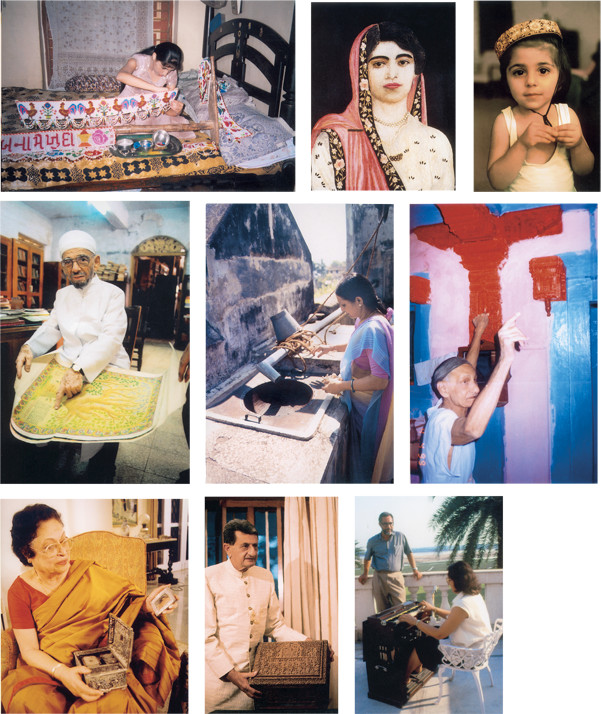
L to R (1st row): Monaz Variava creating a bead toran; embroidered portrait of Jerbanoo Kanga (courtesy Ava Khullar); two-year-old Tushna Baria modelling a zardozi topi; (2nd row) Meherjirana with his family tree; Farida Jambusarwala at her tanka in Bharuch; mobed Vimadalal pointing to wood carvings in his Bharuch home; (3rd row) Soona Mirza displaying her mother’s paan-daan; 100-year-old carved sandalwood casket made by Pesi Pettigara displayed by Naozar Chinoy in Secunderabadi court attire; Sarosh and Piloo Ginwala playing the pedal harmonium in Bharuch
An even wider research and docu-mentative project on Parsi textiles and embroidery is under way with NID’s Priya Mani working under the direction of Villoo Mirza, director of the NIFT (National Institute of Fashion Technology), Gujarat. The accent is on the Parsi adaptation of Indian costumes, including the sari, with borders and embroidery incorporating Chinese and European stitches and motifs.
The three Jokhi brothers (tan-Choi) learnt silk-weaving techniques in China before setting up their looms in their native Surat to evolve a fabric — tanchoi — which continues to dazzle the fashion world. According to Cama, the Parzor team was able to locate the original sample pieces of tanchoi with the seal of the family woven into them. On the urging of Mahatma Gandhi and social worker Kamaladevi Chattopadhyay the art had been taught to the weavers of Benares. An illustrated book on Parsi textiles and embroidery is on the Parzor agenda, funds permitting.
Another tangible Parsi heritage is the old tanka system of water harvesting whereby rain water was led off the roof through a series of strainers to collect in a clean underground tank. This system was most prevalent in the old houses of Bharuch. The Parzor write-up notes that at its request Rohinton Jambusarwala, an expert in the methodology, shared his knowledge with the NGO Development Alternatives. The latter reported after tests that the water in the tankas of Bharuch Parsis met the World Health Organiza-tion’s standards of purity.
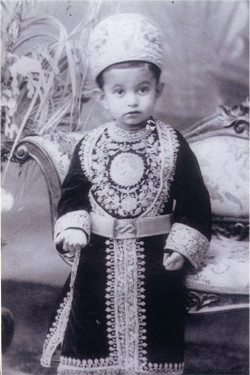
Dara Chenai, aged three, offering ‘nazar’ to the Nizam in 1904
Photo courtesy Soona Mirza
It is, however, the intangible aspects of Parsi heritage which is receiving immediate Parzor attention. Resource people, both priests and laity, are of advanced age and the race to record the knowledge and experience of musicians, artists, medical practitioners and others is a race against time. Manuscripts, paintings, photographs, textiles, jewelry, furniture and artifacts in their possession all have a tale to tell which needs to be recorded. Beginning with the old settlements of Bharuch, Navsari, Surat, Bardoli, Adajan, Bhatha, Suwali, Hajira, Ahmedabad, Baroda, Dahod in Gujarat, and the Hyderabad-Secunderabad region of the Deccan, Parzor’s digital archives have lodged 35 hours of Beta-Cam recording and thousands of photographs. For example, the Parsis of Gulbarga, Jalna, Berar and other places of the Deccan established cotton ginning and processing factories, creating vast fortunes and enjoying prominent positions in the local administration and were closely associated with the Nizam’s court in Hyderabad. The Parsi women’s cars were curtained; they wore zardozi embroidery and Hyderabadi jewelry. Their languages were Persian, Urdu and Telegu as well as Gujarati and they enjoyed and patronized the qawali and mujra with the same gusto as the Parsis of Gujarat danced the garba. The greetings "Khudayaad” and "Khuda nija baan” continue in use in the households there, notes the report.
In Surat, on the festival of Bhai Beej, members of different communities pay tribute to a pheta taken through the streets in procession. The relic belonged to Sahjanand Maharaj, the first leader of the Swaminarayan sect but is in the possession of the Kotwal family whose brave ancestor, Ardeshir Dhanjisha Bahadur, a Kotwal (equivalent to a police commissioner) of Surat, had rid the city of the menace of rural dacoits. Ardeshir earned encomiums from the people and a medal from the British rulers in 1830. The Maharaj, however, showed his appreciation of Ardeshir’s courage by taking off his headgear and placing it at the Kotwal’s feet. The Swami’s homage was cherished by Ardeshir and his family and a regular aarti is performed before the sacred relic to this day.
The collected material, documenting diverse community lifestyles and history, is available to scholars and researchers at the Parzor archives in Delhi. Parzor also answers questions on the community to people around the world. Provided free of cost for academic purposes, Parzor maintains its copyright on the photographs and archival material supplied on request. The Parzor website www.unescoparzor. com is constantly upgraded, as per the report.
Each field trip however costs three to four lakh rupees, says Sethna, adding that a field trip to Bombay in October ’02 is currently under planning. They expect to interview a number of people based on their response to the original questionnaire floated by Parzor in 1999 (see "Documenting a lifestyle,” Parsiana, October 1999.) These trips have also revealed the diversity of interests shared by the community. In Baroda, Dara Hakim shared the written account of his father’s bicycle journey around the world — a story of escapades and adventures, meetings with kings and presidents with a foreword by India’s first Prime Minister Jawaharlal Nehru. In Baroda too the Parzor team met the octogenarian Homai Vyarawalla, India’s first woman photojournalist and organized an exhibition of her historic photos recapturing the Independence era at New Delhi to coincide with the 40th anniversary celebrations of the Katrak Dar-e-Meher.
Prof Mahesh Champaklal of the Maharaja Sayajirao (MS) University at Baroda and Dr Gopal Shastri have agreed to share their expertise with the Parzor sub-module on Parsi theater coordinated by core committee member Dadi Pudumjee while the MS University’s Faculty of Performing Arts and the Yazdi Karanjia troupe will assist in the collection of sets and props. Dr Bharati Modi of MS University, an abridged version of whose doctorate thesis on Parsi Gujarati literature had been published by Parsiana ("Thus spake Parsis,” January 1992), Dr Ratan Marshall, the noted litterateur of Surat and criminal lawyer Kersi Shethna of Ahmedabad are participating in the module on Parsi Gujarati literature coordinated by Dr Mani Kamerkar, vice president of the Asiatic Society of Bombay,
The Parzor study on traditional Zoroastrian medicine led Prof Lokesh Chandra of the International Akademy of Indian Culture to explain how Tibetan medicine, especially pulse determination, was influenced by Sasanian Iran. Parsi vaids, hakims and hadvaids had once been leaders of a profession that is now dying out so Parzor has interviewed and recorded the techniques of the very few who still remain in the field.
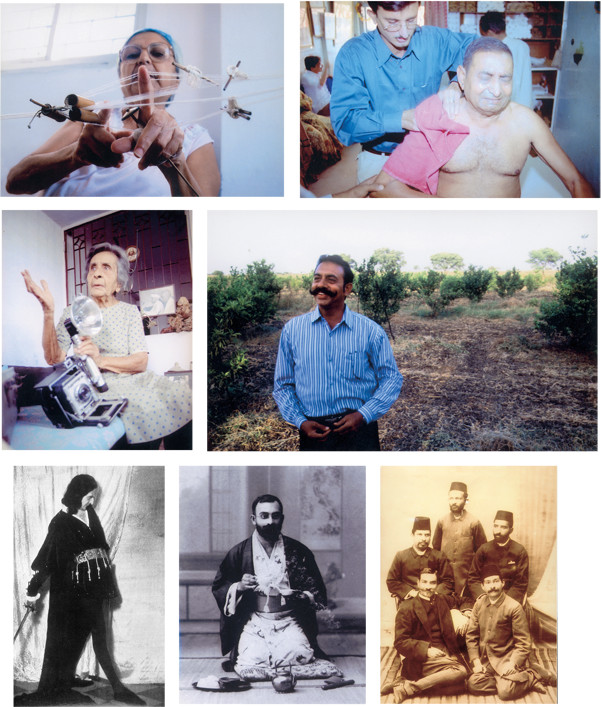
L to R (1st row) Katy Patel weaving a kusti in Navsari; Dr Jarsis Bonesetter, a trained allopath, works with his father as a hadvaid in Baroda (2nd row) Vyarawalla and Contractor of Dahod (3rd row) Jal Khambata of Wadia Theatricals enacting Hamlet (courtesy Shirin Vakil); Hoshang Kotval at a tea ceremony in Japan in 1905 (courtesy Avi Sabavala); (seated on floor) Dr D. N. Wadia, father of Indian geology and Dr Sorabji Shroff, founder of the first charity eye hospital in North India (courtesy Mehru Shroff)
Despite the enormous industrial activity in the Hajira belt of Gujarat, the empty Parsi vads and vadis amid the massive industrial estates of Essar, Kribhco and Reliance testify to the diminution of the community. Why did the villagers leave? Did they just die out? These questions prompted Parzor to institute a demographic medical module headed by former University Grants Commission chairperson Dr Armaity Desai. The cooperation of the medical fraternity and the Census of India has led to an awareness of the medical problems peculiar to Parsis. Using modern genetic methods researchers at the Bombay Hospital, South Gujarat University and the Cancer Research Institute will review each topic in light of the data generated by our small community, the results to be fed into a medical demographic data center. The "predicaments of progress” and their impact on the youth and the aged are being coordinated by TISS (Tata Institute of Social Sciences) in Bombay and Ava Khullar in Delhi. These sociomedical problems of a progressive community — late marriages, infertility, high rates of cancer and neurological illness — will be examined to benefit Parsis as well as to aid other communities in the rapidly changing social structure of India.
The project has spawned a variety of benefits. Apart from the exhibitions at Delhi, Ahmedabad and Baroda, Parzor’s "Pictures with a Purpose” was exhibited by UNESCO, New Delhi at its Paris headquarters in 2001 during the UNESCO general council meeting, notes the report. The Government of India is also said to have selected the Parzor project as its candidature file for the international UNESCO award, "Masterpieces of the Oral and Intangible Heritage of Humanity.”
A happy side effect of the project has been the increasing involvement of youth in Ahmedabad, Baroda, Delhi, Dahanu, Bombay and Secunderabad. Offers of help have even come in from young community members in UK and the US. If the initial funds are forthcoming for the printing of books, CDs, etc, revenue in the form of their sale price would enhance the resources available for further research. Cama’s urgent appeal for donations to the project may be answered by cheques/drafts made to "UNESCO, New Delhi (Parzor Project)” and despatched to UNESCO House, B5/29, Safdarjung Enclave, New Delhi 110029 with the envelope superscribed "Attn: Dr Shernaz Cama.” The money is audited and allotted by UNESCO as per the requirements of each phase and module, notes Cama’s report.
On the Parzor agenda is research into military legends starting with Field Marshal Sam Manekshaw. Sabeena Gadhiok of Jamia Millia University is working on a book on Homai Vyarawalla and her historic pictures.
The Zoroastrians of Uzbekistan and Tajikistan are urging UNESCO to term the year 2003 as the 3,000th year of Zoroastrian culture and are seeking Parzor’s support. "There is a tremendous amount of interest in Zoroastrianism all over the world,” says Sethna.
Though sensitive to the "penalties of progress” including small families, disease, allergies, infertility and foetal loss, high divorce rates and the problems of aging ("26 percent of Parsis in India are over the age of 60. Compare that to 12 percent of the general population in the UK and 13 percent in Canada and Europe”), Sethna obviously believes, like Shakespeare, that "There’s a tide in the affairs of men which, taken at the flood, leads on to fortune...”
Why are our numbers declining?
The Parzor module on demography and health is an effort to seek the causal factors behind the community’s declining numbers. Coordinated by Dr Armaity Desai, former director of the Tata Institute of Social Sciences (TISS) and former chairperson of the University Grants Commission, it envisages a study of the socioeconomic and attitudinal factors impacting the community as well as clinical research to understand how and to what extent genetic factors are responsible for the hypertension, cancer, diabetes, osteoporosis, sterility and foetal loss, etc that cloud the Parsi healthscape.
The socioeconomic and attitudinal study has been roughly compartmentalized into family, youth and aging, the first two to be undertaken by two researchers at TISS. It is meant to provide an in depth indication as to how the community perceives problems of the family, of children, of old age, of delays in marriage. The study will be both qualitative and quantitative, says Desai, the former with discursive interviews, the latter with a questionnaire followed by very structured interviews. For example, youths and young adults will be asked a range of questions regarding education, employment, marriage, etc.
The census commissioner of the Government of India has undertaken to organize the study on aging, using the census data from all over India. This will probably be in the latter half of the decade when the census office normally indertakes small studies, says Desai.
The medical component will examine issues relating to the molecular, cellular and genetic composition of the community. Desai hopes that these studies including blood, tissue samples, etc could be housed in a central data bank, accessible to scientists — both Parsi and non-Parsi, from India and abroad. The clinical as well as the social data could prove useful to other communities that face similar problems. A better understanding of the diseases borne by the community could lead to a more healthy aging process, to action programs for target groups and to the provision of requisite services, she adds.
With the limited sponsorship available so far, efforts are underway. But research is a costly process and Desai hopes that individuals and trusts will come forward to sponsor these programs. If funding for a central facility is available full-time staff could generate analyses and spread the available information by publishing small pamphlets, she notes.
Having studied the immuno-genetic aspects of breast cancer in Indian women for four to five years, Dr Narendra Joshi seeks to confirm his data by studying a "genetically distinct and homogenous community,” the Parsis. Though the incidence of breast cancer in Parsi women is relatively higher, "it is not an alarming situation,” he says. He notes that he chose to work with Parsis because they are "easy to identify and being more progressive are that much more cooperative.”
Joshi’s three year project, funded by the Lady Tata Memorial Trust and supported by Parzor, targets a comparative study of 50 patients aged 65 or less who have been diagnosed after June 2000 against a control group of 200 healthy women (30-65 years).
There is a "suggestive possibility that breast cancer patients could have a genetic make up that contributes to a reduction in their immunity to cancer,” says Joshi. The project involves the study of white blood cells vis-à-viz related genes. For this Joshi needs about 20 cc of venous blood.
Those willing to volunteer for a pro-ject that could generate a permanent data base for the community may contact Joshi at his office at the Tata Memorial Centre (4123803 ext 208) or at home (5400398) or email him at narennjoshi@yahoo.com. Joshi assures confidentiality to the participants.
◆ ◆ ◆
From the archive