
Religion
"Grudge me not this space"
Mt Damavand, Pasargade and Persepolis continue to inspire Zoroastrian tourists from India
In the August 21, 2006 issue Parsiana had carried the author’s impression of her motherland, Iran, and the joy of touring the major cities. In this second instalment she captures the awe on sighting Mt Damavand and their pilgrimage to Pasargade, the first capital, and Persepolis, the splendid seat of government of the Achemenian empire .
A mountain of faith
Damavand, the majestic. Damavand, the mystical. Damavand koh (peak) of a dozen legends heard over the years. Finally we were going to be in the presence of this awesome entity, the spiritual mountain in the mighty Elburz range, where we would offer a celebratory jashan. The Elburz straddles northern Iran, starting from Tabriz in the west, to fuse with the Hindukush and Himalayan ranges in India. Mt Damavand, some 50 km north-east of Tehran, is the highest peak in the Elburz range scaling 5,671 m or 19,000 ft.
Mt Damavand, literally translated meaning one that is covered with clouds, had shed its customary veil of cloud and stood revealed to us in all its brilliance and beauty — a snow-capped cone (similar to pictures of Mt Fuji) against a clear blue sky. The peak was visible from various bends and turns on the mountain road, much before we reached the base of Damavand. As our excited group surged from the left window of the coach to the right, our obliging driver made a "two-minute stop, for taking pictures and for seeing!”
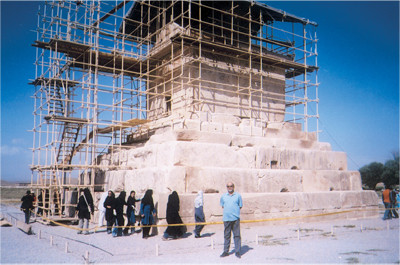
Restoration work carried out on King Cyrus’s tomb
A little over an hour after leaving Tehran, our bus stopped, not far from the base of Mt Damavand. We walked a short distance over rocky outcrops and through green meadows dotted with red poppies, white daisies and purple wild flowers, till we came to a level area where the jashan would be performed. In no time Rustam, Byram, Parvin and Dilnavaz, our Irani Zarathushti helpers had set the scene for the ceremony — durries, afargan, sukhad, flowers, khumchas of malido, fresh fruits and dry-fruits and water for the priests to cleanse with. About 25 chairs were unfolded for those unable to sit on the ground. Thoughtfulness and comfort left little else to be desired.
We had six priests in our group, ranging from the aged and venerable to freshly ordained navars. For the two young boys, it was of special significance and honor to perform a jashan at Damavand, at such a tender age. The priests washed their hands and faces, did their kusti and donned their white jamas, the two youngest looking like farohars in white!
The assemblage sat in a circle around them, bound together in the unseen cord of shared ethnicity and religion. Soon the fragrance of sukhad pervaded the mountain air and the mesmeric flames in the afargan danced to the cadence of prayer. The tranquil and beautiful setting with Mt Damavand standing sentinel in the background could be described. But that feeling of oneness with nature, with our fellow pilgrims and with a spiritual power within and above us, has to be experienced. It cannot be put into words.
In this serene setting, it is hard to believe that Mt Damavand is a dormant volcano with hot springs and steam vents on the flanks and a molten magma body beneath it. It is easier to believe the many other legends that surround it, making it a mountain of piety and worship for Zarathushtis.
Damavand is believed to be the celestial home of Sarosh Yazad.
Another widely held belief is that after death, the souls of the pious pass over the Chinvat Pool via the Elburz.
Persian poet Firdausi Toosi relates in his epic Shah Namah, how the evil demon Zohak is overthrown by Shah Faredoon of the Peshdadian dynasty and imprisoned in chains in the bowels of Damavand. Local legend asserts that Zohak’s groans may still be heard on the inclines. At night when the forces of darkness and evil prevail, Zohak’s chains begin to weaken. But when the cock crows at the crack of dawn and light and virtue regain supremacy, Zohak’s chains bind tight once more. It is a beautiful allegory of the continuing battle between good and evil that every individual must face every day of his life.
One school of thought says that a Zoroastrian dynasty of Masmogans or mobeds continued to rule in the Elburz mountains in the vicinity of Damavand for well nigh 300 years after the fall of the Zoroastrian empire of Yazdegird Sheriar.
As recently as 100 years ago, in the early 1900s, Behramsha Shroff, an 18-year-old Zarathushti from Surat, wandered into the Damavand area of the Elburz via Peshawar. Led by some holy men to the secret caves in the mountain, he is believed to have stayed there for three years. On his return, he claimed that highly evolved spiritual masters continue to live over there. These Masmogans or magavs are believed to be the unknown and unseen guardians of the Zoroastrian religion.
Years later Sahib Minocher Pundole corroborated this theory.
"Whether they (the stories) are believed or disbelieved, for them that have faith they are a fact and for them that have not, they are a legend.”
For me and for many others in our group, the beauty and the peace of the mountains, the sonorous sound of the Avesta prayers, the faith in our religion, the pride in our identity and the spirituality of the moment that bound us together, were reason enough to pay homage with a joyous jashan at the feet of Mt Damavand.
History etched in stone
Pasargade in the province of Fars was the first capital of the Achemenian empire. Literally translated Pasargade means seat (gade) of the Persians (Pasar). Pasargade is a vast, flat land ringed by mountains. All that remains of a great court that must have flourished here once is the tomb of Cyrus the Great.
Cyrus died while on campaign but as was the custom, his tomb was built in his lifetime and he was laid to rest here. Seven massive stone steps lead to a square chamber topped by a pediment and entered by a low door. It is devoid of any ornamentation. A two line inscription now effaced, underlines the humility of the man:
"Passerby, I am Cyrus the Great. I have given the Persians an empire and I have ruled over Asia. So grudge me not this space.”
In an age when cruelty and slavery were the norm, Cyrus the Great created the world’s first known Charter of Human Rights. More than 2,500 years ago, he had engraved on a clay cylinder the rights and freedom that every man — serf, slave and sovereign — was entitled to have.
The Cyrus Cylinder discovered in 1878 in Babylon is one of the most prized exhibits in the British Museum in London. Among other things, the cylinder states, "May Ahura Mazda protect this land from foes and falsehood, from rancor and drought.”
Heads bowed our group of pilgrims stand in silent awe before the spirit of Cyrus. Then, led by our revered priest we say a hambandagi and a prayer for the soul of the great king, at the foot of his tomb. An Iranian couple in their sixties who was watching our group of circled worshippers told us that their forefathers were also Zarthostis and that they were honored to meet Zarthostis from across the seas, who had safeguarded and preserved the religion all these long years!
In contrast to Pasargade which is stark in its simplicity, Persepolis has an extent and grandeur that can be reconstructed in the mind’s eye, despite the desecration and destruction it suffered at the sword and say of Alexander, the Accursed.
Darius built Persepolis to be the splendid seat of government of the Achemenian empire and to showcase the grandeur and wealth of Persia. It was built to be the ceremonial center for receptions and festivals, the most important of which was the spring festival of Navroz. On the occasion of Navroz, satraps from the 22 nations under the great king’s rule, came to pay homage, bearing gifts and good wishes. The ethnic diversity of his visiting subjects — an Indian prince is one of them — and the gifts they bore, from gold mohurs to goats and silver to spices are depicted in detail, in the stone carvings on the walls and the grand staircase of the palace.
Persepolis covers an impressive area. It was built of local stone from the surrounding mountains but the skilled workers, who crafted it, came from all parts of the vast Persian empire. Twenty thousand clay tablets were found at Persepolis with detailed accounts of materials, workers and wages. These wise and just kings did not build Persepolis with the sweat of slaves.
High over the sculptures in cuneiform script there are inscriptions proclaiming the glory of Ahura Mazda and attributing all their achievements to Him. "A great God is Ahura Mazda, who created yonder sky, who created man, who created happiness for man, who made Xerxes king, one king of many peoples.”
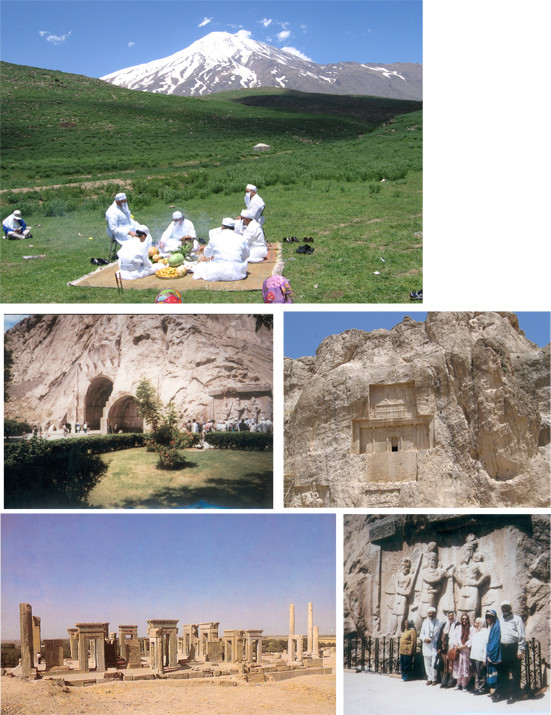
Clockwise from alongside: Jashan at the foot of Mt Damavand, etchings at Naqsh-e-Rustam, sculpture at Taq-e-Bostan, the ruins at Persepolis and the grottoes at Taq-e-Bostan
At another place he proclaims, "By the favor of Ahura Mazda I built this gateway of all nations, I built other beautiful things. I built them and my father built them, all by the favor of Ahura Mazda.”
Elsewhere he says: "May Ahura Mazda protect me from harm and protect this land and whatever by me and by my father has been built.”
After dusk there is a sound and light show at the still grand ruins of Persepolis. The commentary in English is disappointing. But with imagination, helped by the lights and music I could conjure the splendor and ceremony of a 2,500-year-old past.
At Behistun one can see the most famous inscription of Darius cut high on the mountain. "That which I have done, I have always done by the grace of Ahura Mazda. For this reason Ahura Mazda blessed me, because I was not wicked, nor a liar, nor a tyrant. Neither I nor my family.”
What purity of thought, what strength of promise in their word, nobility in their deeds and depth of faith these followers of Ahura Mazda had. They truly embodied the essence of Zoroastrianism.
Have we, the inheritors, lost it somewhere along the way? Concluded
◆ ◆ ◆
From the archive