
Zoroastrians Abroad
Intrinsic to Iran
Iranian Zoroastrians are keen to interact with the global community
Today, migration is taking its toll on the Zoroastrian population… especially in historical countries like Iran and India,” mentioned Dr Esfandiar Ekhtiyari, the Iranian Zoroastrian Member of Parliament in his message to the Ninth World Zoroastrian Congress. He was particularly concerned with "the disproportionate migration of our youth who are our future-makers.” More so, when "the young, who are enchanted with the luxuries of the West and fly in pursuit of an ambitious life,” get totally assimilated in a foreign culture. He therefore impressed on the need for inculcating in the children and adolescents "the thoughts and teachings of Zarathushtra and the Gathas, teachings… in line with the principles of Zoroastrianism, namely truthfulness and purity… which will stay with them forever…
"We Zoroastrians are scattered throughout the globe which can be considered as a fortunate opportunity. But this dispersion turns into opportunities when we are affiliated,” resulting in greater interaction among mobeds and organizations throughout the world. Ekhtiyari, who is also the managing director of the monthly bilingual newsletter Parsnameh expressed his views in the January 2010 edition.
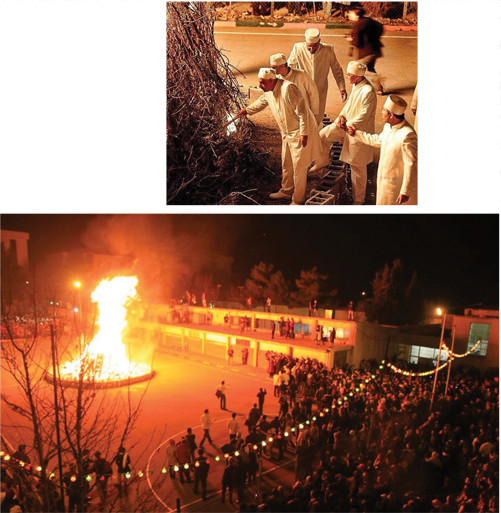
Iranians light giant bonfires to celebrate the mid-winter festival of Sadeh
"It is nearly half a century since the World Zoroastrian Congresses have been held… Congresses whose most important results have been establishing relationships among the world Zoroastrians and familiarizing them with activities and problems of one another. Yet this doesn’t suffice. We should (take) longer strides in solving these problems and issues by active participation. One of the most common points amongst the entire world Zoroastrians is the motherland, Iran,” stressed Ekhtiyari. He was keen that members of the international community establish connections with Iranian Zoroastrian organizations and anjumans starting with a single mail that could be followed by visits.
"Unity doesn’t come… just by talk or speech… it should be felt by each one individually,” Mobed Ardeshir Khorshidian, head of the Mobedan Anjuman of Tehran, was quoted in Parsnameh. "Only organizing meetings, congresses is not enough. All anjumans should be respected, their voice should be heard and all the questions answered.” Mobeds worldwide should organize an international anjuman to solve religious problems through closer talks and decision making, he advocated, stressing, "Our religion is not based on laws but on principles (like fastening the kusti) and tariqat (religious way of life) which show how a person should lead his/her life… Our religion should be the same. The customs may change. The most beautiful and the best fact about the Zoroastrian religion is that… we have always accustomed ourselves through changes of time and place.”
An eye surgeon at Arya Hospital, Khorshidian was born in Yazd, studied for his physician’s certificate from Esfahan, proceeded for higher studies abroad, and then built three hospitals with a new one coming up in memory of the first Aryan surgeon Trita. His religious tutelage was under his father Mobed Shahzadi and Mobed Firuz Azargoshasb, reported Parsnameh.
The newsletter frequently refers to the motherland as "The Ahura Blessed Iran” and announces that "Iran was elected as the venue for the 11th World Zoroastrian Congress.”
While Zoroastrians are scattered throughout the country, most reside in Tehran, Yazd, Kerman, Shiraz, Isfahan, Ahwaz and Zahedan "upholding many of the religious customs and rituals…” In these cities too are found many fire temples and sacred places. "The only world Zoroastrian museum is located in Kerman,” states the eight-page newsletter, printed in such a small font that reading is an effort.
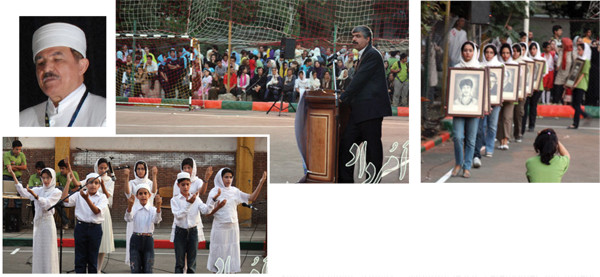
(Above) Dr Esfandiar Ekhtiyari at the Jam-e-Jaanbakhtegan annual sports event (above right and alongside) in memory of Zoroastrian martyrs; (top left) Mobed Ardeshir Khorshidian Photos courtesy www.amordad news.com
Bonding through celebrations
Monthly feasts, ceremonies and athletic competitions are regular features in Iran. Come Navroz and the fire temple in Yazd is packed with tourists who consider it a pilgrimage center. Though the building is only 75 years old, the fire burning in it is believed to be more than 1,500 years old, according to The Culture of Yazd Zoroastrians written by Sedigheh Ramezanzadeh and translated by Rowshan Lohrasbpour. The fire traces its origins to the flames of the Pars Karyan fire temple in Larestan which was brought to Aqda, Yazd and kept burning there for 700 years before being taken to Ardakan where it was kept for the next 300 years. In 1473 it traveled to Yazd and was given an abode in the house of Mobed Tirandaz Azargoshasp in a place called Khalaf Khan Ali until it was shifted to its present site in 1934.
Since the last eight years this temple has featured on the national heritage list and its doors have been opened to tourists. Although initially Zoroastrians were not in favor of permitting tourists to their sacred temple, due to public pressure they agreed to open up a part of their premises to all visitors who can see the sacred fire burning in its censer from behind a glass wall.
In ancient Iran, a fire temple was not a place for worship only but also served as a court, a clinic and an educational center. Every fire temple had eight entrances and a number of octagonal rooms with the fire place in the middle of the temple.
The Yazd fire temple was constructed with funds sent by an Indian Parsi, Homa Bani, on land endowed by a few Iranian Zoroastrians, including the Amanat brothers. The main building is at a height of 21 m in the midst of a garden full of pine and cypress trees with a water pond facing the entrance. The stone capitals in front of the main hall and the flower figured stones at the foot of the walls are the work of Isfahani craftsmen while the Fravahar image on the tile atop the entrance door is the work of Yazdi tilers.
Yet another celebration from Iran’s pre-Islamic past that drew interest from Muslims this year is the festival of Sadeh when thousands of Iranians gather at dusk against a snowy mountain backdrop to light giant bonfires, according to a news report in the Associated Press, Boston.com. This mid-winter festival observed in January celebrates the discovery of fire and its ability to banish the cold and dark. Once the "national festival of ancient Persia when Zoroastrianism was the dominant religion before the conquest by Islam in the 7th century… now it is mostly celebrated in the homes and temples of Iran’s 60,000 remaining Zoroastrians.”
There are around 40 officially accredited Zoroastrian bureaus in Iran — formed within local associations, charity institutions and unions — committed to enhancing the status of the Zoroastrian society. These associations have sufficient funds "which may require correct management,” specifies Parsnameh. Although there is collaboration and cooperation among these associations, they never interfere in each other’s affairs.
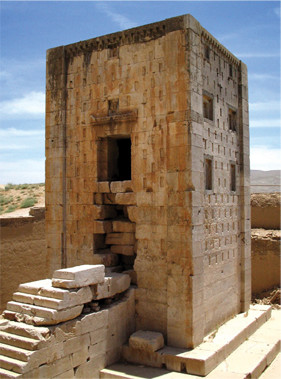
Zoroaster’s Kaba at Naqsh-e Rustam in Fars
Some of the Zoroastrian associations are totally run by the youth and one of the "most active, democratic, purposeful… but least funded” belongs to the youth. The Zoroastrian Students Association (ZSA), a democratically run organization, "is home to many active committees and councils and executes many different programs across the country.” Among the major events coordinated by them are the scientific symposium held annually in Bahman mah (February) when inventions, innovations and papers are presented by students. One of the most important sports activity in memory of Zoroastrian martyrs is the Jam-e-Jaanbaakhtegan Cup in July where nearly 700 sportspersons from across the country as also foreign lands participate in nine athletic fields. A special music fiesta is organized annually to bring together Zoroastrian musicians on a common platform where they can showcase their talent. A significant religious activity in Iran is the Manthra program where the youth scientifically research into Avesta and the Gathas and learn Din Dabireh (Avestan font) and Avesta recitation correctly. Another youth affiliated organization in Yazd is Yaneshvaran Association that conducts different programs and activities.
Yet another active society of Zoroastrian students is Kanoon-e Daneshjooyan-e Zartoshti, popularly known as Kanoon, established in 1968. At their Mantra gatherings in September over 250 participants compete in either reading Avesta or writing on religious subjects. These competitions inspire some competitors to study academic religious courses at university levels. August is the month of Ordu (camping) when about 100 youths aged between 14-18 come together to experience team work whilst participating in different classes and visiting cultural and historical places. Chelleh Night, the longest night of the year, is celebrated with recitation of poems by great Iranian poets like Hafez, Ferdowsi and Molana, performance of traditional rituals and other programs. Ferdowsi’s veneration is also encouraged through Shahnameh recitation because the poet’s "treasure” is believed to have saved the Persian language.
That Iranian Zoroastrians enjoy "high level of academic and scientific accomplishments” is credited to "the great efforts exerted by Parsis to establish the underlying educational groundwork.” Among the one million students vying for admission to university based on a four-hour examination, the top 10 scorers would be Iranian Zoroastrians, reports Parsnameh. Similar is the case with postgraduate courses. Zoroastrian youngsters have also made their mark in the field of invention, innovation and technology by participating in national and international science conferences like the International Conference of Inventions of Youth in Geneva and Kharazmi Conference in Iran.
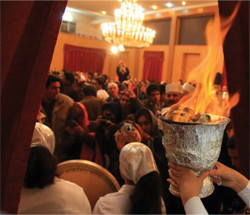
Celebrating Sadeh at home
In music, both pop and classical, Zoroastrians have earned fame and in recent years some Zoroastrian singers have even launched albums. Whether featuring in comedy serials on television or excelling at the International Student Puppet Theatre Festival, Zoroastrians even feature in the performing arts. In the fine arts young Zoroastrian artists, painters and sculptors have set up galleries and participated in professional festivals. Award winning photographers, authors and poets have brought laurels to the community too.
Young Zoroastrians have been selected for the national teams in basketball, volley ball, cricket, chess, badminton, swimming, recounts the newsletter. Participation from visiting teams would lead to "proximity of cultures and a better understanding” with simultaneous improvements on the social, religious and economic fronts,” mentions Ekhtiyari, adding, in entrepreneurship "we are still weak… and are in need of more training.”
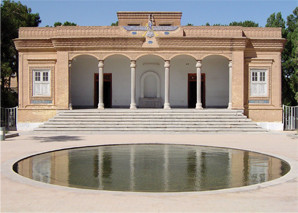
Fire temple in Yazd
Significant sinkage
Escalating earth sinkage due to drilling of wells and the consequent reduction in the water table levels at the ancient site of Naqsh-e Rustam in Fars province may lead to the destruction of Zoroaster’s Kaba which is located at a distance of five meters from the sinking earth, notes a news item from the Tehran Times Culture Desk forwarded by Cyrus Bulsara. The mishap could cause cracks in rocks bearing the ancient bas-reliefs, it is feared.
The significance of the Kaba has been interpreted differently by experts. While some believe that the monument was the home of a complete copy of the Avesta which had been written on 12,000 leather parchments, others believe that it housed a sacred fire, yet others say the monument is the tomb of Smerdis, the son of Cyrus the Great who was murdered by his brother Cambyses and some archeologists think the site was used as an ancient government archive. Rejecting all earlier hypotheses, in 2005 Iranian archeologist Reza Moradi Ghiasabadi declared the monument as the world’s most unique calendrical and astronomical building.
The Kaba bears a Sassanid era inscription explaining the historical events during the reign of the Sassanid King Shapur I. There is a trilingual inscription (in the Sassanid and Parthian dialects of Middle Persian and ancient Greek) describing the war between Persia and Rome in which Shapur I defeated Valerian who was captured in 260 CE and died in captivity.
Naqsh-e Rustam houses the tombs of the Achemenid Kings Darius I, Xerxes I, Artaxerxes I and Darius II and features several other sites dating back to the Elamite and Sassanid eras.
◆ ◆ ◆
From the archive