
Iran Focus
"Spiritual motherland"
A number of Zoroastrians have started visiting Iran to rediscover their religious and cultural roots
Iran is a vast country blessed not only with rich natural resources, but more importantly a rich legacy of history, culture and spirituality. Zoroastrianism ceased to be the state religion of Iran around the middle of the seventh century A.D. However, for devout Zoroastrians all over the world, Iran is still a "spiritual motherland.” It is the land which cradled one of the world’s first revealed religions, reared benevolent kings who upheld and championed human rights even before the term was coined and which threw up men of learning who were to influence the thought processes of thinking men all over the then-known world.
It is a happy augury that over the last couple of decades, a number of Zoroastrians, not just from India but, from all over the world have started visiting Iran to rediscover their religious and cultural roots.
Iran always evokes a multitude of passions and emotions among Zoroastrians. On one hand, there is the joy of embarking on a pilgrimage to the holy land, being with one’s fellow Zoroastrians, joining them in worship at the holy fires and sacred shrines. On the other hand, there is always some feeling of sadness. In India, it may be still disputable whether the Babri Masjid was built over a Hindu temple in Ayodhya. In Iran, it is public knowledge that some of the most architecturally beautiful mosques in Isfahan, Yazd and other places have been built over Zoroastrian fire temples. And this is not what the Zoroastrians tell you. It is the Muslim guides who openly tell you this!
The Zoroastrians of Iran are a warm, friendly and robust community. Official census figures indicate that there are more than 90,000 Zoroastrians living in Iran. However, the Zoroastrian anjumans in Tehran and Yazd believe the Zoroastrian community’s total strength in numbers to be around 25,000-30,000. The community mainly resides in urban Tehran and rural Yazd with others scattered in Kerman, Shiraz, Isfahan and other centers.
Zoroastrians are no longer a persecuted community in modern Islamic Iran. There may be a degree of discrimination when it comes to employment or securing certain state benefits. However, Zoroastrians, Christians and Jews are recognized minorities and have one representative each in the Iranian Majlis (Parliament).
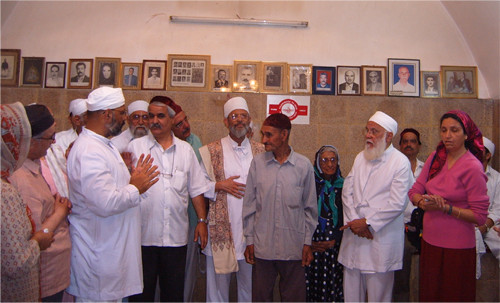
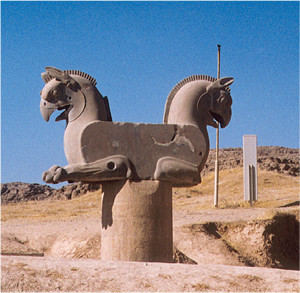
Above: Double-headed griffin at Persepolis (Photo: N. Rustamjee) Priests felicitating keeper of the Cham fire (This and following photos by N. Dadrawala)
Mostly agriculturists cultivating pomegranate and pistachio farms in Yazd and Kerman or self-employed in trade or transport services, many Zoroastrians own or drive tourist buses. Being a bus driver is a fairly lucrative career option and moreover a very macho thing in Iran.
As in Bombay, the Zoroastrians try to live in a community setting as far as possible. This has several advantages in terms of common cultural bonding, inter-dependence and sense of security. In Tehran there is a huge Zoroastrian housing complex called ‘Rustom Baugh’ built under the patronage of late Arbab Rustom Guiv. In Yazd, there are virtually exclusive Zoroastrian villages like Cham, Zainabad, Moborake and Sharifabad.
Issues like late-marriage, no-marriage and inter-marriage are virtually alien to Zoroastrians in Iran, particularly those residing in rural Yazd. Most of them marry by the time they are in their mid-twenties and each couple raises on an average at least two to three children, if not more. Among themselves they speak a Persian dialect called Dari which is quite difficult for non-Zoroastrians to understand. However, in the course of day-to-day business Farsi is the lingua franca.
Iranian Zoroastrians are ethnically of Persian origin tracing their roots largely to Yazd and Kerman. Parsis who came to India from Iran, about 150 years after the fall of the Sasanian Empire (i.e., around the 9th century A.D.) trace their ancestry back to the province of Khorasan, known in ancient times as Parthia. There are no major differences between the religious doctrine, beliefs and practices of the two. In fact, in India, it is a settled law that the term "Parsi” includes immigrant or visiting Irani Zoroastrians (see 1968 Bombay Law Reporter — Jamshed A. Irani vs Banu J. Irani).
Many Zoroastrian residents of Iran wear the sudreh-kusti only when entering a fire temple. This is more out of habit and local custom that has been handed down over generations that faced persecution. Almost every Zoroastrian home, particularly in Yazd, has a hearth fire or an oil lamp before which prayers are offered, morning and evening. Sopra tables are laid out every Tuesday and Mushkil-Aasan prayers are offered every Friday, especially by elderly women.
The dakhma (towers of silence) are a major tourist attraction in Yazd. Curious westerners, especially Germans, come in large groups to study and admire this ancient system for the disposal of the dead, which has since many years been abandoned in favor of burial. With the hot desert sun and the dakhmas situated on remote hilltops, the system was working quite effectively. However, excessive westernization under the Pahlavi regime made certain Zoroastrians living in Tehran embarrassed of this ‘archaic system.’ Although the Zoroastrian villagers in Yazd were happy and comfortable with this natural and effective system, the ‘urban intellectuals’ spurred by the Late Mohammed Rezasha Pahlavi, brought sufficient pressure on the simple villagers to change the centuries old system of dakhmenashini.
The Zoroastrian villagers are truly a simple, warm and friendly people. They love meeting fellow Zoroastrians who come as tourists or pilgrims and their hospitality and graciousness is legendary. Even the poorest Zoroastrian family would not allow a visitor to leave without a cup of tea, ‘sherbet,’ sweets or fruits.
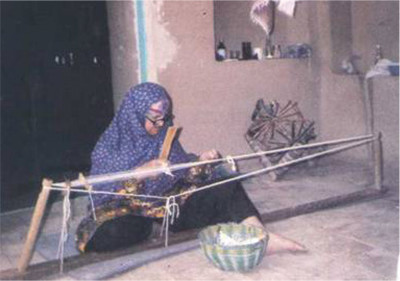
Kusti weaving in Yazd
The special fires
The desert province of Yazd, in Iran, is an ancient Zoroastrian stronghold. Even today a number of ancient spiritual fires are preserved in its sleepy little villages. The fire that burns in the village of Sharifabad is said to be more than 2,000 years old. Also, the only Atash Behram other than the eight that burn in India, is in Yazd.
There are also the legendary "flying fires.” This is not to say that one can see them fly. According to oral tradition, the Zoroastrians of Yazd believe that generations ago these special fires came flying into certain Zoroastrian villages like Cham and Zainabad. These special fires were typically found crackling and glowing on a cypress or mulberry tree in the village. One could rationalize that lightning may have struck the tree or the intense desert heat may have triggered a spontaneous fire. But there is no denying the fact that these fires have a natural origin. Over the decades devout ‘Atashbands’ (keepers of the Holy Fire) have preserved these fires with great devotion and piety. Several miracles and legends are associated with these fires.
There are hardly any ordained Zoroastrian priests left in Iran. Most fire temples have a mobedyaar or a paramobed. No major liturgical ceremonies like yasna, vendidad, vispered and nirangdin are performed. However, jashan ceremonies and gahambars are observed. Navroz is a major national festival and celebrated with great enthusiasm.
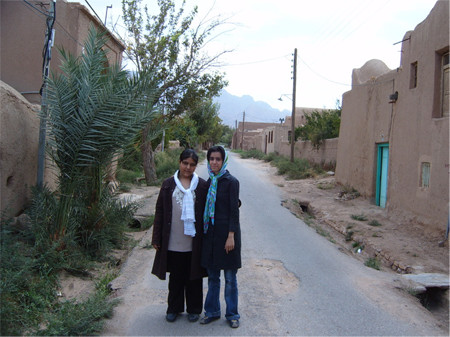
Zoroastrian teenagers in Yazd
The holy shrines
There are also a number of holy shrines, which the locals revere as ‘Pir’ (ancient/ holy). These mountain shrines consist essentially of sacred rocks in high and lonely places. According to folklore, after the defeat of Yazdegird III (the last Zoroastrian monarch of Sasanian Iran) at the hands of the Arab invaders, his family not only had to flee from the palace but were separated and had to roam about in the wilderness. The invaders were in hot pursuit of Yazdegird’s wife and daughters. It is believed that when everything seemed lost, the princesses prayed to Dadaar Ahura Mazda for help, whereupon the mountains opened up and took them in. Most of these shrines are mountain oases bringing life and fertility in the hot and arid salt deserts.
Prof Mary Boyce in her book, A Persian Stronghold of Zoroastrianism, writes, "These sanctuaries were very dear to the Zoroastrians. So much so that one explanation, which they gave for their seemingly miraculous survival as a community, was that they had been spared ‘for the sake of those in the hills.’ That is, so that they might continue to worship at these remote places, and to maintain the rites which were proper to them.
"The five sanctuaries,” continues Boyce, "and one other in the plain near the city of Yazd, were in communal trust. Each village looked after the shrines in its own fields and lanes, but all joined together to care for these six. To visit any of them on any occasion was an act of much merit, but the merit was greatest when one joined in the yearly pilgrimage at the time appointed. Each pilgrimage lasted officially for five days, like each of the major festivals.”
In times of religious persecution
The condition of the Zoroastrians who had remained behind in Iran after the fall of the Sasanian Empire had always been miserable. In 1511, they wrote to the Parsis in Navsari that since the reign of Kaiomars they had not endured such sufferings, even under the execrable government of Zohak, Afrasiab, Tur and Alexander!
One of the harshest concomitant circumstances of the conquest of Iran by the Arabs had been the jazia tax. Muslims were the only community exempted from this tax — all the other ‘infidel inhabitants’ of the Kingdom, Armenians, Jews and Zoroastrians, being subject to it. However, among minorities, the Zoroastrians were the worst hit.
Writes Prof Edward G. Browne in his A Year Amongst The Persians (the year being 1887-88), "Upto 1885, no Parsi was allowed to carry an umbrella. Upto 1885, there was a strong prohibition upon eye-glasses and spectacles; upto 1885 they were prevented from wearing rings; their girdles had to be made of rough canvas, but after 1885, any white material was permitted. Upto 1886, the Parsis were obliged to twist their turbans instead of folding them. Upto 1888, only brown, grey and yellow were allowed for body garments but after that, all colors were permitted, except blue, black, bright red or green. There was also a prohibition against white stockings and upto about 1880, the Parsis had to wear a special kind of peculiarly hideous shoe with a broad, turned-up toe. Upto 1885, they had to wear a torn cap, upto about 1880, they had to wear tight knickers, self-colored, instead of trousers. Upto 1881, all Zoroastrians had to walk in town and even in the desert, they had to dismount if they met a Mussalman of any rank whatever.”
Browne writes about an incident in 1860 where a Zoroastrian man of 70 years went to the bazaar in white trousers of rough canvas. According to Browne’s account, "they (the Mussalmans) hit him about a good deal, took off his trousers and sent him home with them under his arms.”
Fortunately around the end of the 15th century, ties, so long broken between the Zoroastrians of Iran and those settled in India were happily renewed. In a letter to the Parsis of India dated September 1, 1486, Nariman Hoshang wrote from Sharifabad declaring that all the Irani Zoroastrians had been desiring for centuries, to know if any of their co-religionists still existed on the other side of the world!
Parsis settled in India were shocked to learn that while they prospered in the land of their adoption, their poor Irani brethren in the motherland, suffered. A Society for the Amelioration of the Conditions of the Zoroastrians in Persia was founded and the valiant Maneckji Limji Hataria was dispatched as an agent of the Society. Hataria struggled against oppression of every sort and in 1882, he succeeded in getting the Jazia tax abolished.

Noshir H. Dadrawala is chief executive officer of the Bombay based Centre of Advancement of Philanthropy and sits on the board of several international philanthropic organizations including the Hong Kong based Asia Pacific Philanthropy Consortium and the U.K. based Resource Alliance. He has participated in research studies and contributed papers for Harvard and Johns Hopkins Universities and authored a number of books on management and philanthropy. As a team member of the Poona based Social and Voluntary Group (SVG), he conducts annual tours to Iran to inculcate religious, historical and cultural pride among members of the Parsi Zoroastrian community.
◆ ◆ ◆
From the archive