
Iran Focus
Iran through a bus window
A glimpse of heritage, a sprinkle of history, and hours in the desert, racing through the country
As we touch down at Tehran, I reluctantly jam a scarf over my head and wonder whether I am the first of 39 generations in my family to make this momentous journey back. Or has some adventurous ancestral Parsi soul inspired by tales from Marco Polo beaten me to it? Who knows?
Our very first outing is to Mount Demavand — made famous by Behramshah Shroff’s accounts of the "maghavs” (biblical Magi) or Saheb-e-Delans, spiritually evolved, near supernatural beings said to inhabit the region known as Firdaus. They were said to be capable of making themselves invisible to enemies and communicating to each other and to their animals through mental telepathy. The mountain peak itself is darker than the surrounding heights and characterized by a play of light and shade that makes it seem quite mystical. At the base of the mountain, we conduct a jashan (ritual prayer using fire and fruit) with the help of local priests and are thrilled to hear our familiar daily prayers being recited by a people from whom we have been separated by 13 centuries.
In Tehran, we visit the Bastani or pre-Islamic museum followed by a round of Reza Shah’s palaces (great carpets and gardens, but a somewhat mixed taste in art and artifacts compounded by a seriously excessive use of mirrors!). Then we fly to Shiraz, — the culture capital of Iran — a piece of trivia of which we are going to be reminded several times by our Shirazi guide before the tour ends. Here we visit the tomb of Hafez — the greatest poet of Iran, Firdausi and Omar Khayyam not withstanding.
Onwards to the ruins of Persepolis, the spring capital of the Achemenian dynasty (500 BC), strategically located at a height that supremely overlooks a vast expanse of land. The imposing imperial staircase adorned on either side by visitors from distant lands bearing gifts for the King, the Apadana Hall where the "Navrooz” celebrations took place, the hall of a hundred columns. Notable in the rock carvings is the recurring use of the Asho Farohar graphically representing man’s freedom of choice — to take the straight path, honor the ring of contract or trust, use good thoughts, good words and good deeds to vanquish bad thoughts, bad words and bad deeds.
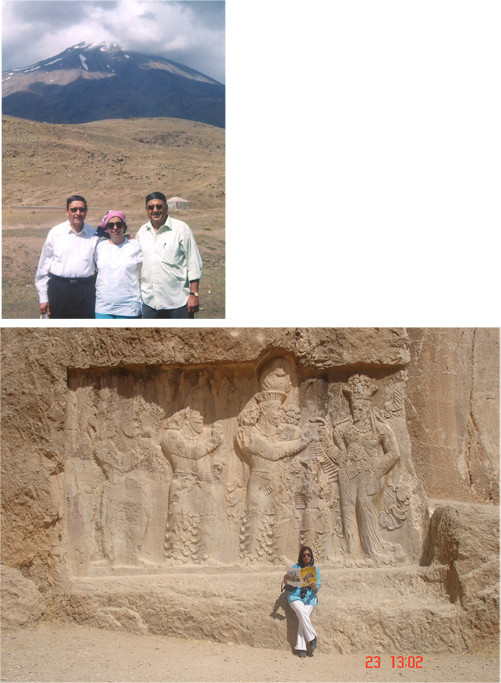
Top: Mount Demavand Above: Naqsh i Rustam, Pasargade
Testimony of an intrinsically ethical way of life that prevailed under the three great kings of the ancient Persian empire – Cyrus the Great who conquered Babylon without shedding a drop of blood, set free the Jews from captivity and authored the world’s first Declaration of Human Rights; Darius the Great, renowned for his sense of justice and administrative foresight and during whose reign women were treated equal, paid equal and granted three months’ maternity leave; and Xerxes the Great who continued his forefathers’ good work.
Come sundown and the hills reverberate to a sound and light show designed to re-create the magnitude of mindless desecration let loose by Alexander (the accursed) of Macedonia, guaranteed to shock and awe — even in Persian. Particularly warming to the cockles of the Parsi hearts in the audience are the numerous allusions to the Great God Ahura Mazda (while the jury is still out as to whether or not the Achemenian kings were Zarthoshtis, it is clear that they were true Mazdayasnis).
From then on, it is one long bus journey after another (average 10 hours a day) punctuated by innumerable pee halts – causing a wag to dub the trip as the Washroom Tour of Iran! An exhausting sojourn, made bearable only by the steady stream of jokes (no pun intended), imitations and repartee churned out by 56 noisy Parsis all on the wrong side of 56. My favorite (which is the most popular bra in Iran? The nuclear bra — just two strings and 95 percent fallout!)
See Pasargade – and some fabulous bas reliefs outside the tombs of Darius and Xerxes. In particular, Shapur II’s conquest of the Roman emperor Valerian is a treat. We are assured that the new dam will not impact these historical world heritage sites. On to Yazd known for its mud houses where there are still many remaining Zarthoshtis. Visit an atash behram which houses the fire from heaven which has been burning continuously for the last 16 centuries. Visit a sacred cypress tree said to be some 4,000 years old and visited by Zoroaster himself. Encircle it and say a group prayer. On to Esfahan to see half the world — because seeing Esfahan is as good as seeing half the world. A city dotted with gardens and blue mosques, their walls and domes decorated with exquisite inlaid tiles and carpets. Then, Hamadan (historically Ekbatana), where we paddle boat across the world’s largest underwater lake in the Ali Sadr caves. Finally, Ramsar, a lakeside resort on the Caspian Sea (renowned for its caviar) followed by an enthralling drive through the magnificent Alborz or Elburz mountains back to Tehran.
Food consists of a near daily diet of chelo kabab — dry rice and drier kababs (no spice, no oil, no gravy, no nothing). Despite this, we eat voraciously and all the time. Right down to the chelo — or last kabab, for our Parsi-Gujarati challenged readers. As if to make up for the lack of culinary imagination, the Iranian people are extra warm, loving, friendly and trusting. The women are perfectly proportioned under their black tunics and trousers, with peachy, glowing complexions, eyes that are dark inviting pools in which most men could happily drown.
And to round off the account of our travels, here’s part of a poem by Olivia Sharifi, titled Save the Caspian Sea – quoted here as it captures the charm of an era long gone by:
"I am the ancient Mare Caspium,
The pride and livelihood of the ancient Empires of the Persia, Russia
and the Byzantine
My coast, a heaven of fertile and
untouched forest land
I was the throne of the Silk Road from
Tauris to Samarkhand
From Marragha to Hyrcania
I hosted travelers from Mesopotamia
to China,
I was in the crossroads of the ancient
Metropolitan Empire
Where the sea-faring Marco Polo
came to admire
Where beautiful village women
danced with their colorful attire
Where great warriors came to fight,
where merchants came to acquire
Silk, cloth and turquoise
I was defended by the Great walls of
Alborz and Mount Demavand
My heritage can be still found at the Tomb tower of Lajim in Mazandarn
Alongside my shores the Zoroastrians
lived in harmony and peace
Where the rich Persian culture and
literature refused to cease.”
◆ ◆ ◆
From the archive