
Comment
Harvesting the rain
The Centre for Environmental Research and Education is holding two workshops to encourage Parsis to harvest rainwater
"Fresh water cannot be manufactured on a large scale so our only source is rainwater and therefore, we need to seriously start acquiring the skills required to harvest rainwater,” reasons Dr Rashneh N. Pardiwala, director and founder of the Centre for Environmental Research and Education (CERE), a Bombay-based non-profit organization that works towards improving the urban environment by promoting environmentally-sustainable lifestyles. Pardiwala adds, "We let all the fresh rainwater merely run into the sea and are unable to collect it for the dry summer months. We need more storage and collection facilities all over the city to collect the rainwater so as to meet growing water demands, recharge old wells, increase the groundwater table, improve the environment and that precisely is what rainwater harvesting (RWH) is all about.”
Rainwater is the purest form of water available on earth. The practice of harvesting rainwater, where rain that falls on rooftops and terraces during the monsoon season is stored in tanks or is channelled into the ground to recharge the water table, is a proven, simple, economic and sustainable means of meeting household demands for water. An indigenous Indian custom that has been long forgotten in many places, the practice has now successfully gained momentum in other Indian cities such as New Delhi, Hyderabad and Madras but it is yet to take off in Bombay as the city hasn’t faced a drought in the recent past. However, the problem of increasing water scarcity needs to be urgently addressed.
CERE has embarked on a long-term project that aims to introduce, promote and help install RWH systems amongst the Zoroastrian community in Bombay so as to improve the living conditions and urban environment of the city. In April 2006, CERE helped further the efforts of rainwater harvesting at Malcolm Baug in Jogeshwari. Malcolm Baug had previously incorporated RWH into their water management regime by digging bore wells and channelizing the rooftop rainwater to percolation pits. Under the new project, jointly executed by CERE and the Malcolm Baug Zoroastrian Association, a large open well near the adaran that lay in a poor condition was fully cleaned, repaired and restored so as to serve as a large receptor for rainwater which could then be pumped to a 4,000-liter storage water tank fitted on a plinth so as to supply water for gardening and washing purposes to five south-side buildings in Malcolm Baug. The entire project was completed in a short period of four months from April to August 2006 and today the system has already started harvesting rainwater, thereby greatly reducing dependence on costly municipal water. "RWH makes complete financial sense as well and that’s why a number of business houses such as the L&T factory in Powai have adopted RWH,” states CERE co-founder Kitayun Rustom.
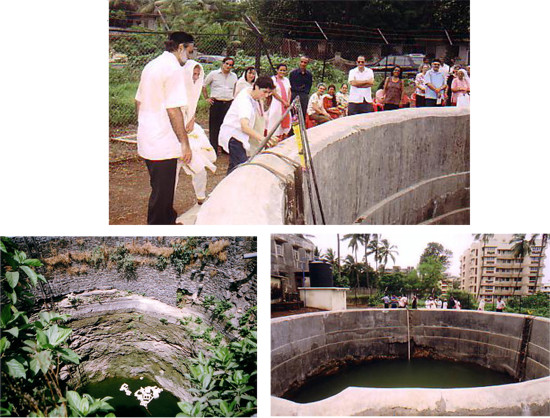
Alongside: Pardiwala inaugurating the RWH project. Below (left): The inside view of the well showing dirty water and over grown vegetation and (right) the restored well with a 4,000-liter storage tank
"Another excellent example among the Parsi community is Mhow where in 1997, Phiroze Illava commenced a RHW project for the Parsi agiary, dharamshala and adjoining residential complex and the Tower of Silence. The harvested rainwater is used to recharge underground aquifers and two open wells, one being the agiary well and another on the residential complex premises. Ever since the RWH systems have been installed both wells do not dry up during summer and have a perennial supply of water. Illava, as president of the Lions Club of Mhow, has worked closely with the Indian Army stationed in Mhow to promote RWH practices around the main lake supplying water to the town. Today residents of both Malcolm Baug and Mhow are reaping the benefits of RWH and these are success stories that need to be emulated,” emphasizes Pardiwala.
Rainwater is a precious natural resource that needs to be tapped, utilized and judiciously managed but few communities are taking the proactive steps needed to harness a rich resource so freely and abundantly available, especially in a country like India that is blessed with a long monsoon season.
Bombay receives an average rainfall of 110 inches in the course of four months from mid June to early October with all the major freshwater lakes quickly overflowing. But come February, the Municipal Corporation of Bombay starts introducing water cuts in a number of localities and by the onset of summer, most residential areas are dependent on water tankers to augment their dwindling municipal water supply. The Municipal Corporation has the capacity to supply only 2,900 million liters a day (MLD) while the overall demand of an ever-growing city is 3,400 MLD. This difference of 500 MLD is expected to rise to an alarming 2,045 MLD by the year 2021.
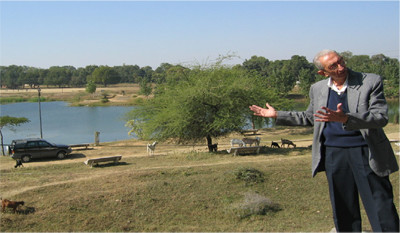
Illava explaining the project undertaken at the main lake in Mhow
CERE, established in 2002 by Pardiwala and Rustom, focuses on promoting environmental sustainability through educational and awareness programs. Pardiwala is a young ecologist having gained her doctorate from the University of Edinburgh, UK and founded CERE upon her return to India. Rustom is an environmental activist having worked in the field for almost two decades. CERE has conducted many research projects and environmental education workshops and teacher training programs in schools across India. CERE has also published school readers that convey important environmental and social messages through the mainstream curriculum. More than 36 prominent schools across India are prescribing the books and over 50,000 copies have been sold in three academic years. In 2005, both Pardiwala and Rustom were recognized for their dedication to environmental conservation work and awarded the Ashoka Fellowship.
The next phase of CERE’s project will be to help install a RWH system in rural India and in smaller towns to spread the message as widely as possible. "We wanted one baug to lead the way and demonstrate that RWH was feasible and then showcase that model to encourage other Parsi colonies to follow suit and benefit from RWH. The same knowledge and models could be replicated and applied to community-owned lands in other cities such as Poona, Nagpur, Delhi, Hyderabad and Bangalore as well because all of India faces severe water shortages during summer. Self reliance in water is the key and for that we need to conserve, renew and augment our own water resources,” reasons Rustom.
CERE has organized two free short seminars on RWH for the benefit of the entire community. The seminars will be held from 10 a.m.-12.30 p.m. on October 7-8, 2006 at Malcolm Baug (Jogeshwari) and Tata Colony Hall (Tardeo) respectively. All are welcome. Pardiwala’s dream "is to see every Parsi property and land owner in India harvesting rain water for the benefit of themselves and nature.”
Precautions for harvesting rainwater on terraced buildings
Not to store any polluting substance such as cement, réti (sand), bricks, food articles, or things that could rust, on the terrace.
Have the terrace/roof thoroughly cleaned occasionally, and especially just before the rains start (say in early June).
Allow the rain water from the first two showers to drain away and not enter the recharging system, to prevent polluting the underground water system, with muck that could have accumulated in the pipeline during the year.
After the first two showers, connect the drainage pipe to the charging system, and you have an automatic recharging system that would work for you for the rest of the monsoon months.
Phiroze B. Illava
◆ ◆ ◆
From the archive