
Religion
Four agiaries and an atash behram
A tour of Iran evokes nostalgia and wonderment
A wave of excitement gripped the group of 55 Parsis as our flight was announced and we were ushered to the aircraft. The noise level from the Zoroastrians rose by a couple of decibels. The few ‘mullas’ and clerics boarding the flight gave us disapproving looks. The younger Iranian boys and girls, mostly students in Bombay and Poona, eyed our motley crowd with amusement. The older women made efforts at conversation. They were delighted that we were visiting Iran, welcomed us on behalf of their country and wished us a happy stay in halting English, interspersed with khoob and khairat.
Five hours later, we made a graceful landing at Meherabad International Airport, Tehran. From our older neighbors in India, I had heard stories of how they had touched their foreheads to the earth of our matru vatan (motherland) on reaching Iranian soil. Not that I was about to do it but there was no mother-earth to be seen on alighting. It was all concrete, marble and mosaic.
The drive from Meherabad (abode of light) airport into Tehran city was a revelation and a delight. Such cleanliness, greenery and beauty amid bustling high-rises, mosque minarets and copper-clad spires, took our breath away. The beauty of Tehran is further enhanced by the snow-capped Elburz mountains to the north of the city.
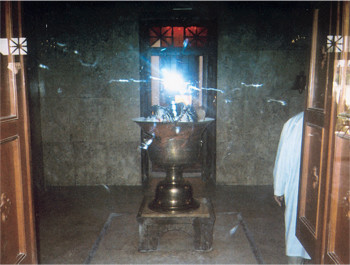
Atash at the Yazd atash behram as seen from behind a glass screen
It is early evening in late spring, the weather neither hot nor cold, the sky a cloudless blue. Someone points out of the window of the moving bus and excitedly shouts "Mt Damavand!” It is indeed the famed peak we had seen from the plane but which, we were told, is rarely visible from Tehran because it is always shrouded in low clouds and haze. A veteran in our group said, "In the 11 times that I have come to Iran in as many years, this is the first time I have seen the sacred Mt Damavand from the streets of Tehran.” The rest of us were silenced in awe; an auspicious start to our pilgrimage of Iran.
We reached our hotel, the Tehran Grand on a broad tree lined avenue in a well heeled part of town. The ubiquitous Achemenian guards and winged bulls of Persepolis adorn the entrance to a plush lobby and friendly reception desk.
The urban Zarthostis of Tehran appear to be more affluent than their counterparts elsewhere. In Tehran there is a big housing complex called Rustam Baug where many of them live. Around Yazd and Shiraz there are villages like Cham, Sharifabad and Zainabad which are almost exclusively Zoroastrian. The people here grow pistachios, pomegranates and other fruit. They are simple, trusting and honorable people, whose given word is said to carry more weight than a written document.
The official figure for the number of Zoroastrians in Iran is given as 90,000. However, community leaders put the figure of practicing Zoroastrians at a more modest 30,000. The majority of these reside in the cities of Tehran, Yazd, Shiraz and Esfahan.
There is one Zoroastrian representative in the Iranian Majlis (House of Parliament) and there is no overt persecution of the community now. To the credit of the Iranian government, we saw many historical and archeological sites and inscriptions pertaining to the religion being preserved and restored. Of course the history of the Peshdadian, Kayanian, Achemenian and Sassanian dynasties is the history of ancient Iran, just as much as it is the history of the Zoroastrian religion.
The first agiary that we visit in Iran is the dadgah of Bhikha Behram in Tehran. It was built by the same person after whom the Bhikha Behram kua (well) in Bombay is named.
On entering, I am impressed by two things. The plush interior and more significantly, the number of local Zarthostis who had come there to pray. Certainly far more than I have ever seen in our Nagpur Agiary on a normal day. I was told that many of them do not wear a sudreh-kusti at all times. They wear these vestments only when visiting the fire temple. White, cotton caps (like those worn by our nassessalars) are available at the entrance of the agiary, for those who need them.
"Athra Ahura Mazdao Putra means fire, the son of God. You are in His presence when you enter an agiary,” we were told by our group leader. "Behave with dignity and decorum and refrain from taking any pictures.” We offer sukhad at the kebla (sanctum sanctorum) and leave rials by the ten thousand (10,000 rials translate to about Rs 60) for the keepers of the flame.
It is early evening and the Irani Zarthosti community, in groups of twos and threes come to the Bhikha Behram dadgah to pray and to socialize. They recognize us as coming from India and are happy to meet with us. There is much hugging and kissing and conversations limited to mostly "You Zarthosti?” "Me Zarthosti!”
Behind the agiary there is a big hall used for gahambars and get-togethers. From the utensils, chairs and other equipment seen, I gather it must be put to frequent use.
Shiraz in the province of Fars in southern Iran is known for its wine, its roses and its poets. Hafiz and Sadi, Persian poets of yore are buried here. Their tombs, set in beautiful rose gardens draw crowds of lovers and visitors. Of Shiraz it is said, "A heart finds its peace, a lover its beloved, a dreamer his dream.” Hafiz’s poetry is greatly influenced by Zoroastrian philosophy.
The agiary in Shiraz is on a busy commercial street right opposite the Hotel Eram where we were staying. The entrance to the agiary has a flight of three short steps leading to a steel door that is barred and bolted. Pressing an electronic bell releases the lock. Deceptively small from the outside, the door opens on to a large area that has Pezersihgah (Zoroastrian rest house), manager’s home, hall, library and a dadgah. There are few ordained priests in Iran. Most agiaries like this one are looked after by a mobedyar. An unusual sight was an afargan under a tree a few feet away from the dadgah. If a non-Zarthosti enters, he could pay obeisance at this altar.
Esfahan was the most beautiful city that we visited in Iran. It is situated on the banks of the river Zayandeh Rud. Wide, landscaped gardens with flowers, trees and lawn, fountains and sculpture, run along both banks of the river for miles. Old arched bridges lined with popular tea-houses span the river at intervals. On colorful carpets and comfortable cushions, locals and tourists sit and have chai (tea) and smoke a hookah, while looking at the lazy river below. The turquoise domes and elegant minarets of its many mosques add to the splendor of Esfahan.
Esfahan is also fondly referred to as nesf-e-jehan (half the world). I agree with whoever said that!
A new agiary, built in 1978 caters to the religious needs of the 150 to 200 Esfahan Zoroastrians. Two huge winged bulls with human heads guard the entrance to the fire temple. Folding wooden doors open into a tasteful interior. The atash is shielded by a glass door.
The visitor’s book inside the agiary has entries from people around the world — Christians, Hindus and Moslems. All the comments are appreciative of the agiary, the Zoroastrian faith and the opportunity to be in such holy and tranquil surroundings.
A sampling of what people wrote:
"Thank you for the wonderful message of good thoughts, good speech, and good actions. May there be peace in the world” — Lily Yeh from Philadelphia.
"Thank you for your welcome to us. We enjoyed your illuminating message and your kind response to our questions” — Katherine Fulherson, Kentucky, USA.
"I come from Bombay. There we are not permitted to enter a fire temple. Many thanks for permitting me to enter and have holy vision of divine fire” — R. N. Shet.
Can such respect really desecrate our places of worship? Or do they add to the piety of the place? I wondered.
Esfahan is famous for its shireen (sweet) gaz, a delightful combination of nougat and pistachios. A visit to the Maidan Shah or Quaisariyeh Bazar, a huge covered arcade around a big square is a must. Here you can bargain for and buy carpets, turquoise, both real and fake, gaz, beaten silver, copper and brass trays and artifacts and intricate mosaic tile work in shades of blue.
Rae, one of the most historic places in Tehran province, now sadly swallowed up by the urban sprawl of Tehran, has great significance for Zoroastrians. It is believed by some scholars to be the birthplace of Zarathushtra. I clearly remember my grandmother teaching us the song "Hasto janamyo ek mahatab, Rae naam na gaam ma,/Manashni, gavashni, kunashni, jhenu hatu farman.”
(A smiling prophet was born this day, in the hamlet of Rae./Good thoughts, good words, good deeds, was his message for mankind to heed.)
Situated some eight km south-east of Tehran, it was an important city from 5000 BC to 1200 AD but was destroyed by Genghis Khan in 1221.
Though Rae has almost merged into the capital city of Tehran one can still see the ruins of an ancient Sassanian fire temple believed to have been built in 600 AD by King Khushroo Pervaze at a historic site called ‘Mill Tapeh’ (tapeh means mound).
Buried under centuries of soil, this ancient fire temple is being carefully excavated by the Iranian Government’s Archeological Department for the past 23 years. So far only the top level has been excavated which reveals a huge platform on which stands an equally massive taq (arch). They expect to unearth two more levels. Such a large atash kadeh (fire altar) suggests a sizable Zoroastrian population in this region 1,500 years ago.
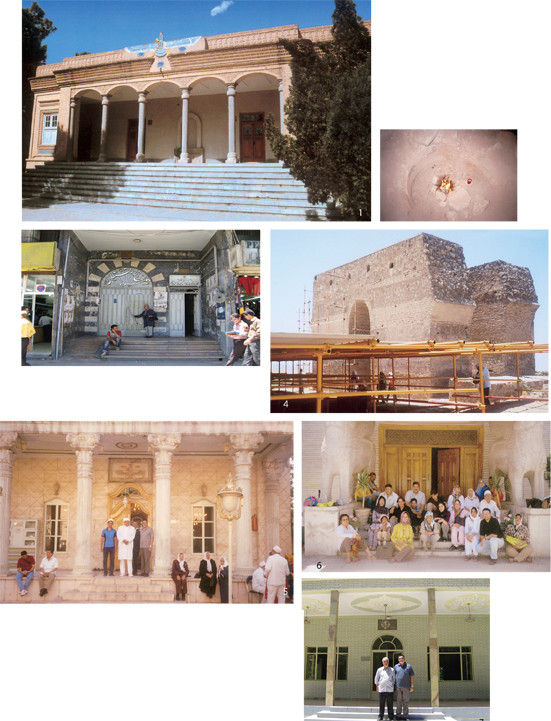
1) Atash behram in Yazd
2) Fire that was lit in Rae
3) Street entrance to agiary in Shiraz
4) The excavated atash kadeh at Rae
5) The Bhikha Behram Agiary in Tehran
6) Entrance to the Isfahan Agiary
7) On the steps of the agiary in Shiraz
The leader of our group hesitatingly made an appeal to the archeologists to let us light a small fire in this historic and holy place and pray before it. The men hesitated, conferred and finally seeing the intensity of our desire, permitted us our request.
The priests amongst us arranged the sukhad that came tumbling out of bags and backpacks. With one strike of the matchstick the atash leapt up! We stood around in a circle, Iranian officers with heads bowed included and prayed the Atash Nyaish.
We were overwhelmed by a sense of having trodden the same path, said the same prayers, lived by the same values and had the same hopes and aspirations as our ancestors. We were joined in spirit to our past and we rejoiced in our heritage.
A small museum near the site at Mill Tapeh has a wealth of unearthed artifacts such as pottery, cups, jugs and carved cornices. The fish motif is prominent. Perhaps the reverence for water has given the fish an important place in our religion and customs such as saré dahré, machhi na chowk né dhan-dar taréli machhi (on auspicious occasions one must put fish designs outside the house and have fried fish) for lunch! A big fish made of stucco (a fine plaster) is seen in the museum. Large ceramic urns were excavated containing barley, wheat and silver Sassanian coins, donations probably made by the faithful.
The city of Yazd and the villages around it were a Zoroastrian stronghold at one time. Till as late as the 19th century there was a sizable population of Zoroastrians. Thereafter, persecution forced many to flee. They dispersed to USA, Europe and India. In spite of this, the largest population of Zoroastrians in Iran is still in Yazd.
There are two Towers of Silence in Yazd. The Towers were constructed long ago according to strict ritual observance. There is a water cistern and a room for mourners and an area where the body would be cleansed and dressed before being carried up to the platform. The dakhmas are no longer in use. By the law of the land, the dead are now buried.
In the past both the Zoroastrian royalty and commoners suffered from religious persecution. Yazdegird Sheriar (the last Zoroastrian King after whom we count the Yazdegirdi year), his queen and his daughters died while fleeing from the Arabs. To save her honor the Queen jumped into a well. The daughters prayed to the mountains to swallow them, rather than see them captured. Shrines called ‘pirs’ mark these holy spots.
Yazd has the only atash behram outside of India. It is located off Ayatollah Kashani Street on a hill surrounded by a garden. The sacred flame in this atash kadeh is believed to have been burning since 470 AD at Nahid-e-Pars. From there it was moved to Ardakan and then to Yazd. Maneckji Limji Hataria, a Zoroastrian from India helped garner donations to build the atash kadeh in Yazd in 1870. The present building housing the holy fire was built by donations from the Petit family. It was inaugurated by Arbab Rustam Guiv, the Iranian philanthropist in 1944. The atash kadeh is set in a sprawling garden with evergreen trees. A large pool in the front courtyard reflects the image of the temple.
I was surprised to see dozens of European and Iranian tourists and tour guides entering. Our Zoroastrian group was led through a side entrance to the back door, which led to the main hall of the atash behram. It was a resplendent room, rich with carpets, chandeliers and French style sofas and settees. Handsome brass grills allow worshippers to see and pay homage to the holy fire. Sukhad and rials given by the faithful, pile up at the window. Here again, a large number of local Zarthostis are deep in prayer.
The atash kadeh in Yazd, like agiaries and dadgahs throughout Iran, is open to the public. Anyone who wishes to enter, be it from curiosity or faith can do so. There is no entrance fee but donations are welcome. The sacred fire can be seen by the general public from behind a glass screen. A group of European tourists listen in rapt attention as their guide, in broken English, explains how the Zoroastrians disposed of their dead before the government put a stop to the practice. The fire temple has been "turned into a museum; not an atash behram,” muttered an irate leader of our group.
Second instalment will be carried in the next issue.
◆ ◆ ◆
From the archive