
Zoroastrians Abroad
Unwalla's HIV therapy
A novel gene therapy to prevent HIV infection has been innovated in Dr John Rossi’s laboratory in Los Angeles and the young molecular biology postdoctoral fellow behind it is Hoshang Unwalla, notes Darin Joy in an article in Hope News (March 27, 2006), the newsletter of the City of Hope Cancer Center. The publication was forwarded to Parsiana by well-wisher Adi Jehangir.
"When infecting a cell, HIV inserts its DNA into the host cell’s chromosomes and hijacks the cell, forcing it to create more of the virus,” explains Joy. Unwalla’s technique is designed to move one step back in the process and prevent the virus’ DNA from invading the cell’s normal DNA "by taking advantage of a naturally occurring cascade of events” that are triggered when the virus contacts the cell.
An earlier technique known as RNA interference had been used to block the virus but by then the virus had entered the cell and incorporated itself into the human DNA. Unwalla’s discovery has led to a system that comes into effect before the host is attacked.
Taking advantage of this phenomenon in the early stages of infection — HIV sets off a number of signals that eventually lead to activation of the Cox-2 gene – Unwalla coaxed the Cox-2 gene promoter to produce small interfering RNA molecules (siRNAs) in response to these signals. The result is that these siRNAs prevent HIV from inserting itself in human DNA, thus cutting off the infection before it takes hold. Moreover, the technique regulates the production of siRNAs, generating them only when protection is needed. "This limits off-target effects and reduces the risk of unexpected, adverse consequences,” Unwalla told Joy.
Rossi, who is mentoring Unwalla, spoke to the reporter of the immense potential of gene therapy to improve treatment options for a variety of diseases including viral infections and some cancers.
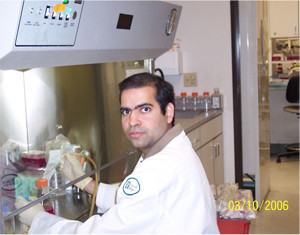
Unwalla: research technique
A US patent application for the process is pending, according to Unwalla’s bio data. The team of researchers is about a year to a year-and-a-half away from beginning the first phase of the clinical trials process for a non-switching version of the therapy, Rossi was quoted by Kimm Groshong in Pasadena Star News (December 2004). A peer-reviewed article of his was published in the prestigious Nature Biotechnology (2004#22); a second one is said to be under process. Umpteen other articles of his — some as member of a team — have been published since 1998, five papers being in internationally recognized scientific journals. In the past few years he has also been a participant in national and international conferences on themes related to HIV/AIDS, the DNA and sexually transmitted diseases, his bio data further informs us.
The American Foundation for AIDS Research (amfAR) has recognized the potential of Unwalla’s research and awarded him a prestigious two-year fellowship — only one of four offered worldwide by the Foundation, writes Joy. A non-profit organization dedicated to the support of HIV/AIDS research, prevention, treatment and the advocacy of a sound AIDS-related public policy, amfAR has invested more than $ 233 million in support of its mission since 1985 and funded grants to more than 2,000 research teams around the world, notes Joy.
The only child of Zarine and Jehangir Unwalla, Hoshang completed his schooling from the J. N. Petit Institute in Poona. After graduating in science from Bombay’s Elphinstone College and getting his master’s degree from Baroda’s M. S. University, Unwalla acquired his doctorate from Delhi’s National Institute of Immunology. Zarine recalls that her son, always a very bright student, was never a sports enthusiast but enjoyed music, joining the school choir.
Hoshang is married to Khushnuma (née Dehnugara) who used to work with airlines and travel agencies when she was in India. However in California she took up a career as a senior secretary for three senior professor scientists who are experts in their own respective fields and, most conveniently, works in the same institute and in the same building as Hoshang does.
In response to a Parsiana query Unwalla writes, "I actually love my work. It gives me an amazing amount of freedom to try out new ideas for my research. It also gives me the ability to be independent and grow. I guess I am one of those lucky ones who gets to do what he wants to do and gets paid for it. Of course, it comes with pros and cons. There are times of success and great achievements and there are times when hypotheses fail. It’s all in the game. Besides that I love hiking and trekking, visiting remote areas where there is peace. Although I haven’t done that ever since I got married. Reading too is one of my hobbies.
"My ambition in life is to work hard towards my goal, to be a successful, well-established independent scientist, have my own lab where I could (seek) to find the cure of life-threatening diseases. I’m also a proud priest (navar) of the Zoroastrian religion and am community-oriented, religious and a god-fearing person. I’m a simple person with a simple life. My wife likes to joke that I am a ‘boy with few needs.’”
Grateful to God and his parents whom Unwalla describes as "wonderful people who have supported me and always encouraged me, stood by me in times of success and failures” and to Khushnuma who "helped me overcome my loneliness in the US,” Unwalla has a special acknowledgement for the J. N. Petit Institute from where he began his career and for all his well-wishers, especially Adi Jehangir, who have touched his life in different ways.
◆ ◆ ◆
From the archive