
Books
Glorifying the gara
Peonies and Pagodas: Embroidered Parsi Textiles/Tapi Collection edited by Shilpa Shah and Tulsi Vatsal. Published in 2010 by Garden Silk Mills Limited, Sahara Gate, Surat 395010. Pp: 196. Price: Not mentioned.
These yarns bespeak heritage. The stitches in time, the knots of posterity have all been threaded together to create a masterpiece in print. The editors of this work have succeeded in raising awareness of the elaborate embroidery on garas, kors, ijars and topis through knowledge shared by historians, scholars, artists and curators.
"The book Peonies and Pagodas: Embroidered Parsi Textiles/Tapi Collection covers not only the rich embroidered textiles of the Parsis but systematically tells the story of the development of the gara, placing Parsi embroidered textiles in the wider context of Chinese export embroideries. It discusses Indian designs and the origins of certain early Parsi textiles. It also relates interesting oral accounts of how different Parsi families learnt about and came to acquire garas,” writes art collector Pheroza Godrej in her foreword. She further acknowledges the unparalleled efforts of Praful and Shilpa Shah of Garden Silk Mills who founded the Tapi Collection in a bid to methodically "conserve and preserve our textile heritage.”
"As a Bombayite, it was impossible not to be struck by those sepia-tinted faces of mamaijis in shimmering silk and kors or cherubic boys and girls in jhablas and topis staring out of silver frames delicately perched on grand pianos… whenever we visited our Parsi friends’ homes… Those childhood memories, at some stage in the seventies and eighties, turned into an interest in collecting these wonderful embroidered Parsi textiles,” conveyed Shilpa Shah to Parsiana.
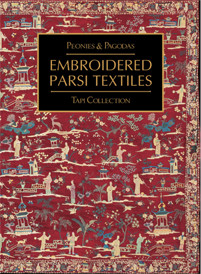
From the third quarter of the 19th century, a gara was considered "the most distinctive item of Parsi women’s clothing,” according to the editors Shilpa Shah and Tulsi Vatsal. Chinese style embroidery was further used to embellish other garments like jhablas and ijars recommended when sitting astride a horse. "Worn initially by upper class Parsi ladies, over time the demand for these embroidered garments spread to other layers of Parsi society… Significantly the Chinese inspired embroidered textiles, whether made in China or India, were until recently worn exclusively by the Parsi community, hence they are referred to as ‘Parsi’ embroidery,” notes the introduction by the editors both of whom were products of Parsi schools. While Shah has been a Bombay based advertising professional for the past 25 years, Vatsal has authored several text books.
Even in the early days ‘Parsi’ embroidery was expensive, with a kor costing around "HK $ 15-16… when a servant’s salary was two dollars a month,” notes Dr Shernaz Cama, director of the UNESCO PARZOR Project for the Preservation and Promotion of Parsi Zoroastrian Culture and Heritage in her piece on "The Embroidery Cupboard: Oral Accounts of Parsi Embroidery.” Garas were sold on weight with the heavier, richly embroidered saris commanding a higher price. The most expensive among the embroidered items was "gold couching or the Parsi daria ni sari made to order only for the rich patrons of the Parsi trade. Parsi women preferred white and cream embroidery rather than typical Chinese multicolored embroidery because it matched the white lace sudrehs every woman wore,” reveals Cama.
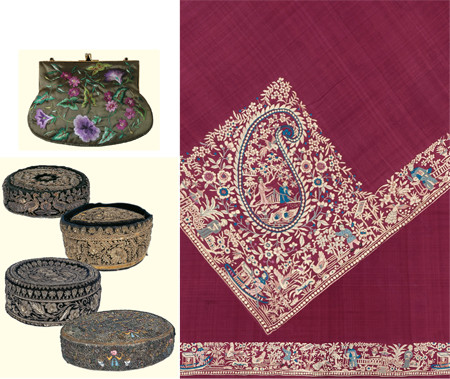
Right: Late 19th or early 20th century Chinese kor pallav no garo left: Embroidered purse and zari embroidered topis on velvet
To cut costs sometimes the embroidery work was done indigenously by local craftsmen with imported silk yarn. Twisted, two-ply silk thread was most commonly used in working satin stitches while untwisted multi-end silk floss was the choice of thread for knotted stitches. Old timers from Bharuch and other towns of Gujarat have memories of "Chinese pheriawallas… in a white tunic, white trousers and small black skull-cap” making weekly visits, first on foot and later on bicycles, to sell their wares carried in cane baskets.
To their surprise, the editors were not able to ascertain when and where garas were first made, commissioned and procured. Neither were they able to determine how the Parsis took a fancy to Chinese embroidery. "Was it entirely a byproduct of the lucrative China trade in cotton and opium that Parsi merchants had successfully established in collaboration with English East India Company? Or was it rather the influence of the ‘oriental’ craze that swept through Britain and Europe from about 1870…?” enquire the editors.
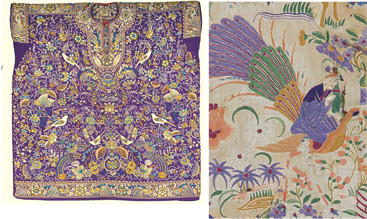
Left: Late 19th century Chinese chakli nu jhablu executed in knot stitch; right: Late 19th century embroidery with polychrome twisted silk thread
The compilation includes 15 articles of which four are jointly or singly penned by the editors: "Patterning a Gara” has been written conjointly by Shah and Vatsal; "The Gara today: An Heirloom Reinvented” by Shah; "Looking West, Buying East” and "The China Connection” by Vatsal wherein she mentions, "Parsi merchants had the reputation of being shrewd businessmen and exacting moneylenders, and were known to have driven a number of Chinese merchants into bankruptcy.” Additionally there are three articles authored by design professional Priya Mani-Venkatraman: "Parsi Attire: Garas, Jhablas and Ijars;” "Sari Borders: Kors;” and "Methods and Stitches.”
Since this book is a showcase for the Tapi Collection, Jasleen Dhamija has introduced "Aspects of Assimilation: The Indian Group of Parsi Textiles in the Tapi Collection.” There are other non-Parsi scholars who have contributed to this work: Madhavi Thampi who teaches Chinese history at the Delhi University’s Department of East Asian Studies has written a feature on "Chinese Communities in India” and Yueh-Siang Chang, research curator at the Victoria and Albert Museum, presented "Exporting the Exotic: Embroidered Silks of China.”
Insights from community members too have made this book memorable: There is an article on "The Parsis in India” by Dr Zenobia Dumasia whose doctoral thesis was on the "Contribution of Parsis to the Development of Education and Social Change in Bombay City, 1820-1920.” Offering a perspective on "Parsi Dress and Identity: Clothing in Transition” is Jesse S. Palsetia, associate professor of history at the University of Guelph, Canada.
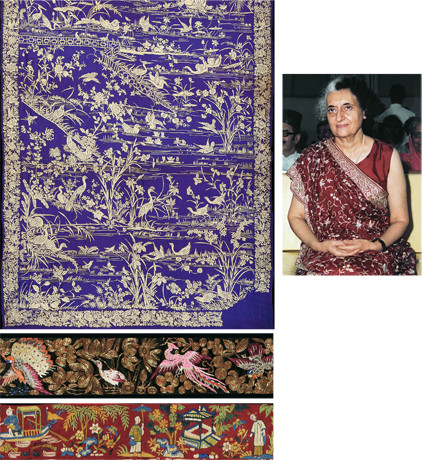
Left (top): Fully embroidered late 19th century Chinese garo; (center) border pattern of birds in metallic gold filler ornament; (bottom) sari border depicting boatman, gardener and kiosk; right: Indira Gandhi wearing chakla-chakli no garo
A layperson not interested in the treatises on the community or embroidery would derive maximum satisfaction from gazing at pages 41-97 as also 130-161 of the book which present visuals of different fascinating exhibits from the Tapi Collection, accompanied by an incisive and brief narrative on each specimen. Accommodated here is an article on "Parsi Headgear: Topis” by the former director of the National Institute of Fashion Design Villoo Mirza referring to the ancient custom of keeping the head covered at all times to protect the halo as also to prevent the evil spirit from entering the skull.
"A quixotic phalanx of human, animal, bird, floral and architectural elements come together to create this extravaganza of Chinese export embroidery,” states the book. While some Chinese symbols illustrate legends and myths of the past others convey "the ideals of Confucianism, Daoism and Buddhism — the three major religious and philosophical systems of China,” explains Aban Mukherji, a freelance writer and translator, in "Decorative Motifs and Bird Symbolism in Parsi Embroidery.” Traditional Chinese motifs had many meanings e.g. the plum, peony, lotus and chrysanthemum, when presented together symbolized winter, spring, summer and autumn.
To depict a coherent symbol set, certain motifs had to be seen together. When the spotted deer was seen next to an eight-spoke wheel it symbolized Buddha’s first sermon at the Deer Park at Sarnath. If the deer were seen with a pine tree and a crane, it represented longevity. Spotted deer were considered particularly auspicious for they were believed to have the faculty to locate the fungus of immortality, elaborates Mukherji.
Pagodas were often seen in the background as also wealthy men being pulled in hand-drawn rickshaws. It is believed that in the early 20th century, one in six adult males was a rickshaw puller in China. A sari depicting motifs of figurative Chinese characters was called cheena-cheeni no garo. Dots in a lozenge grid were kanda-papeta no garo, a pinwheel motif was the karolia (spider) garo.
Goldfish in pairs were a popular symbol of fertility and fecundity, a sign of prosperity. Goldfish depicted eating algae were considered particularly auspicious. Ribbons and sashes in Chinese decorative art are clues for auspicious messages, reinforcing the miraculous properties of the objects they embellish.
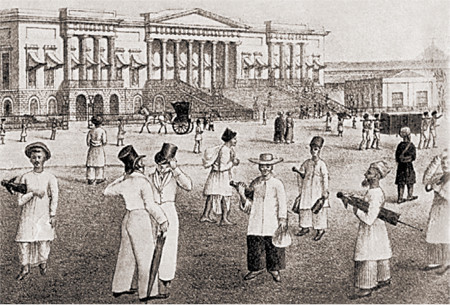
1883 lithograph depicting men of different communities in front of Town Hall, Bombay
The fascination with winged creatures was very prevalent. Pairs of birds atop branches were chakla-chakli no garo. As explained in the book, "The Chinese word xi meaning happiness is a homonym for the magpie hence this bird motif is symbolic of happiness. In Chinese art, a pair of birds of similar size and type shown on a branch together generally represent a male and a female signifying a happy union.” A rooster, hen and flock was commonly referred to as a margha-marghi no garo. The popular rooster is perceived as the harbinger of dawn, the presager of hope, benevolence and faithfulness.
Pheasants could be recognized by their two long, sword-like barred, tail feathers. Admired for their beauty and dignity they represented good fortune and literary refinement. When standing on a rock, gazing at the sun, a pheasant symbolized imperial power. The mythical phoenix was believed to appear only during the rule of the righteous emperors and in times of peace. The phoenix evolved from the Iranian simurgh with the head of a dog, paws of a lion, body of a dragon and the tail of a peacock. Peacocks in Chinese art represented wealth, status and power although some Parsis associate it with ill omen. A peacock with its tail fanned out suggested that more magnificence is due to come.
"It was in the Tang and Song dynasties (618-1279 AD) that the Persian love of nature mingled with the skill of the embroidery schools of China across the Silk Route,” reported Cama. Some of the khakhas (tracing paper patterns; not to be confused with the khakho or knot stitch) preserved over the years bore handwritten details of the color preferences, date and name of the person for whom the design had been created. Such khakhas would find place on the last shelf of the embroidery cupboard known to exist in most Parsi homes around 50 years ago, relates Cama. On other shelves of the cupboard stood Chinese lacquer boxes and wicker baskets plus an array of needlework items.
Until the mid 20th century embroidery was not only a favorite pastime but often a valuable source of income for Parsi housewives who would be engaged in creating decorative furnishing pieces like bedspreads, wall hangings, screens and drapes. Spanish shawls, also called piano shawls, were used as decorative drapes on pianos or as tablecloths. The family trade links with China saw enterprising Parsi women establish all-women Zenana Stores in Hyderabad which supplied saris, embroidered cloth, China ware and other items to the Nizam’s family and the aristocracy of the Deccan before Independence.
Pestonjee Burjorjee Dhabhar was among the big time exporters of embroidered materials from China just as Hormusjee and Sons and Karanjia in Bombay were the principal importers. A ship left for India every month and the gara trade flourished until the outbreak of World War II in 1939, it is recounted in the book.
With the rise of nationalism and the swadeshi movement in which many Parsis participated, the demand for foreign products waned. Growing westernization saw a change in sartorial preferences with Chinese style embroideries giving way to lace and broderie anglaise. French chiffon which showed off a figure was considered a better option to the heavy gara that hid the girth. Wanton cutting of the garas to create dressing gowns and cushion covers or blouses was not uncommon.
The revival of gara art commenced in the 1960s "stemming probably from a stronger feeling of cultural identification with the embroidered fabrics that had played such a key role in defining Parsi identity in the 19th and 20th centuries,” states Mani-Venkatraman. Of late, imaginative embroiderers are creating a modern look for the gara by modifying patterns and embellishing them with Swarovski crystals, sequins and spangles, seed pearls, beads and zari threads to enhance their value. Considered a fashion statement today, garas are now zealously preserved to be passed on to the next generation.
◆ ◆ ◆
From the archive