
In Memoriam
Boyce's Zoroastrian perspective
Died: Nora Elizabeth Mary Boyce (85), professor emeritus of Iranian Studies at London University in London on April 4, 2006.
Died: Nora Elizabeth Mary Boyce (85), professor emeritus of Iranian Studies at London University in London on April 4, 2006.
"The role of a great academic is to inspire and instill enthusiasm amongst generations of students. Prof Mary Boyce did this so ably and skillfully for over 60 years of her academic life. Today, many of her past students are reputed professors, at centers of learning all over the world,” wrote Dastur (Dr) Firoze Kotwal in a message read at the condolence meet hosted by the Zoroastrian Trust Funds of Europe (ZTFE).
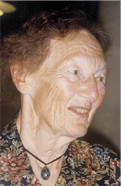
Boyce: stern, demanding and supportive
"Professor Boyce was a great and genuine friend of the Zoroastrian community. It was she who inspired the establishment of a Chair in Zoroastrian Studies at SOAS (School of Oriental and African Studies),” wrote former ZTFE president Dorab Mistry quoting the distressed Mobed Mehraban Zartoshty who has made a large donation to establish the Zartoshty Brothers Chair in Zoroastrianism at SOAS: "She was the most dedicated and distinguished scholar of Zoroastrianism of our times who loved our religion and our community very much. It was a great privilege for me and my brother Faridoon and our family to have known her and to be associated with her in ensuring the teaching of Zoroastrianism at SOAS. She devoted her entire life to the study and teaching of Zoroastrianism and I salute her life and work. We Zoroastrians were truly blessed to have such a committed and scholarly friend. Throughout her long and dedicated years of work, she highlighted to the academic world the true genius of our Prophet Zarathushtra and His unique message. As a scholar and a historian of ancient Iran, her work will occupy pride of place forever. May her soul always bless us from her abode in Garothman Behesht.”
Kotwal had first met Boyce in 1966 after he had completed his PhD in India. "She inspired me to read Pahlavi from a historical and philological perspective and years later, she was instrumental in helping me publish my thesis under the auspices of the Royal Danish Academy of Sciences and Letters in Copenhagen, Denmark. She was interested in writing about traditional beliefs and practices, and so I spent many hours with her translating a number of Gujarati sources to English, for her research and ready reference.”
Kotwal’s comment summarizes Boyce’s fabled commitment to the study of Zoroastrianism, her concern for the work of her juniors and attention to detail.
Boyce’s published works include The Manichaean hymn-cycles in Parthian (1954); The Letter of Tansar (tr. 1968); A Persian Stronghold of Zoroastrianism (1977); A History of Zoroastrianism (3 vols. 1975-91, vol. 3 with Frantz Grenet); and Zoroastrianism, Their Religious Beliefs and Practices (1977, 1984). She delivered the fourth Columbia Lecture Series on Iranian Studies, published as Zoroastrianism, Its Antiquity and Constant Vigour (1992).
A frequent contributor to the Encyclopaedia Iranica and its consulting editor for Iranian religions Boyce taught Iranian Studies at SOAS (1947-1990) simultaneously serving as secretary and treasurer of the Corpus Inscriptionum Iranicarum (1955-1970), member of the Council of the Royal Asiatic Society (1956-1960) and (1965-1968), and member of the editorial board of the journal Asia Major (1962-1976). She was awarded the Burton Memorial Medal of the Royal Asiatic Society in 1972 for her fieldwork with Zoroastrian communities in Iran. In 1975 she was elected an honorary member of the American Oriental Society, and in 1978, a foreign member of the Danish Academy of Sciences and Letters. In 1985 she received the Sir Percy Sykes Memorial Medal of the Royal Society of Asian Affairs, note entries under her name on the Web.
Tributes poured in thick and fast as news of her demise reached the many celebrated scholars who had learnt their techniques under her. Albert de Jong of the University of Lieden who had been working alongside the late Boyce on the fourth volume of her magnum opus — A History of Zoroastrianism — notes in his obituary in The Independent (April 28, 2006), "She traced the early history of the religion, not only by focusing on the earliest texts, but also by reconstructing the ways in which these early texts could have led to later varieties of the religion and how the later traditions could, by reasoned speculation, cast light on obscure points in the early literature. She was one of the main scholars to advocate…an early date for Zarathushtra, the founder of the religion (which has by now been commonly adopted), and she was a pioneer in pressing the importance of the fact that Zoroastrianism had been, for the first half of its 3,000-year existence, an oral tradition.”
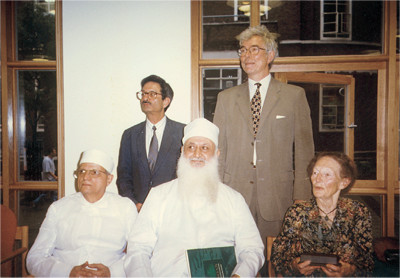
At the founding of the Zartoshty Brothers chair at SOAS in 1997: with Dasturs JamaspAsa and Kotwal, Rusi Dalal and Sir Tim Lankester
"I started my postgraduate studies at SOAS under her supervision within days of her return from Iran; it was exciting to be a student of a scholar beginning to explore new thoughts and rejecting received scholarly thinking,” writes John Hinnells, currently professor of comparative religion at Liverpool Hope University College in The Guardian (April 11, 2006).
"She was the first western scholar to experience Zoroastrian religious life as an ‘insider,’ and this experience proved formative for her interpretation of the religion. This and subsequent encounters with the Iranian Zoroastrians led Mary Boyce to conclude that Zoroastrian beliefs are embodied in their religious practices and that both continue traditions that have been handed down virtually unchanged over more than three millennia,” states The Telegraph (April 28, 2006).
Boyce’s perspective on Zoroastrianism, was transformed by a year of fieldwork among orthodox Zoroastrians in remote villages around the desert city of Yazd in central Iran. Notes Hinnells, "What she discovered there led her to question many scholarly assumptions about the Prophet Zoroaster and his followers. Who, she asked, was best able to interpret the teachings of the Prophet, almost three millennia ago: western scholars in the comfort of their studies, or the practitioners of the religion living in a remote region free from outside influences?
"She contended that in non-literate societies ancient practices are preserved with greater fidelity than are teachings in a literate society. She thereby constructed a picture of the continuity of Zoroastrianism, starting with the priestly tradition into which Zoroaster had been born and trained, and progressing through the millennia, so that the beliefs and practices of modern Iranian Zoroastrians, untainted by western and urbanized living, could be used to interpret ancient texts.”
In A Persian Stronghold of Zoroastrianism Boyce writes of the time she spent in the little village Sharifabad-e Ardekan, at the northernmost end of the Yazdi plain, graciously acknowledging all the kindness and courtesies shown to her, not only by her Zoroastrian hosts but by Moslem ones as well:
"While on leave from the School of Oriental and African Studies, University of London, I spent 12 months in Iran during 1963-64, and most of this time I was able to pass in Sharifabad, thanks to the great kindness and hospitality of Agha Rustam Noshiravan Belivani and his wife Tahmina Khanom. To them and to their children I owe the warmest debt of gratitude. I was shown much helpfulness too by their relatives and friends and by the Zoroastrian villagers at large who received an unexpected stranger in their midst with truly remarkable tolerance and kindness…My first hosts in the city of Yazd were a Moslem family, that of the late Agha Abbas Mohitpour, who not only sheltered me initially (there were no hotels then in Yazd) but showed me thereafter unstinting kindness and friendship, despite my entire preoccupation with Zoroastrian affairs. It is a cause of keen regret to me that it is impossible to write about the Zoroastrians of Yazd without casting the Moslems in the role of villains, just as it is impossible to write an account of Jews in Europe without showing Christians in a hateful light.”
What she learnt firsthand in Iran became the subject of the six lectures she was invited to deliver in 1975 in the Ratanbai Katrak series instituted in Oxford by the late Dr Nanabhai Navroji Katrak in memory of his wife and thereafter became the base of the aforementioned book.
Born on August 2, 1920 in Darjeeling, India, the daughter of Anglo-Irish parents — her father, W. H. Boyce was a judge in the Indian civil service, and her mother, previously N. I. Gardiner, was the granddaughter of the historian Samuel Rawson Gardiner — Boyce was educated in England at Wimbledon High School and at Cheltenham Ladies College, and then went up to Newnham College, Cambridge, where she read English before switching to archaeology and anthropology, graduating with a double first in 1943, notes the obituary in The Telegraph, adding, "While carrying out war work in the city, she started to learn Persian with Prof V. Minorsky of SOAS, which had been evacuated from London to Cambridge during the Second World War… In 1946 Boyce returned to Cambridge to read for a doctorate on ‘The Manichaean hymn-cycles in Parthian’ under the supervision of the brilliant Iranist Walter Bruno Henning.” "Like many of her later colleagues, she came under his spell,” notes de Jong, adding that the study of Manichaeism and Parthian times were areas of Henning’s special expertise.
Once a valued and thriving academic discipline, when she turned to the study of Zoroastrianism it was in disarray, writes de Jong: "The perspectives offered on the religion, gained chiefly by reading difficult ancient and medieval texts, diverged widely and the fact that there was a living religion to be studied, in Iran and India, was seen, if considered at all, as a mere curiosity that would not last much longer…
"The most obvious change (as a result of her stay in Iran) was her awareness that the Western academic study of Zoroastrianism had made a critical mistake in believing that Zoroastrianism could be understood only on the basis of its literature and that this literature should be studied with the well-established instruments of philology only.
"What Boyce witnessed among these Iranian Zoroastrians was a whole world of priestly and lay rituals and observances… that were of much greater significance to them than anyone had realized previously. What is more, the enormous upheavals in the religious history of Iran, especially the advent of Islam, were only dimly reflected in the religious lives of these Zoroastrians, although they often made themselves cruelly known in their daily affairs…
"(Boyce’s) innovative approach (did) spark controversy, but mainly concerned points of detail. The central features of her views on Zoroastrian history, in fact, remain largely uncontested to the present day.”
"She could be a harsh critic with tongue and pen; students and academics alike anticipated her criticisms of draft chapters or articles with trepidation. But what few know is how generous she was to students facing difficulties, either personal or financial. She was stern and demanding but also kind and supportive,” notes Hinnells. The Telegraph describes her as a "warm-hearted but austere lady and a stern critic,” adding, "Because of a back problem, which started in the early 1960s, she did much of her teaching in the study of her flat in Highgate, lying on her back. She usually asked visitors to come in the early afternoon for tea and used a special cup with a spout so that she could drink while reclining. The ensuing discussions went on for many hours, occasionally until midnight.”
De Jong describes her house in Highgate, north London, where she received her colleagues and students as "not only filled with books and articles by scholars of Zoroastrianism, but also with memories of them. Since her physical condition prevented her from travelling, they all came to her, to be treated to long and passionate discussions and to black tea with dates from Kerman, brought by a friend from Iran and Parsi shortbread offered by visiting Zoroastrians from India.”
Working to a very advanced age, despite her crippling disability, in her London flat during the academic term, her last years were said to have been devoted to the fourth volume of A History of Zoroastrianism covering five centuries of Parthian rule. "Only the sketchiest of overviews of the subject exists…but she has largely written it and, once published, it is destined to open yet another entirely new perspective on the history of Iran, and of Zoroastrianism,” writes de Jong.
"A very private person, outside her academic and family concerns she had a great passion for gardening (a Zoroastrian passion as she had noted in her piece on The Zoroastrian Houses of Yazd: "Persia, with its love of gardens and flowers, was Zoroastrian before it was Muslim; and it was poverty and oppression that forced the Yazdi Zoroastrians into their small bare, fortress-like homes, without a blade of greenness to relieve the monotony. [But] as soon as pressure on them slackened, they created houses with gardens again”). In recent years she would hobble down into her north London garden once a week and, from her window above, relish the spectacle of each season and the abundant bird life. She never married, being wedded — as she put it — to her academic work,” notes Hinnells.
She is survived by her brother Peter, with whom she spent much of each year in Somerset and by many grateful and devoted students.
◆ ◆ ◆
From the archive