
In Memoriam
A faithful friend
Died: Prof John Russell Hinnells, 76, scholar of comparative religions and author of several books on Zoroastrianism, on May 3, 2018 in the UK.
"We in the Zoroastrian Trust Funds of Europe (ZTFE) and the Zoroastrian community, especially the Parsis, held Prof Hinnells in high esteem for his scholarly work on our community, especially on the UK diaspora,” noted a condolence message from ZTFE president Malcolm Deboo. A regular lecturer at ZTFE, in 2007, the ZTFE managing committee bestowed on him the title of "Honoured Friend of the ZTFE.”
"We in the Zoroastrian Trust Funds of Europe (ZTFE) and the Zoroastrian community, especially the Parsis, held Prof Hinnells in high esteem for his scholarly work on our community, especially on the UK diaspora,” noted a condolence message from ZTFE president Malcolm Deboo. A regular lecturer at ZTFE, in 2007, the ZTFE managing committee bestowed on him the title of "Honoured Friend of the ZTFE.”
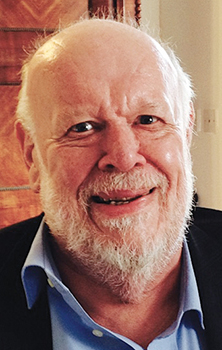
Prof John Hinnells
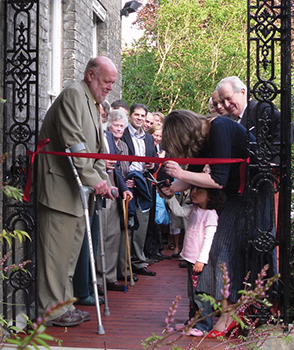
Prof John Hinnells at the opening of the disabled access at
the Ancient India and Iran Trust, Cambridge
The ZTFE were indebted to the scholar for his book Zoroastrians in Britain which "continues to be the primary source of information for those wanting to find out about the ZTFE and the UK Zoroastrians in the 19th and 20th centuries. It was one of the reasons that the ZTFE readily agreed to sponsor (in 2016) the publication of the Festschrift for Hinnells — Holy Wealth: Accounting for This World and the Next in Religious Belief and Practice,” stated Deboo.
"John’s achievements can only arouse admiration. His life-affirming attitude and ability to overcome and succeed in the face of adversity has made his life a story of success. His good sense of humor, combined with a bright mind and warm-hearted personality makes him a source of inspiration and encouragement for all of us,” wrote Dr Almut Hintze, Zartoshty Brothers Professor of Zoroastrianism at the School of Oriental and African Studies (SOAS), London University in the Festschrift that she co-edited. "Hinnells has for many years been one of the foremost writers on the subject of the indigenous Iranian religion of Zoroastrianism and, more particularly, the various communities in Iran, the Indian subcontinent and in a global diaspora,” stated co-editor of the Festschrift Dr Alan Williams.
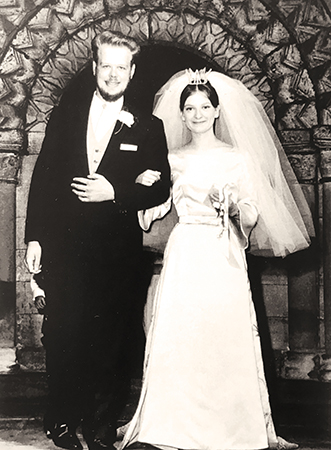
John Hinnells and Marianne Bushell on their wedding day
"As an earnest and devoted scholar of Parsi Zoroastrian culture, faith and identity, John brought a radically non-Eurocentric and non-Christiancentric approach to religious studies,” appreciated Burjor Avari, former honorary chairman of the North West Zoroastrian Community in Manchester, adding, "It was John who first encouraged and persuaded us to form our association, however small it was, because he believed in establishing a network of Zoroastrian communities all over the world.”
Whilst his last years were spent at Cambridge and Oxford, it was at the Manchester University where Hinnells spent 23 years of his professional life, rising to professor of comparative religions. In addition to Manchester University, he started degree programs in comparative religion at three other universities: Newcastle upon Tyne, Open University and SOAS. His office at the Manchester University was "like a Zoroastrian museum,” recalled Avari. In the corridor outside hung a large portrait of Dastur Sorab Kutar, the head priest of the UK Zoroastrians in the 1960s and 1970s. The books he was presented with are now in the collection of the Manchester University Library.
Originally planning to join a monastery, Hinnells changed his course after he met Marianne Bushell whom he later wed. He graduated as a Bachelor of Divinity from King’s College, London and engaged in postgraduate research on Zoroastrian influence on Judeo-Christian tradition at SOAS. "But then when I started studying Zoroastrianism, I got so interested in it that I never got around to the New Testament, I just stayed in Zoroastrian studies,” Hinnells had conveyed in an interview with Parsiana (see "The religion of the good life,” Parsiana, December 1973).
"Prof Hinnells’ contributions to SOAS were considerable,” summed up Hintze. "From 1993 to 1998 he served as founding head of the newly established Department for the Study of Religions at SOAS while holding the position of Professor of Comparative Religion. At SOAS, he conceived the plan together with (his mentor) Prof Mary Boyce to raise funds for the endowment of a Chair in Zoroastrianism. The idea of an endowed post dedicated to the study of Zoroastrianism became a reality when the Zartoshty Brothers committed themselves to make donations towards the Zartoshty Brothers Chair in Zoroastrianism.”
Despite his dependence on crutches, a lasting repercussion of a severe attack of tuberculosis as a schoolboy, the tenacious researcher traveled to India and to Iran, in search of teachers and priests from whom he could learn. "I have not come to teach, I have come to learn… I study Zoroastrianism and the Parsis because I have terrific respect for the faith… I respect it because of its integrity... There is so much in the faith that demands respect that I hope Parsis come to know of it and learn to respect their own heritage,” stated Hinnells in the Parsiana interview, endearing himself to community leaders.
Among the many books on Zoroastrianism and comparative religions, authored and edited by Hinnells, were Zoroastrianism and the Parsis; Parsis and the British; Persian Mythology that included beautiful color photographs; Bhownaggree, one of the few parliamentary biographies to be published; and the Penguin Dictionary of Religions. He is also known to have produced a series of Open University learning and teaching guides to Zoroastrianism that are considered a valuable educational resource.
His magnum opus, The Zoroastrian Diaspora: Religion and Migration is described by Amazon as "the outcome of 20 years of research and of archival and field work in 11 countries.” As pointed out Hintze, "His unrivalled first-hand familiarity with communities worldwide enabled him both to present fiercely debated topics in a sensitive and impartial manner and to convey personal perceptions of individual Zoroastrians.”
Declared Hinnells, "Any Parsi who thinks that his faith is not facing a terrific threat is just blind. It is not just the decrease in numbers, it is the problems of urbanization… A secular state is a much greater threat to any religion than persecution.”
A self-confessed non believer, Hinnells had stated in Parsiana that the differentiating feature of Zoroastrianism was its emphasis on "individual responsibility… a moral and a religious responsibility to make the best of this world… I greatly respect Zoroastrianism for what seems to me to be a very wholesome attitude to life and the way to live. Parsi charity, benevolence, social concern and educational concern goes with this fundamental religious attitude to the world.”
The academic is survived by his sons Mark and Duncan.
◆ ◆ ◆
From the archive