
Milestones
The decline continues
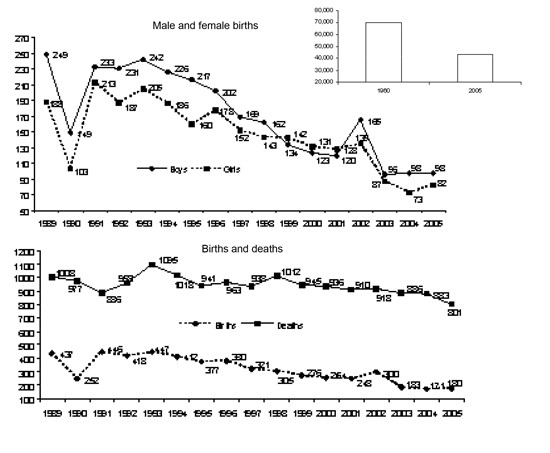
The statistics on births obtained from the Bombay Municipal Corporation by the Bombay Parsi Punchayet (BPP) and forwarded to Parsiana by BPP executive secretary Cawas Panthaky, shows 1,082 births for the period 2001 to 2005. The corresponding death figures for the same five year period is 4,398. This includes the death list supplied monthly by the BPP as well as names of the deceased obtained from the Chandanwadi municipal crematorium. So the total number of deaths over births since the 2001 census (which covered the period till the end of 2000) is 3,316.
The 2001 census figures showed 69,601 Parsis residing in India of which 46,557 resided in Bombay till end-2000. The Bombay figures hence would now be 46,557 - 3,316 = 43,241.
The highest figure shown in the census for Bombay was 70,065 in the year 1960. That means Bombay has 26,824 less Parsis in end 2005 than it did in 1960, a span of 45 years. This works out to a decline of almost 38 percent, or a .84 percent drop a year. If that percentage holds, Bombay’s population will be 40,800 by 2010. If on the other hand, the figure of 3,316 for 2001-2005 repeats for 2006-2010, the number will decline to 43,241 – 3,316 = 39,925, a drop of 43 percent over 50 years or .86 per year.
The analyses of the 2001 census figures for the National Commission for Minorities by noted demographer Prof Ashish Bose and his team showed more men than women in the marriageable age group. This trend is further exacerbated in the 2001 to 2005 period. The number of male births was 577 and females 505, a difference of 72. This means more men will have to marry out of the community as the number of eligible men exceeds that of eligible women (unless the Parsi Marriage and Divorce Act is amended to permit a Parsi woman two husbands!).
For the 2001 to 2005 period 1,041 community and 492 interfaith marriages took place, an out marriage percentage of 32.
Despite the surfeit of marriageable men available in the community, 221 women chose to marry outside the faith between 2001 and 2005. The number of men marrying outside the faith was 271.
In the 20 to 35 age group for every 1,000 females there are around 1,012 males. Consequently the number of men marrying out will increase, or they will have to remain bachelors. After the age of 35 the number of women is greater than men. Women generally live longer than men, all things being equal.
If we go to the younger age group from 0 to 19, here also males predominate. For every 1,000 males there are around 930 females. The figures for the 0 to 14 age is even more alarming. For every 1,000 males there are 908 females.
In the last 17 years the number of male births exceeds female in all but three years 1999 (134 males, 142 females), 2000 (123 males, 131 females) and 2001 (120 males, 128 females). The totals for the years 1989 to 2005 are 2,914 males to 2,493 females, a surfeit of 421 males.
How did this happen? Where did the female babies go?
◆ ◆ ◆
From the archive