
Cover Story
The impress of Zoroastrianism
A Zoroastrian Tapestry: Art, Religion and Culture edited by Pheroza J. Godrej and Firoza Punthakey Mistree. Published in 2002 by Mapin Publishing Private Limited, 31, Somnath Road, Usmanpura, Ahmedabad 380013 and Grantha Corporation, 80, Cliffedgeway, Middletown, NJ 07701, USA. Pp: 762. Price: Rs 7,500, UK £ 175, US $ 195.
Religion and politics, food and fashion, creativity and commerce are some of the strands that two indomitable women — Pheroza J. Godrej and Firoza Punthakey Mistree — have woven together into A Zoroastrian Tapestry, Art, Religion and Culture in their 10-year-long project to answer the question "Who are the Zoroastrians?” In the process they have tapped leading names in Iranian studies from within the community as well as the international arena of scholarship — Prof Mary Boyce, the doyenne of Zoroastrian studies, has contributed four major articles — and sourced a wealth of pictures, maps and artifacts from around the world that breathe color and comprehension to perspectives that stretch 2,500 years into antiquity.
Designer Kirti Trivedi has orchestrated this cultural cornucopia into 762 art paper pages — a remarkable combination of eyefilling color and artistic detail to balance the 41 textual contributions.
Author, art historian and environmentalist, Godrej has pioneered the study and documentation of Parsi portraits in Bombay. Punthakey Mistree has behind her years of teaching Zoroastrianism to school children and researching the oral history of Yazdi Zoroastrians. A Zoroastrian Tapestry took them nine years to compile and was simultaneously launched in Bombay and London in June 2002 (see "This monumental work,” Parsiana, August 2002).
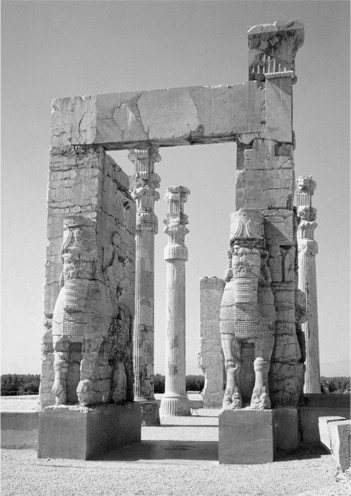
Winged bulls with human heads guarded the eastern side of the Gate-House of Xerxes at Persepolis
Photo: Khojeste Mistree
Though the book has not been divided into sections, the initial articles deal with the teachings of Zarathushtra and their implementation during the three Zoroastrian empires. The second sector articles examine the interconnections with Hinduism, Judaism, Christianity and Islam. Lay and priestly observance is in large part confined to the Parsi heritage in India. Also, the flowering of Zoroastrian culture after the Arab conquest was restricted, almost by definition, to the relative freedom and harmony of the Parsi diaspora in India.
Referring to the injunction to pray in the presence of fire, Boyce writes, "There are multiple reasons why fire should have been identified as the creation of the Spirit of all-regulating Asha...the principle of what ought to be, in the cosmic, social and moral spheres... through the sun it regulates the hours and seasons, while for the ancient Iranians it had a part in judicial ordeals, deciding the truthfulness or falsehood of an accused. It was present at almost all acts of worship, and was to be found on the hearth of every house, being essential for everyday life. Furthermore, it gave out not only warmth but light, visibly driving back the darkness which belongs to Angra Mainyu, and which is linked symbolically with ignorance and wrong. There was thus complex significance both in giving the guardianship of fire to Asha Vahishta and in making it the icon of the faith; for Zoroaster ordained that his followers should pray in its presence, turning towards sun or moon or earthly fire, so that it would help them to fix their thoughts on the justice and truth of Asha, and hence of Asha’s great Creator, Ahura Mazda.”
As each of the Amesha Spentas — collectively referred to as the Heptad — was a guardian of one of the seven creations, the Zoroastrians who venerated them were given "a sense of fellowship with the natural world, and of responsibility for it, and were provided with countless ways of serving God in the course of daily living.” Boyce speaks of the Zoroastrian ethic of joyousness and hope — qualities with which to "overwhelm the sad malignancy of Angra Mainyu, author of sorrow, despair and... the ultimate negation of life.” She notes that "Cheerfulness...is an admirable form of courage and in this life-affirming religion both optimism and courage are prized virtues” as each votary strives for cosmic salvation as a co-worker of Ahura Mazda.
In his article "The Place and Time of Zarathushtra” Harvard University’s Prof James Russell corroborates, "It is perhaps evidence of the imprint of the Prophet’s own steadfast good cheer that Zoroastrianism seems never to have conceived any ritualized festival of mourning for its martyred founder.”
Alluding to the various responses of practicing Zoroastrians to the issues of our times Boyce notes, "Zoroastrians are nevertheless united in worshipping Ahura Mazda and in honoring His Prophet; and all accept as a common bond the moral code which Zoroaster gave his community, to strive for good thoughts and words as well as actions.”
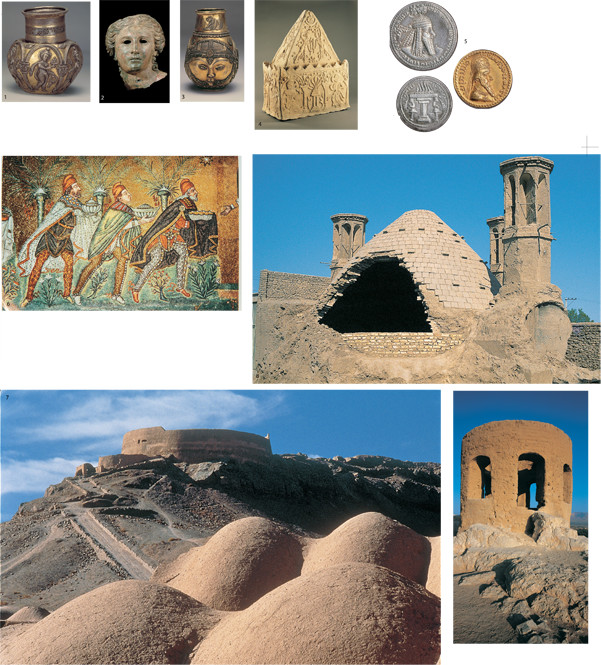
1. Sasanian silver vase Collection and copyright: The State Hermitage Museum, St Petersburg, Russia. 2. Bronze head of Aredvi Sura Anahita Collection and copyright: British Museum, UK. 3. Sasanian jug Collection and copyright: The State Hermitage Museum, St Petersburg, Russia. 4. A stamped terracotta ossuary Collection: Samarkand Museum, Uzbekistan. Photo: Frantz Grenet. 5. Silver half-drachm coin and reverse (left) and gold dinar of Ardeshir I (right) Collection and copyright: British Meseum, UK. 6. Mosaic of three Magi at San Vitale church, Ravenna, Italy Photo: Almut Hintze. 7. Dakhma in Yazd Photo: Kaveh Kazemi. 8. A water reservoir at Yazd Photo: Oshin Danili Zakarian. 9. Part of Sasanian fire temple, Isfahan Photo: Mohammed Husseinzadeh
Assigning Zarathushtra to some remote region of inner Asia between 1500 and 1200 BCE as per the "basis of Avestan evidence and comparative studies,” Russell writes, "Given the gulfs of time and space that separate us from Zarathushtra, it is remarkable that the little we do know of him has survived, and not been lost by passing wholly into fanciful legend.” Russell seeks to locate this homeland of the Prophet — Airyanem Vaejah — according to the Vendidad and the Bundahishn at 40°20’ north latitude "where the longest night of winter was equal to the two shortest days, and the longest day of summer was equal to the two shortest nights.” Noting that "In Zoroastrian tradition, Airyanem Vaejah, as the Prophet’s homeland, had come in time to be regarded as the center of the world, a semi-mythical region where all great events of the past, mythical or legendary, had taken place,” Russell wonders if Zarathushtra’s people could have lived so far north. He then goes on to assess a variety of other speculations and sources. "Airyanem Vaejah is a harsh land and, even today, some of the religions of Siberia are dualistic in character, their attitudes reinforced, one would think, by the struggle for survival, light against darkness and warmth against cold. Although northern Kazakhstan might seem a remote region to postulate as the location of Airyanem Vaejah, the Avestan and Pahlavi texts adhere firmly to the tradition of a northern land with a harsh climate.”
Writing on "Zoroastrianism in Ancient Imperial Times,” Boyce refers to Darius the Great’s religious allegiance as declared in the carving over his tomb. He is shown in reverence before fire and "symbols of the heavenly fires of sun and moon... Since the Iranians had no tradition of their own of plastic representations of natural phenomena, the Persians borrowed from the religious iconography of their Near Eastern subjects.” The symbol for the moon — a full disk with a crescent along its lower rim was borrowed from Mesopotamia. The winged disk with falcon tail which originated in Egypt as the symbol of the sun-god Horus was modified as symbol of the Assyrian sun god Shamash and of power and good fortune with the upper part of a man being set within what now became a winged circle. The Iranians endowed it with the concept of Khvarenah, the divine glory attending great men, heroes, prophet Zarathushtra and righteous mortals. The symbol’s "oldest attested (Zoroastrian) use” is at Mt Behistun where Darius recorded his victories in the name of Ahuramazda, notes Boyce.
An event of immense significance was the writing down of the sacred Avestan texts in Sasanian times. "Once the holy texts were set down, they were studied even more intensively, with resulting developments in prayers, rituals, and purity laws. A secondary religious literature was also developed in Middle Persian, in which were written down renderings of old oral works from both eastern and western Iran, as well as new compositions. One very important literary work was the compilation by royal scribes of the Khwaday Namag, ‘Book of Kings,’ based largely on Parthian heroic epic, culminating in a chronicle history of the Sasanians.” Khwaday Namag was later to be the base on which Firdausi built his literary edifice of the Shahnameh.
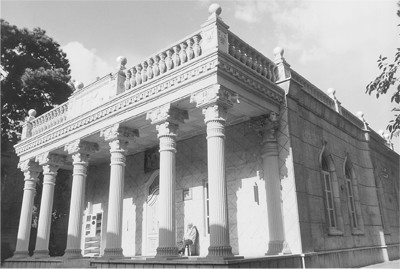
Tehran Dar-i Mihr built with community funds from India, Tehran, Yazd, Kerman and Kashan Photo: Farhang Mehr
While early Greek culture was marked by receptivity to Near Eastern ideas, traditions, customs, their crushing defeat of the invading Persians changed their identity from a loose collection of city states and small autonomous regions into an awareness of their shared culture based on language and customs, writes Albert de Jong of the University of Leiden. However "the image of Persian hating Greeks is contradicted by a wealth of evidence. There were, of course, large areas of the ancient world where the Persians and the Greeks cohabited for centuries in the cities and rural areas of Asia Minor.” Cultural exchange was "easiest in those areas which did not require too much knowledge of foreign languages: art, architecture, cooking and music.” Under the Seleucid Empire, which followed the invasion of Alexander of Macedonia, the subject people were allowed to pursue their religion undisturbed.
However a number of new cities were founded which were Greek in organization and spirit with theaters, gymnasia, games and city councils. These were peopled by Greek descendants and sympathizers. When the Parthians established themselves over the Seleucids they retained the Greek administrative model and used the Greek language and religious iconography on their coins. When Christianity had become the state religion of the Eastern Roman Empire by the end of the fourth century CE, dissident theologians persecuted there had found asylum in Sasanian Iran. When Emperor Justinian closed the Academy of Athens, pagan philosophers arrived at the Sasanian court, notes de Jong.
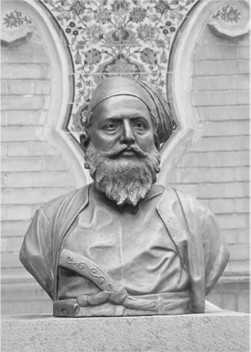
Bust of Manekji Limji Hataria in Yazd Atash Behram Photo: Rohinton Irani
Greek literature reflected the steady flow of Greco-Persian contacts. Because these texts — from Greek historian Herodotus to Byzantine times — are datable, information on Persian culture is of particular interest to scholars. "The majority of authors describe observable facts and some names: rituals, gestures, divinities, Zoroaster, the priesthood, the magi, temples, as well as funerary practices... A more exciting factor in this area is the possibility that the Greek texts describe Zoroastrianism as lived and understood by the majority of its followers: the laity. Characteristic in this respect is the almost total absence of the Amesha Spentas in descriptions of the religion of the Persians. Many interpretations of Zoroastrianism consider this doctrine of the Heptad to be the backbone of Zoroastrian theology, but the evidence from Greek literature suggests that it may not have been as prominent for lay Zoroastrians as Zoroastrian literature indicates... Many descriptions contain elements that are not easily recognizable as Zoroastrian traditions; these include a carnivalesque festival called the Sacaea, a god of silence, and the idea that Ahura Mazda tripled in size at an early stage of creation. It is frequently very difficult to interpret such descriptions but they must be taken seriously if we want to understand the history of Zoroastrianism prior to the Sasanian period.”
Mountains, deserts, oases and settlements along river banks characterize the geography of Iran, Afghanistan and Central Asia, writes Harvard’s Prof Emeritus Richard Frye. Forms of Zoroastrianism distinct from the Sasanian state religion, existed in Central Asia. Manichaeism, Nestorian Christianity and Buddhism were widespread. "One of the most characteristic features of Central Asian Zoroastrianism are the ossuaries, in which the bones of the departed are preserved in a stone or ceramic astodan. In Sogdiana and in Khwarazm, ossuaries are found in every archaeological excavation. A remarkable sixth or seventh century ossuary from Mulla Kurgan (a site in Uzbekistan near Samarkand) shows two figures, presumably priests, wearing the padan, cloth covering the nose and mouth. Between the two figures, one kneeling and the other standing, is a fire-holder with flames.” Since the Central Asians borrowed motifs from India, Iran, China and the northern nomads, Frye emphasizes the problem of interpreting representations found on excavated artifacts — whether the users were aware of their religious connotations or simply copied the motifs for aesthetic pleasure.
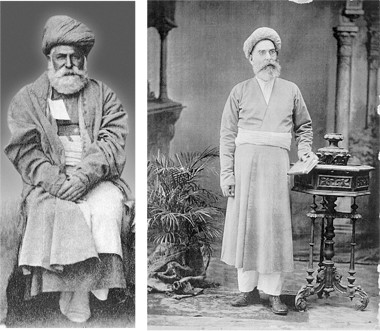
Dastur Tirandaz of Yazd (left) and Yazdi benefactor Rashid Mehr
Photo: Parviz Varjavand
"Sogdian merchants travelled far into China and northern India, becoming entrepreneurs on the ‘Silk Route’ through Asia. The extensive commercial activities of the Sogdians may have been one reason for the secular emphasis in their society and for their evident disregard for religious matters.” Like the Kushans whose coins portray a wide variety of deities including Mithra, Shahrevar and others from Iran, the Sogdians too adopted many religions, avers Frye.
Sorbonne Prof Frantz Grenet writing on "Zoroastrian Themes on Early Medieval Sogdian Ossuaries” describes a fragment of an ossuary discovered in the Samarkand area which "depicts precisely what occurs in heaven, while the chaharom is performed on earth. The soul is being judged at the Chinvat Bridge (the allegorical bridge of the Separator, mentioned in Zoroastrian eschatology). Sitting on the left, Rashn holds the scales with which he is going to weigh the merits and demerits of the individual. The soul itself, the figure of which is not depicted in this fragment of the composition, is led to the place of judgement by another divine being, most probably Srosh, who presents an incense-burner to Rashn as a testimony of the soul’s piety. Apart from this detail, the scene closely corresponds to the descriptions given in the later Pahlavi literature.
"This example shows that Sogdian funerary art sometimes depicts Zoroastrian yazatas (divine beings) taking part in that which befalls the soul in the hereafter. In the scene just examined, the divine beings wear long, plain robes after the fashion of the priests, but they are crowned like kings.”
Trade with China, India and the Roman Empire contributed to the wealth of Parthian Iran, writes Boyce in "The Parthians — Defenders of the Land and Faith.” Excavations at Mithradatkird near Nisa have revealed nine cellars so far which have yielded "thousands of os-traca,” i.e. bits of broken pots with records in ink noting when the wine was brought, by whom and from which estate. The earliest of these, dating back to Mithradates I (13/12 BCE), include a wealth of personal names, many of them characteristically Zoroastrian. Some which are fully dated bear the Arsacid era in combination with the Zoroastrian calendar — its first recorded use in everyday life, according to Boyce. These ostraca provide the earliest example of Aramaic written phonetically as an Iranian language with a local script. The Parthian language was called Pahlavi and so this form of writing came to be known as Pahlavi. "The fact that this way of writing Pahlavi thus evolved directly from Achaemenian Chancellery Aramaic, still in use nearly 200 years after the downfall of the Persian empire, is one of the clearest pieces of evidence for cultural continuity in Parthav from Achaemenian to Arsacid times,” notes Boyce.
The Arsacids’ "practical approach to governing” is proved by three documents on local land sales in Dura (which had a strong Greco-Semitic culture) being in Greek though the parties to the transaction are Iranian. Greek remained by custom the written language of the law courts in the area until the practice eroded with time.
In a footnote Boyce states, "Throughout history the religion of a king with absolute power has been the religion also of the state he ruled; and, with all the evidence by now available, there can be no reasonable doubt that the Arsacids were faithful Zoroastrians.”
In "The Contribution of the Sasanians to Zoroastrian Iran” scholar Faribourz Nariman credits their establishment of fire-temples, "the fusion of religion and kingship,” the confiscation of the property of the Manichaeans and the persecution of Christians who were both perceived as threats to the church and the state. However, admitting the demoralization of both these institutions, Nariman quotes G. K. Nariman, "Not only was there the young and powerful Christianity politically opposed to and morally combating with fatal firmness, the decadent State and Church of the Sasanians, but there were mutually hostile schisms and sects among Zoroastrians... about which we authoritatively learn from Arabic writers like Shah-rastani and Ibn Hazm. Each sect was actuated by a spirit of pious intolerance and breathed sanctimonious odium against others.”
As "temples and images were alien to the Iranian religion,” foreign models were used as prototypes under later Achaemenian kings, notes Russian archeologist Boris Marshak. Greek statuary personalized the worship of individual yazads. For example, the Parthians identified Verethraghna (Behram in later tradition), the Zoroastrian yazata of victory with the Greek hero god Heracles, he states. The Sasanians however mounted "an official iconoclastic campaign which resulted in the removal of cult images from those temples which were dedicated to the yazads.” However, beautiful silver artifacts of these epochs — jugs, bowls, plates depicting hunting scenes, flora and fauna — are prized possessions in the museums of the world. An outstanding collection of pieces in The State Hermitage Museum at St Petersburg, exquisitely reproduced, accompany its curator Marshak’s article "Zoroastrian Art in Iran under the Parthians and the Sasanians.”
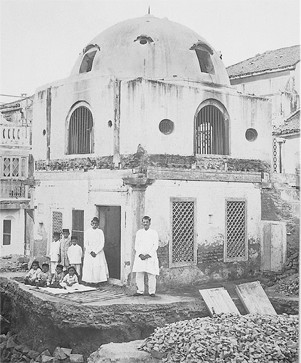
Outer facade of old Navsari Atash Behram adhered to old Iranian design Collection: Firoza Punthakey Mistree Photo: Madhur Shroff
Tracing "The Theme of Truth in Mythology” Jamsheed Choksy, assistant professor at Indiana University, observes how "Mithra served as a mythic overseer of social order and harmony, a friend and guardian of virtuous Iranians,” for, social order according to Zoroastrian belief has "cosmic and eschatological consequences.” Choksy quotes a passage from the Bundahishn: "Ahura Mazda suggested to...humanity’s immortal souls, ‘Should I create you in corporeal form to battle evil, vanquish it, and then be resurrected perfect and immortal...or should you always be safeguarded from the vile enemy. Which option appears more advantageous to you?’ The immortal souls of humans knew, through perfect wisdom...of the adversary’s final defeat and so agreed to enter the material world.” "The notion of humans contesting evil found manifestation repeatedly in many other forms of Iranian writing and imagery” including the integration of Rustam into the Kayanian legend cycle, states Choksy.
Dastur (Dr) Hormazdyar Mirza of Udwada and Bombay discusses where, when and who transcribed the manuscripts that are prized collections in libraries all over the world. He also discusses the processes of dating, providing an explanation of the Parsi Era or Zoroastrian Era found on some manuscripts as against the more familiar AY — after Yazdegird.
Comparing the Rig Veda with the Avesta, Sanskrit scholar Sindhu Dange traces commonalities between "Zoroastrianism and Hinduism.” The common Indo-Iranian heritage of the tribes "upheld a belief in a god who fixed the unfailing law of nature and on whom this law rested forever.” The Iranians identified him as Ahura Mazda; the Indians venerated him as Varuna.
Archeologist Arvind Jamkhedkar dwells on the commonalities between "Parsi and Hindu Sacraments.” A prosperous married life with children and grandchildren was an ideal cherished by both traditions, he notes.
Exploring the historical associations of "Zoroastrianism and Judaism” which date back to the freedom Cyrus the Great granted to the Jews held captive in Babylon, linguist and professor of comparative religion at the Hebrew University Shaul Shaked examines the changes in the Jewish concepts that resulted from their long association with Zoroastrians. "The meeting of the two peoples, the great and dominant Iranian people, and the small but historically significant Jewish people, had overriding consequences for the history of western civilization to which few other cultural encounters between two peoples can be compared.”
Relationship between "Zoroastrianism and Christianity” range from shared national identity and a hospitable nurturing of the new faith by the more liberal Parthians to the oppression and persecution of Christian citizens of the Sasanian Empire once the Eastern Roman Empire began to be perceived as an enemy state. With much objectivity Alan Williams, lecturer in Comparative Religion at Manchester, traces the political tension of living in that theocratic state for a community dedicated to proselytization.
"Zoroastrianism in Iran after the Arab Conquest” was one long descent into misery for the faithful who resisted the conquerors’ effort to convert them to Islam, recounts Boyce. Nevertheless they retained their dignity and self-respect despite centuries of insult and poverty. The more pragmatic eventually gave up the unequal fight and the most zealous among the converts became the old religion’s bitterest enemies.
Sounding "Mazdaean Echoes in Shi’ite Iran” A. Sh. Shahbazi of the Eastern Oregon University notes how the poetry of Rudaki and Firdausi, the works of historian Biruni and scientist Ibn Sina (Avicenna) buttressed Iranian nationalism when other Islamic nations had "melted into a single universal ‘people.’” Shi’ite Iran has maintained its social structure and its festivals, notably the national celebration of No Roz, (Navroz) to current times.
The impress of Zoroastrianism on peripheral peoples who once came under Iranian rule or absorbed its influence persists among the Yezidis and Ahl-e Haqq of Kurdistan, notes Prof Philip Kreyenbroek of Gottingen University in "Modern Sects with Ancient Roots.” Noting that "the Zoroastrian religion was transmitted orally until well into the Sasanian period,” Kreyenbroek states, "While it seems likely that the ancestors of the Ahl-e Haqq and Yezidis were at one time influenced by Zoroastrianism, and may indeed have regarded themselves as Zoroastrians, the roots of their beliefs may... go back to an even earlier stage in the history of Iranian religion.”
Former president of Pahlavi University Farhang Mehr writes about "Zoroastrians in 20th Century Iran,” recounting the slow emergence of the community from the privations of poverty and deprivation after the Jizya Tax was rescinded by Nasser al-Din Shah Qajar in 1882 thanks to the unremitting effort of Manekji Limji Hataria. The constitutional reforms of 1906 when Arbab Jamshid became the first non-Muslim member of the Iranian Parliament, the Majles, enhanced the process of amelioration. Though Zoroastrians eventually entered public service, few rose to positions of authority and they continued to be barred from the judiciary, he notes.
Architect Faroukh Dastur and Pun-thakey Mistree trace the architectural evolution of "Fire Temples and other Sacred Precincts in Iran and India.” The article ascribes the later mushrooming of adaran fires in India to the introduction of non-Zoroastrian domestic help. "Their presence did not permit the priests to keep their house fire in a state of ritual purity. Therefore, it became desirable to have a separate place of worship where the sacred fires could be kept.”
Architect Azmi Wadia writes on the "Evolution of the Towers of Silence and their Significance,” from the primitive mud plastered buildings of rural Iran to the sophisticated structures on Bombay’s Malabar Hill with their elevation, sloping platform, central pit, purifying filters, etc.
The function of Zoroastrian rituals in "Protecting the Physical World” are explained by Dastur (Dr) Firoze Kotwal and Zoroastrian Studies’ Khojeste Mistree. They enumerate the five components of a ritual which lead to the triumph of good over evil as order and truth (Asha), purity, fire, water and the holy word (Manthra Spenta). The higher liturgies of the faith — the Yasna, Visperad, Vendidad, Nirangdin, etc — are explained by the two authors in "The Court of the Lord of Ritual.” Daily observances in Parsi and Iranian Zoroastrian homes are described by scholar-researcher Shehnaz Munshi and Sarah Stewart of the School of Oriental and African Studies, London.
Dastur (Dr) Kaikhusroo JamaspAsa provides "A General Account of Iranian Studies.” Though earlier Zarathushti texts were vandalized by the Arab and later invaders, Pahlavi and Middle Persian writings like the Dadestan-I Denig, Skand Gumanig Wizar and the Denkard preserved the Zoroastrian religious and intellectual heritage. The Rivayats enlightened the Parsis; the initial faltering steps of Thomas Hyde and Anquetil du Perron whetted Western interest. Eventually philology led Frederich Max Mueller to the study of comparative religion; Martin Haug translated the Gathas; E. W. West made English translations of the Pahlavi works accessible to English speaking Parsis even as Ibrahim Poure Davoud’s translations of Zoroastrian scriptures into modern Persian made them accessible to the people of Iran.
In "Parsi Arrival and Early Settlements in India” Mistree follows the fortunes of the boat community of Diu and Sanjan through their low profile years in Gujarat to their establishment in Navsari, Surat and Bombay. Scholar Rusheed Wadia recalls the exchange of Chinese tea, silk and porcelain for Indian opium in "Colonial Trade and Parsi Entrepreneurs.” Though the community acquired a significant quantum of wealth in the process, Wadia enumerates the restrictive trade practices of the East India Company which laid the Parsis open to greater risk and unfair competition.
Distinguishing between the more permanent Zoroastrian settlements in Karachi, Aden and London with their initially transient counterparts in Canton and East Africa, in "Bombay Parsis and the Diaspora in the 18th and 19th Centuries” research professor John Hinnells of Derby University writes that wherever they went they enriched the local environment and society. But they also ensured that their wealth and political influence was deployed for the benefit of the community in India.
Ventilating public grievances, pressing the cause of social reform, supporting the Indian National Congress were some of the reasons that drove "Parsi Pioneers of the Press (1822 — 1915)” to establish newspapers and journals. Noted journalist B. K. Karanjia scouts the field from the establishment of The Bombay Samachar by Fardoonji Marzban in 1822 — the oldest newspaper in Asia today — to Byramji Malbari’s Indian Spectator, K. R. Cama and Dadabhai Naoroji’s Rast Goftar, Sir Pherozshah Mehta and B. G. Horniman’s partnership on The Bombay Chronicle and a wealth of other publications.
While Parsi theater dominated the Indian cultural scene for a century, its heyday stretched for two decades 1870-90, notes Saryu Doshi’s assessment "Of Costumes and Sets.” The honorary director of the National Gallery of Modern Art notes that knowledge of English literature and exposure to enactments staged by itinerant British companies led to the establishment of the Parsi Natak Mandali and the Victoria Natak Mandali. The Alfred Natak Mandali’s penchant for special effects made them an integral part of Parsi theatrical presentations. Outstanding actor/entrepreneurs in theater were Kaikhusru Kabrajee (who "recognized the usefulness of theater as an instrument for social change and worked untiringly towards making it an integral part of people’s lives”) and Dadi Patel who introduced Urdu to the theater as well as women actresses.
They recognized the virtues of local self-government and constitutional means to freedom, notes former professor of political science Adi Doctor in "Parsis and the Spirit of Indian Nationalism.” He traces the careers of Dinshaw Wacha and Pherozshah Mehta, Dadabhai Naoroji, Muncherjee Bhownagree and Shapurji Saklatvala, the trio who got themselves elected to the British Parliament from English constituencies, as well as extremists like Bhikaiji Cama and Veer Khurshed Nariman. He also acclaims the wisdom of Jamsetji Tata and of Ardeshir and Pirojsha Godrej who realized that political freedom needed economic underpinning.
"Entertaining the Zoroastrian Way” by gourmet cook and author Shirin Simmons describes the cuisine and festivals of Iran, "Jamva Chalo” by writers Shalini Devi Holkar and Sharada Dwivedi lingers on the eating habits of the Parsis. "Parsi Cuisine in the Villages of Gujarat” is archeologist-caterer Katy Dalal’s nostalgic evocation of the good life in earlier, more leisurely times.
Undaunted by lack of pictures, Vesta Sarkhosh Curtis, curator of Iranian coins in the British Museum, examines the statuary and friezes that time has spared to describe the "Dress of the Imperial Court.” Punthakey Mistree finds "Hues of Madder, Pomegranate and Saffron” in the "Traditional Costumes of Yazd.” "The Tanchoi and the Garo” have pride of place amid "Parsi Textiles and Embroidery” with Kalpana Desai, director of the Prince of Wales Museum recounting the evolution of these fabrics as a by-product of the Parsis’ lucrative China trade and their own enhanced social standing. "Style and Elegance — Parsi Costumes in the 18th and 19th Century” by Punthakey Mistree and Godrej embraces the integrated Indo-Iranian sartorial style.
Godrej discusses painting techniques and the art of portraiture in "Faces from the Mists of Time,” showcasing "Parsi Portraits of Western India (1750-1900).” The relative strengths of Indian, European and Chinese artists come under her microscope as much as the personalities the paintings commemorate. Two pictorial essays — "Zoroastrians of Iran — A Panorama” and the "Parsis of Western India” — compiled by the editors round off their herculean task. But not quite. Also included is a Chronology of Kings and a Glossary, a Select Bibliography and a 25-page index.
With an eye for detail the end of each article is marked by a display of both sides of a different ancient coin, its caption recording and explaining its main features. The continuity of each article is depicted by a miniature from one of its outstanding illustrations repeated on the upper outer corner of the pages — a reference point by itself.
Dispersed among the articles are five double spread maps, beautiful to behold but not quite answering questions that arise in a lay reader’s mind while perusing articles that refer to relatively little known places with ancient names that vary with time.
Apart from its daunting 13.5” x 10” x 2.75” format weighing seven kilograms and a few minor errors of proof-reading, A Zoroastrian Tapestry is well worth reading — and keeping — and gifting — for an understanding of our past and its bearing upon our present and our future.
◆ ◆ ◆
From the archive