
Medicine/Health
Coyaji’s clinical chronicles
Pathologist, teacher and social worker Dr Goolcheher Coyaji believes she’s “made a difference”
"Pathologists mainly do histopathology which means studying and reporting the tissues and organs that are removed at surgery. Most people perceive pathologists as the ones who only report on blood and urine samples. This is not true as these can be done even by laboratory technicians,” explains Dr Goolcheher Coyaji who during her practice as a pathologist for over four decades must have worked on more than 30,000 histopathology reports "and the count is still rising,” she states.
From September 1, 1971 to August 31, 2001 Coyaji was in charge of the department of pathology including the blood bank, at the Jehangir Nursing Home, Poona. Being so used to working, she found it difficult to sit idle at home when the management of the Bharti Vidyapeth Medical College decided to retire all those who were 65 years of age. She took up work at Jagat Clinic which is a charitable private clinic having X ray, sonography and laboratory investigation facilities.
Having taught at the Armed Forces Medical College (AFMC) and the Bharti Vidyapeth Medical College some of her outstanding students were Lt Gen Puneeta Arora, the first woman in the three services to reach the second highest rank in the armed forces echelon, her predecessor Maj Gen Ramji Rai, Dr Shrikant Kelkar, Poona’s reputed ophthalmologist and Riyaz Ginwala who is settled in England. "As a teacher I was strict and never allowed anyone to even look here or there, let alone copy. Puneeta was a regular and good student. It was a pleasant surprise I gave her when I went for her farewell party. She hugged me and told me how happy she was to see me,” says Coyaji.
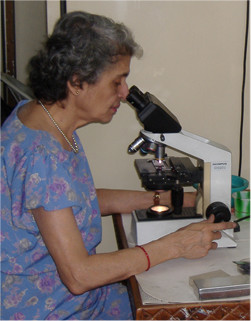
Coyaji: examining tissues and organs
Coyaji herself had studied at the AFMC, having done a 10-month course in clinical pathology. While she was teaching there she was enthused to do MD in pathology, the subject of her dissertation being chromosome studies. After she left AFMC, Coyaji applied for the India Foundation work cum training program under which students were given a loan to go abroad. She worked for a year and a half at New York’s Beth Israel Medical Center (BIMC) and then returned to India to be with her parents.
Born to Dinshaw and Bhikhu Coyaji, Goolcheher remembers herself as a rather submissive, timid and shy child. "I was crazy about books. Reading was my lifeline. I was a pampered child but not spoilt. I was born in Surat… but I grew up in Karachi and studied in St Joseph’s Convent Girls High School, the Central Government College for women and then the Dow Medical College, nursing my desire to be a doctor since the age of five. Although these institutes were in Karachi, I never faced any kind of problem when I wore a dress to college. We all had more important things like our studies to concentrate on.”
In civil hospital after a mandatory one-year house doctor’s job (junior most doctor in the medical hierarchy) she worked as a Resident at the Holy Family Hospital. "By then I was a 23-year-old happy adult. Then my parents dropped the bombshell of going to India. They were worried that after them what would happen to me since they were advanced in years,” says Coyaji.
With the help of the Indian embassy they got a three months’ holiday visa for India. It broke their hearts to leave behind all their possessions and come to India with only three suitcases in 1961. The three months’ visa was extended to another three and the Indian government gave them two options — to go back to Karachi, stay there and get immigration or stay on in India and obtain Indian nationality. While Coyaji and her mother wanted to go back to get their things of sentimental and irreplaceable value like the three book cases full of rare books or the long playing records, her dad who had worked there in Llyods bank for 40 years was adamant on not going back to Karachi.
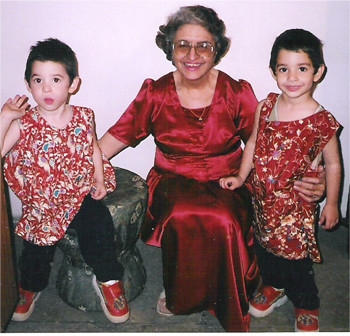
Coyaji with her grand-nephews
Since they did not have a home in India they stayed with relatives for three to four months. "In February 1962 I started working at my uncle Dr Eduljee Coyaji’s dispensary and stayed at his house. My uncle told me that I needed to specialize and from the options of surgery, anesthesia, radiology and pathology, I chose pathology,” recalls the 69-year-old doctor.
Her social work has been her second career with her having played an active role in the University Women’s Association (UWA) since 1968. This is a body of women graduates whose principal aim is to promote education among women. With different associations all over India and affiliated to the Indian Federation of University Women’s Associations, it has built a working women’s hostel, a pre primary school, conducts coaching classes for backward classes, provides local and international scholarships and conducts yoga classes. From 1972 Coyaji has held various posts from joint honorary secretary to that of president which was from 1991-1995. Balancing a full-time job, looking after her incapacitated mother and continuing her social work was tough but she did it. Coyaji was also on the scholarship committee of the international federation when she had to scrutinize applications coming from all over the world.
The doctor in her heydays
Her hobbies include writing, photography, music and cooking. She credits her enlightened and well-read father for developing these hobbies and for guiding and influencing her. She has authored three booklets — one on the Zarathushti religion, explaining the history and the meaning of prayers and ceremonies, a book of poems and the third one on Parsi surnames. Her inspiration to write a poem came to her suddenly one day in 1979 as she was sitting on her desk, with a lot of mail on her lap. "Unlike other types of writing, poetry is a thing of the moment and a matter of inspiration,” she states. She has been hooked on to photography since the age of 10 when her father gave her a box camera. Having learnt the violin she has participated in concerts of the Karachi Symphony Orchestra and the Pune Choral Society. "I must clarify that I like cooking only as a hobby and not as a daily chore,” Coyaji declares candidly.
Content with her contribution to the fields of medicine, education and the fine arts, Coyaji is happy, "I know that I am making a difference.”
◆ ◆ ◆
From the archive