
In Memoriam
The pride of Poona
Died: Dr Keki Byramjee Grant, 90, founder of Poona’s super-multi-specialty hospital, Ruby Hall Clinic (RHC), who was considered a pioneer in the development of India’s thriving health care industry, on January 3, 2011 in Poona.
"He taught me medicine, he taught me manners. He taught us all what is ethics in medicine, how to be modest and always truthful to a patient. He taught us sincerity, punctuality, cleanliness, sternness when needed and how to keep abreast with all the latest happenings in medicine… All he expected from you was loyalty, sincerity, hard work and dedication to his institution,” recalled Dr Ravi Gulati at the condolence meeting on January 6, 2011. The visionary’s "dream to make Poona a center for medical care” was referred to by Dr S. G. Deshpande.
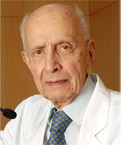
Dr Keki Grant: stress keeps you going
Describing him as a "colossus,” Dr Rustam Wadia, eminent neurophysician who has been with RHC for nearly 50 years declared, "Whatever I have achieved is due in large part to the inspiration, help, support of Dr Grant and the opportunities I got by working at this institution.” Although Grant had painstakingly built it up to accommodate over 500 beds, the founder would never take the credit, maintaining there were many who helped him in his task. "We however know that from 0-350 beds or more there was only one man who did the driving, the building, the deciding and only one man totally taking the responsibility and the rest were only cogs in the wheel. And what institution did he build? Clearly this institute is indisputably Numero 1 in Poona. As far as the quality and promptness of patient care is concerned, this institute can compete with any in India. In fact I know that there are several foreign patients who are absolutely stunned with the promptness and speed of the high quality evaluation available in this institution,” observed Wadia.
For years he would make his first round at 8 a.m. and then again in the afternoon and at night often enquiring why a child was crying, an adult in pain or a relation in anguish. "There were no public relations officers at the time. But the name of Ruby Hall spread by its 100,000 odd public relations officers, our patients and their relations… Grant’s consulting fee at the time was Rs 10 for a new case and this included haemoglobin, sugar and screening chest!... There were no cuts, no fixing or underhand deals — all things honest and above board,” conveyed Wadia.
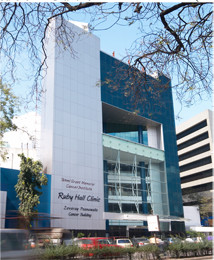
Poona’s Ruby Hall Clinic: offering the latest in health care
"He was a cardiologist with a heart which became the soul of the hospital as he breathed life and innovation into the magnificent edifice that he nurtured and built… Whether it was his inner circle of senior doctors, nursing or administrative staff — everyone from the CEO (chief executive officer Bomi Bhote) to the patients doted on the grand young man who wrote medical history!” observed Farida Master adding, "The first time I’d interviewed the incredible Dr Grant for Citadel, the Poona city magazine, barely after it had been launched, his classic quote stayed with me forever: "When I finish climbing one mountain, I am ready for the next. I don’t know why people keep saying they can’t deal with stress. Stress is good. It’s what keeps you going,” he had laughed.
To his colleagues he was good-natured, frank, open to suggestions and ready to discuss any problems, whether professional or personal. "His generosity and humility at meeting and allowing anyone to walk into his office without several filters endeared him to one and all,” commended Dr Shirin Venkat observing how he "literally and actually bent his back” while striving to bring the best medical care to Poona. "In the last decade of this institution’s growth he… took calculated risks to ensure development. He did not allow emotion to color his vision, relentlessly he moved on. The weaker he got physically, the stronger he got internally and eventually became so frail as to be almost transparent. There was a luminosity that lit his being as he went on rounds and stood up to speak on various occasions… As his physical frame started to call it a day he struggled awhile to goad it and then gracefully surrendered.”
"Every time Dr Grant got up to address, we were sure that we were in for a feast of inspiration. Every lecture would invoke in us immense pride in being an Indian, being a faculty of Ruby Hall Clinic, prophesy of achieving the unachievable… (There was) no room to feel the gloom that comes with management of cancer,” recalled Dr Kumara Swamy, former chief radiation oncologist at Ruby Hall’s Kamalnayan Bajaj Cancer Center.
Referring to the inception of the IVF (in vitro fertilization) unit at Ruby Hall, Dr Suneeta Tandulwadkar acknowledged Grant’s encouragement: "I had a dream to add a dedicated endoscopy unit along with an operation theater on the same floor… a unique day care center concept for an infertile couple. It was granted immediately!... He even granted my request to begin a training center in IVF with a conference room… Slowly but steadily we were recognized as one of the best in the country.” The birth of Ruby Hall’s first baby from a frozen embryo, that was also a first for Poona, became a cause for celebration. Yet another accomplishment was the introduction of the foetal medicine department in 2004. "He was the perfect johori (jeweler) who recognized potential, picked up the gems and placed them in the crown called Ruby Hall,” added Tandulwadkar.
Professor emeritus in Poona’s B. J. Medical College, Grant had taught there for three decades and had set up the cardiology unit at its affiliate David Sassoon General Hospital. His knowledge of cardiology was highly respected for after completing his schooling from St Vincent’s in Poona and MD from Bombay’s Grant Medical College he had an opportunity to train under Dr Paul White (considered the Father of Modern Cardiology) at the Massachusetts General Hospital in Boston, USA. On his return to India Grant joined Poona’s Jehangir Nursing Home as chief medical officer and contributed to the institute’s growth for the next 11 years until he sowed the seeds of RHC in 1959.
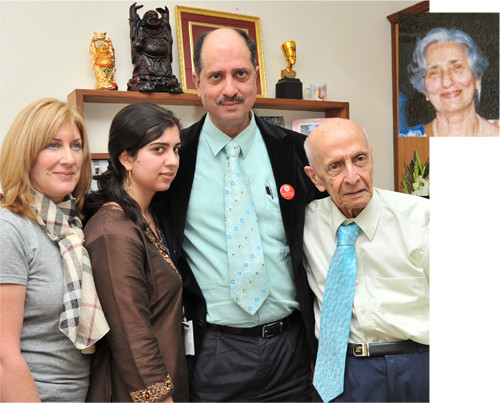
Grant family (from left): Jill, Natalie, Drs Purvez, Keki; (inset) Tehmi
Besides serving as honorary physician to the governor of Maharashtra and many other dignitaries the cardiologist also made space and time for the underprivileged at RHC. Additionally he conducted regular camps in the rural regions of Maharashtra and organized health check-up camps for the police department and different government agencies, orphanages and destitute homes. He enjoyed the distinction of being a Fellow of the American College of Chest Physicians and founder Fellow of the Indian College of Physicians and appeared in the Limca Book of Records 2009 as the longest practicing physician. Many were the awards that came his way including the Lifetime Achievement Award by the Indian Medical Association last year, by the World Zara-thushti Chamber of Commerce in 2008, the Punya Bhushan Award in 2004 when he was referred to as the "pride of Poona,” the nation’s Padma Bhushan award that was announced after his demise on January 26, 2011. An epithet that summed up his life was "an ordinary man who has tried to do extraordinary things.”
His father Byramjee worked in the railways and his mother Freany "inculcated in me the spirit to survive the odds,” Grant had conveyed in an interview with Parsiana in June 1999. Popularly known in Poona as "Hector” (a nickname given to him in childhood in admiration of an old family friend Hector Kothawalla), Grant unabashedly admitted, "I have an obsessive personality.” Wife Tehmi who succumbed to cancer five years ago had then elaborated on his style of stretching to the limit whatever he had set his mind to. After her passing away it was their daughter Zareen who gave him moral support at home while son Purvez as chief cardiologist at RHC’s Cardiac Centre assumed more responsibilities at the hospital.
Known to lead a disciplined life, for years Grant would walk the nine kilometer stretch from RHC every evening to reach home in time for dinner that invariably included boiled fish and fresh beans. He enjoyed western classical music and movies as much as he did jogging and playing golf outdoors. The intrepid doctor was shot in the knee when he was on the Bombay-London flight that was hijacked in Karachi. Despite the agony, he and Tehmi were able to save themselves by jumping from the wings of the aircraft, a lurch that prevented him from walking for the next three months.
A founder trustee of the Association for Revival of Zoroastrianism, Grant’s liberal stance was not appreciated by the orthodox pockets in Poona. As chief guest at the valedictory function at the Third World Zoroastrian Youth Congress in Poona in December 2003 Grant had advocated acceptance of children of interfaith marriages and declared, "I am not happy with the situation of the Parsis today. We are diminishing by leaps and bounds. The only way we can retrieve ourselves is by the thoughts and reformist policies of western Parsis. We are sticking to the same old rituals, the same old ways. Do you want this wonderful community to just vanish away?” When receiving the award from the Federation of the Parsi Zoroastrian Anjumans of India in 2004 Grant had conveyed that he was not in favor of conversion per se, only acceptance of new Zoroastrians if they were people of standing and staunch in their beliefs.
Caring for Grant in his last days was "an honor bigger than being a physician to the president of the nation,” felt Dr Prachee Sathe, relieved that Grant suffered from "no big illnesses, only the age related issues for which the medical sciences have no answer.” Added Sathe, "Dr Grant was as obedient as he could possibly be as a patient but as soon as the procedure was done, he was keen to go home even in the middle of the night. We tried to keep him longer in the hospital… but he would use his power as the ‘boss’ and get an ambulance ready to go home. Before anybody could know he is in the hospital, he would be gone to the place he liked the best — his own home, his garden, the birds, the sun, the flowers.”
The daring doctor is survived by his son Dr Purvez and daughter Zareen.
◆ ◆ ◆
From the archive