
Medicine/Health
Doing a bloody good job!
Dr Zarin Bharucha has devoted her career to ensure that safe, quality blood is supplied to those who need it
"A regular donor’s blood is always time-tested. It is important to screen donors. In Singapore, Australia and Japan, the law punishes people who donate blood in spite of knowing that they are HIV positive. Although the Indian Penal Code has such a section...in India we cannot implement it as people then will not come forward,” declares Dr Zarin S. Bharucha, a founder member of the Federation of Bombay Blood Banks (FBBB) and currently its chairperson since 1996. Her knowledge of blood banking and transfusion medicine acquired over the last 37 years has been effectively utilized by different national and international organizations with which she has been associated.
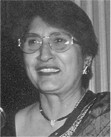
Bharucha: ensure quality
She is a member of the Expert Committee, Blood Safety Department, World Health Organization (WHO) headquarters, Geneva; council member of the International Society of Blood Transfusion, member of the Global Collaboration of Blood Safety (GCBS), member of the National Blood Transfusion Council, and chairperson of the Blood Transfusion Committee, Bombay Red Cross. According to a National Blood Policy that was drafted by a committee chaired by Bharucha, it is the hospitals which should be made responsible for blood supply and not the patients’ relatives, whether emergency or not. The whole system is getting revamped but what is needed is "more support from the government for approvals and the media for awareness,” states Bharucha reiterating that voluntary blood donor recruitment is the safest way to ensure quality blood.
"Everything that one does should (ensure) quality — procurements, staff training, screening of blood donors, testing, storage, separation and processing of blood, documentation... (We need) good manufacturing practices in order to have quality! Yes, a blood bank is considered a manufacturer. It is a product to be given to a patient. In essence, it is considered a drug and, in India, it comes under the Drug Controller. Until and unless the Drug Controller licenses the blood bank, it cannot operate,” explains Bharucha who, with her vast experience, has also trained the Food and Drugs Administration (FDA) inspectors.
Through the GCBS, "we assess the needs for blood transfusion (BT) service in various countries and develop standards for their blood banks. We also see what is being done in the developing countries, how the blood is tested, how they manage within their limited resources... We have various committees to take care of these aspects. I’m on the committee of quality control,” mentions Bharucha.
At the local level Bharucha registered FBBB as a society and a charitable trust. Soon there was better cooperation between blood banks and techniques improved. The FBBB was successful in pushing the voluntary blood donation movement and creating public awareness. Currently, an interactive voice response system is introduced through the Mahanagar Telephone Nigam Limited (MTNL) for the benefit of Bombay citizens. All one needs to do is dial 1910, a toll free number, to get information regarding availability of blood.
FBBB has become a unique organization in the country. A number of Indian states have tried to emulate it, but remain unsuccessful. Explains Bharucha: "This is because a lot of cooperation and coordination is required. We had brought people together by helping them solve their day-to-day technical problems. Since nursing homes do not have their own blood banks, we are trying to organize funds to deliver blood to nursing homes via scooters — like the ones that carry pizzas for customers.”
In April 1985 Bharucha left for Riyadh’s National Hospital as BT specialist. She was assigned the job of starting an independent blood bank there: "The blood bank present there was dependent on blood from USA. There was fear that the blood could be HIV infected. Our aim was to get blood from locals voluntarily. We put up posters, roped in expatriates and created awareness of AIDS. It was particularly difficult to get donors during Ramadaan (fasting month). People used to come forward to get their blood groups checked for getting a driving licence. We made it a pre-condition that they will have to donate blood if they wanted their blood groups checked.” This idea worked well. The blood bank at the National Hospital started successfully collecting blood from locals. The center received accreditation from the American Association of Blood Banks (AABB).
AIDS awareness has actually aided the BT program in India as well. Now the National AIDS Control Organization (NACO), which comes under the Ministry of Health, New Delhi, has started controlling India’s BT programs.
In fact Bharucha developed an interest in transfusion medicine in 1966 when she joined the Tata Blood Bank at the J. J. Hospital: "In those days we used to collect blood in bottles. I learnt everything connected to blood banking — how to prepare solutions, prepare our own sets, what the needle should be like, when it should be discarded... I even learnt about reagents which are used for testing blood. We got patients suffering from thalassemia who required BT. Under the guidance of Dr R. S. Sharma, chief blood bank officer, Tata Blood Bank, we did research on these patients. They are usually from certain communities in Maharashtra. We then went to Mangalore and Goa to do genetic studies. In 1969, when it appeared in journals that the Australia Antigen was associated with Hepatitis, we started developing a technique and doing the test ourselves. By the early seventies I was the first in India to start testing Hepatitis patients.”
In 1969 Bharucha did a two-month course in Blood Group Serology and Blood Transfusion Methodology at the Blood Group Research Centre (BGRC) of the Indian Council of Medical Research, Bombay.
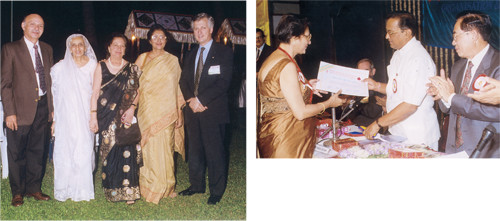
Left (L to R): S. Bharucha, Silloo Kavarana, Chandy Batlivala, Z. Bharucha and the late Dr Ian Young, head of the Blood Department, International Federation of Red Cross. Above: Z. Bharucha receives an award from West Bengal mayor Satam in 1998
In 1971 Sharma left for Australia. Being an academician himself, he had dinned into Bharucha the importance of academics. Besides, she knew that she would not go far without any post-graduate qualification. She joined the Nair Hospital and T. N. Medical College in June 1971 and took over its blood bank. The Nair Hospital blood bank at that time was considered the best in the city "in spite of many lacunae, including a severe space crunch.” Bharucha completed her MD (Doctorate of Medicine) in pathology and bacteriology in 1974. Sadly, BT was not part of the MD course. Laments the doctor: "There was no formal training course anywhere in this field. It is only recently that some board exams in BT have started in the US. An MD course in BT has also started in Lucknow, and is recognized by the Medical Council of India as a specialty.”
Whilst at the Nair Hospital, Bharucha was granted a six-month WHO Fellowship in BT at the Southwest Regional Transfusion Centre, Bristol, UK. It is only after undergoing the Fellowship in 1979, that for the first time in India, in 1981, she managed to get a Cell Separator, a machine used to separate platelets from blood for cancer patients. In 1982 she once again went to UK for further training in this technology.
In April 1988 the pathologist took over the management of the blood bank at the Tata Memorial Hospital. She converted it into a state-of-the-art Department of Transfusion Medicine with comprehensive systems.
After her retirement from the Tata Memorial Hospital in 2000 Bharucha was appointed national consultant by the WHO to assist NACO in their project to establish modern blood banks in some backward states of India like Bihar, Madhya Pradesh, Rajasthan and Uttar Pradesh. As project coordinator, she selected suitable sites for establishing model blood centers, developed blue prints, devised equipment specifications, advised procurement of equipment, prepared staff requirements/organograms and job specifications, and drafted and obtained signed MOUs (Memorandum of Understanding) for commitment from states. She is now handling temporary assignments as short-term consultant or temporary advisor for WHO, South East Asia Regional Office (SEARO) and the head quarters at Geneva.
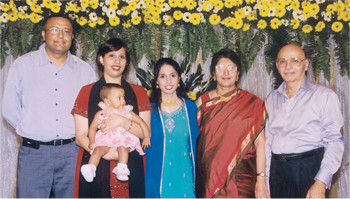
Family portrait (from left): Manesh, Dilnavaz, grand-daughter, Tanvi, Khush-numa, Zarin and Soli
Apart from contributing to several national and international journals, and academic publications she has authored the book, Introduction to Transfusion Medicine and has edited the book, Organisation and Management of Blood Transfusion.
At present she is busy organizing the Asia Pacific Conference of the International Society of BT to be held in New Delhi in November 2003. Teaching BT is very important for Bharucha as "it is not done correctly in all developing countries all over the world.” She had to undergo several educational visits abroad and learn everything there is to learn. Therefore she has always felt the need for starting a BT training institute in India. She is presently working on a project of establishing a training center in Bombay for the Maharashtra State BT Council.
Bharucha, herself, had to pursue medicine against great odds, born in a middle class family on October 23, 1940. While father Minoo was principal of the Jejeebhoy Dadabhoy Charity School, mother Dossan was a housewife. Minoo never wanted his daughter to study in the same school where he was principal. Zarin was admitted in the Sir Cowasji Jehangir High School (Gujarati medium). A very conscientious student, she made time for extra-curricular activities such as debates, elocution competitions, drawing, etc. After passing her School in 1957, she studied science at Elphinstone College. Whilst her school principal advised her to study law, her father was insistent that she take up medicine, as his own studies in medicine were left incomplete due to financial constraints.
As fate would have it, Minoo expired a year later when Zarin had completed only her first year in college. Family members advised her to give up studies, find a job and start shouldering family responsibilities. Only Jal Engineer, a professor taking extra classes in the first year of college and inter-science, persuaded Zarin to pursue her studies irrespective of whether she could pay the fees or not. She passed her inter-science with distinction, passed her MBBS from the Seth G. S. Medical College and after completing her residency at the K. E. M. Hospital, tried to start her own practice. Seeing the plight of patients and having gone through a financial crisis herself she "used to feel bad charging patients,” she says with a warm smile. On realizing that private practice was not her cup of tea, she joined the Tata Blood Bank.
An ardent follower of the Zoroastrian religion, the doctor does not agree with "all the views of Parsis. Though considered a westernized, modernized, forward-looking community, what is happening now seems to be just the opposite. I am not against inter-caste marriages. My own daughter is happily married to a Gujarati boy. Amongst such couples both may follow their own religion and allow their offspring to choose the religion between the two... Religion and caste are two different issues.”
On dakhmenashini, she comments: "The method used for dakhmenashini was adapted to the environment in earlier days. Now, it is better to introduce cremation instead of allowing bodies to putrefy in the absence of vultures at the Tower of Silence.”
Bharucha values the unflinching support from her loving husband Soli, a retired senior executive from Kilburn Engineering Limited. Soli keeps himself occupied as secretary of the A. H. Wadia Baug Society, Parel where he resides with Zarin and younger daughter Khushnuma, a research officer, working on the stem cell project of Reliance Life Sciences. Their elder daughter, Dilnavaz Zaveri, a housewife, married to Manesh, is settled abroad. Zarin has two siblings. Elder brother, Kersi Gyara, did his BCom and aimed to become a chartered accountant. Unfortunately, nature struck and he suffers from a mental ailment. Younger brother Rumi Gyara, "a self-made man,” is an electronic engineer and a successful entrepreneur in Bangalore.
Nearly a dozen awards have been conferred on Bharucha to honor her professional commitment. But she prefers not to dwell on them, saying: "One keeps working and one keeps getting awards.” Her source of inspiration is her conscience "that doesn’t allow me to sit back.”
◆ ◆ ◆
From the archive