
Cover Story
The Pulse at the Jehangir
A new cardiology unit, a unique Bone Bank, superspecialization and a dedicated Research Institute prescribe progress at Poona's Jehangir Hospital
It stands at a major intersection, a stone’s throw from Poona railway station. The cacophony of traffic outside is great, but inside the compound of Jehangir Hospital all seems serene, despite the bustle of patients and medical men. The venerable tower of Readymoney Villa, Sir Cowasji Jehangir’s old bungalow, holds its own alongside new Hospital buildings. Tall trees spread their salubrity over the campus.
The Jehangir Nursing Home, as it was earlier called, was founded in 1946 by Sir Cowasji Jehangir and Lady Hirabai, explains the present, fourth baronet Sir Cowasji Jehangir, who is the founders’ grandson and chairman of the Hospital trust. "The only real hospital then in Poona was the Sassoon General Hospital and the need was felt for a privately run facility which could provide sensitive, personalized care. My grandparents donated their own property and started what was Poona’s first private nursing home along with Dr Edulji Coyaji who was a well-known family physician at that time,” he continues. The fledgling nursing home was named Jehangir Nursing Home after the then baronet’s son Jehangir who died in an air raid accident in London in 1944. An adjacent property was also acquired with philanthropic foresight. "My grandfather however never really actively participated in the running of the nursing home. Lady Hirabai did. She was its heart and soul till her death in 1976,” says Jehangir.
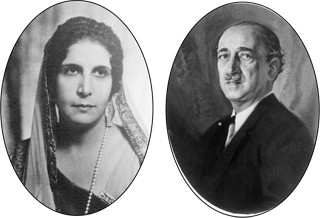
The founders: Lady Hirabai and Sir Cowasji Jehangir, second baronet
The bed strength grew over the decades as the trustees continued to work towards their "mission of providing high quality health care at affordable prices.” In the early years, the "campus was full of barrack-like structures which were a nightmare to manage. We were constantly elbowing this or that (block) to make way for new departments,” smiles the chairman. The healing touch, however, was never in short supply — eminent doctors like Rustom Cooper, Banoo Coyaji, H. V. Sardesai, Keki Grant (who later set up Ruby Hall Clinic), Sammy Mody and others were all associated with Jehangir Nursing Home from the 1960s. Adding to what the doctor ordered through the ’70s and beyond were Drs Kabraji, P. K. Bharucha, Noshir Antia, Goolcheher Coyaji, S. S. Deshpande, Ratan Edibam and others. Deshpande and Edibam still head, more than 30 years on, the departments of medicine and surgery respectively. Conspicuous in the passage outside the obstetrics department is a portrait of the late Dr Roda Dhalla who headed that department for a number of years. The present medical director Dr Erach Bharucha joined the Hospital in the 1980s. The institution has several "firsts,” including the first open-heart surgery performed in Poona in 1972 and several open-heart surgeries by the noted cardiac surgeon Dr Magdi Yaqoub of England in early 1973.
In 1989, the pulse beats of the institution bespoke change. Driven by superintendent Maj Gen D. B. Doctor’s dynamism and backed by the chairman and board of trustees, a new five-storied building came up, transforming the nursing home to what became known from the early ’90s as the Jehangir Hospital and Medical Centre. With the introduction of more modern diagnostic and therapeutic facilities, "we moved to a higher level of patient care, with upgraded operation theaters, more ICUs (intensive care units) and specialized work,” elaborates Jehangir.
The association from 1998 with the Apollo Hospitals Group has brought in new therapies. Jehangir explains the background: "Ours is a quintessential trust hospital. The charitable trust objectives are never to be compromised. Apollo is a corporate body. They were to bring in standardized protocols. They would upgrade systems, bring in better project management and hospital management. Our policy, approach, objectives would remain the same. It was a decision we agonized long and hard over. The arrangement has worked exceedingly well. The association with Apollo has taken us into the tertiary (higher, third) level of healthcare.” In 2002, the name was shortened to just "Jehangir Hospital.”
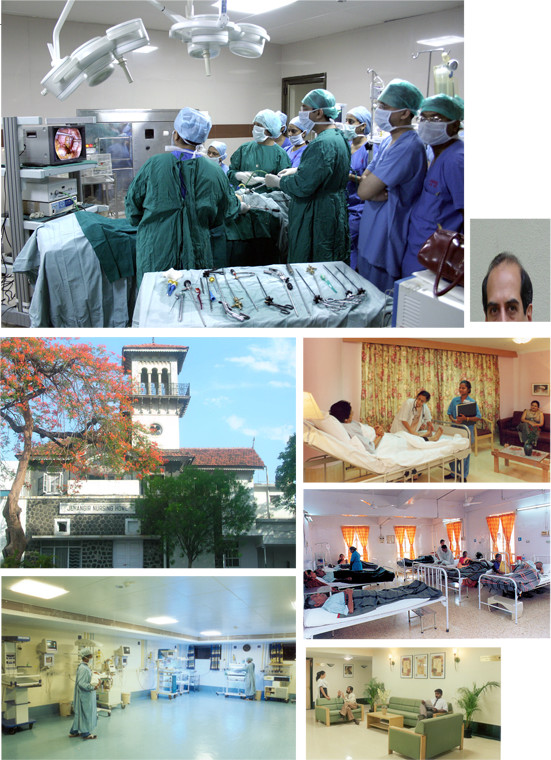
Clockwise from top: Laparascopy in progress, present chairman Sir Cowasji Jehangir; care and comfort at the Hospital; neonatal ICU; the old family bungalow
With an additional floor under construction, the Hospital will have around 330 beds by year end, marketing manager Sainath Pradhan informs us. "But we like patients not to think of this as a hospital, with a stark atmosphere,” he asserts. Renovated rooms and wards have been made livelier, with brighter and warmer colors used for walls and curtains, framed pictures adorning corridors. Jehangir’s wife Jasmine actively involves herself in improving ambience, lending a personal touch. "We will soon have our own, full-fledged cardiology unit expected to be ready by November, with dedicated cardiac theaters, ICU, etc,” says Jehangir, adding that the N. M. Wadia Institute of Cardiology within the Hospital campus is a completely independent institution run by Dr Sammy Mody. (Decades ago, at a time when there were but few cardiology specialists in Poona and Mody had received a donation from the N. M. Wadia Trust, he had requested Lady Hirabai to apportion an area of the property to start an institute of cardiology, Jehangir explains.)
"When Apollo came in we had just six-eight ICU beds. Doctors would get into heated arguments as to whose patient should get the bed!” the baronet recalls. "Today we have over 50 critical care beds spread over different departments. A whole slew of young superspecialists have come in.” In the early days there were but few visiting doctors, adds Edibam. The three full-time salaried doctors — Deshpande, Dhalla and himself — looked after the needs of the patients. Cooper would come once a week from Bombay to operate and patients would be collected and kept ready for him! Nursing superintendent Sheramai Framji was quite an institution. "It is the people who work who make the difference ultimately. It has been very satisfying working here,” asserts Edibam.
With over 50 departments, the Hospital is a recognized center for reconstructive and micro vascular procedures involving hand trauma and deformities and other emergency management, kidney transplants, computer aided joint replacement, thrombolytic treatment for brain stroke, minimally invasive surgery, cancer treatment, etc. The neuro, neonatal and pediatric ICUs, the department of infertility, the Facial and Dental Reconstructive Clinic, 24-hour Blood Bank and pharmacy, the ICU on wheels (the fleet of ambulances with ventilators, defibrillators, scoop stretchers, etc)… are all geared to meet new challenges.
Situated within the complex too is the Hirabai Cowasji Jehangir Medical Research Institute (HCJMRI), doing study and drug trials in the fields of oncology, pediatrics, endocrinology, chest disorders, gastroenterology, urology and AIDS. "The HCJMRI is personally very important to me. It was established in 1995. I was keen that Jehangir Hospital have a research unit. It adds integrity to an institution. Sceptics said it was never going to work. But we have established ourselves, done a host of clinical trials under strict protocols for leading pharma multinational companies,” asserts Jehangir. Recognized by the Directorate of Scientific and Industrial Research, Government of India, the HCJMRI is among the few clinical research institutes in India capable of conducting Phase I, Phase II and Phase III clinical trials.
"Our chairman (Jehangir) is our inspiration. The Research Institute is his brainchild,” opines HCJMRI director Dr U. P. Divate. She commends managing trustee Nusly Pudumjee as a "father figure” to the Hospital and to the Research Institute.
Among the HCJMRI’s pioneering projects is the Bone Bank, established in 1998, under Dr Ramesh Sangle, as the first government recognized one for cadaveric bone grafts. Operations involving bone replacement following bone loss due to disease or accident have been carried out on Poona patients and those from Bombay, Nasik, Ahmednagar, etc. The Bone Bank has also carried out research on evaluation of cadaveric bone grafts in neurosurgery, orthopedic and craniofacial surgery.
Besides Jehangir and Nusly Pudumjee, other members on the board of trustees of the Hospital are Jasmine Jehangir, Kaikobad Pudumjee, Pheroz Pudumjee, Dr Sammy Mody, M. Y. Paranjpe, Behram Dubash and Erach Bharucha. "There will be another major expansion in the next five years,” declares Bharucha.
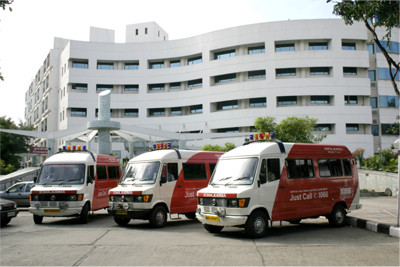
Ambulances with life-saving equipment on call
With the inclusion in recent times of 38 villages within municipal corporation boundaries, the burgeoning Poona population is reportedly nudging the three-and-a-half to four million mark. On Jehangir Hospital’s website www.jehangircares.com are detailed statistics regarding environment, accompanied by a few photos by Bharucha who is a committed environmentalist. The site states that factories in the Pimpri-Chinchwad industrial belt have zoomed from 150 in 1947 to 4,637 in 1998! The Information Technology boom, the unbridled construction and proliferation of vehicles (from the registered 6,240 in 1960 to 9,33,156 in 1998, as per the site, as well as the subsequent increase) have seen horrendous and frequent accidents on Poona’s roads. "Among other things, we would like to set up multi trauma centers not just in Poona but on the peripheries as well,” adds Bharucha. Jehangir Hospital and Dr. K. B. Grant’s Ruby Hall Clinic figure prominently on the list of the city’s as-yet-few, leading multispecialty hospitals, though there is a slew of smaller nursing homes.
Presently, the range of rooms at Jehangir Hospital varies from general wards to semi private rooms to super deluxe suites. "More than 60 percent of the beds are subsidized on the rates we offer. In case of someone particularly deserving, we give relief over and above that. The social worker assesses a patient’s financial needs. The money generated from operations is ploughed back. The meeting of our objectives has been enhanced by the association with Apollo,” observes Jehangir. Donations to the Hospital are eligible for tax exemption under Section 80-G, while donations to the HCJMRI are 100 percent exempt under Section 35 (i) (ii).
The Hospital’s website also provides pointers to "wellness” and keeping fit. "It is the Hospital and its doctors that provide the inputs to keep you well, and perhaps ironically, away from it!” says Jehangir. "As for myself I feel privileged to be associated here.”
◆ ◆ ◆
From the archive