
Books
Ethical leadership
Noted jurist Fali S. Nariman releases the second edition of Russi M. Lala's book In Search of Ethical Leadership
In Search of Ethical Leadership by Russi M. Lala. Published in 2005 by Vision Books Private Limited, 24, Feroze Gandhi Road, Lajpat Nagar III, New Delhi 110024. Price: Rs 190. Pp: 200.
The author Russi Lala, has chosen to bring out through a study of world history and biographies of eminent leaders, the relationship between means and ends. The interesting aspect of the book is it doesn’t cover the theme personality-wise but theme-wise, notes a write up on the book launch function. Some personalities like Lincoln, Gandhi and Churchill appear under 13 themes like communication, compassion, competence, decision-making and man-management.
The 2005 edition of In Search Of Ethical Leadership was released at the national convention on "Transparency and Accountability in Public Governance” organized by the IC Centre for Governance in association with the All India Management Association (AIMA) on April 9, 2005 at the India International Centre, New Delhi.
The audience included the chief election commissioner, chief vigilance commissioner, a number of retired Supreme Court judges and senior Civil Servants. The audience themselves demonstrated the interest of the public in the subject of ethical leadership. The former Chief Justice of India, Venkata-chaliah presided.
The author speaking on the occasion said that the most powerful factor is ‘accountability’ in one’s work and the conscience of the person making the decision. And that if his book could serve the purpose of awakening that conscience, he will feel gratified.
Fali S. Nariman, member of parliament and eminent lawyer who released the book requested the author to ensure that all members of the parliament have a copy of the book.
Here is an edited transcript of Nariman’s speech at the book launch:
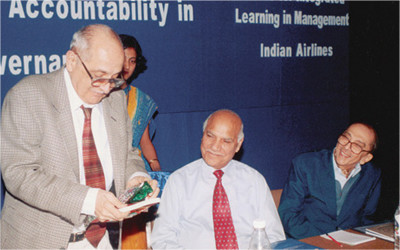
From left: Nariman releasing book, D. N. Khurana and Lala
Russi Lala and I are very old friends. It was 60 long years ago that we both entered St Xavier’s College, Bombay on the same day. Each of us had been molded by learned and compassionate Jesuit missionaries who were our professors. Some of them were our earliest ethical leaders because they informed and guided our young and plastic minds.
If, as Will Durant says, education is "the technique of transmitting civilization,” the civilizing influence was transmitted to us in our four years in College.
The most illustrative example was the presence in the College of Rev Father Heras. He was a familiar figure to generations of Xavierites. He had a long, flowing silken beard, and looked like one of the minor prophets from the Old Testament — or more appropriately, like a rishi from the Himalayan snows! Russi, who took History Honors in College was a pupil, and a great admirer of Heras.
A historian of the Indus Valley civilization, Heras had deciphered the script of Mohenjo-daro. He was one of the very few historians who maintained that Mohenjo-daro (which means the City of the Dead) was Dravidian in origin, and not Aryan.
I mention Father Heras because when I read Lala’s book yesterday I was convinced that the unconscious and unacknowledged inspiration for this work was the admiration that Lala always had for Heras.
But Russi and I also have a shared memory of another professor, Rev Father Gense who was of a different type — a writer of history books, he walked with an awkward gait, and wore on his head at a rakish angle what looked like a Parsi prayer cap! When we crossed him in the corridors of St Xavier’s and greeted him with: "Good morning, Father, how are you?” He always replied with a chuckle: "Hee, hee — Like the British Empire, I am slowly disintegrating.”
The theme of the book just released which I read through not once, but twice, and which all of you will enjoy reading — could well be the theme of this national convention. Transparency and accountability in public governance is just not achievable without ethical leadership: it is ethical leaders that inspire good citizens.
Lala has drawn liberally from history and biography in shaping this small but great book. This book is not about ethics nor about ethical goals. Ethics has been defined in the Doubter’s Dictionary as a matter of daily practical concern described glowingly by those who intend to ignore it.”
And my own experience has been that ethical goals are good only to assuage one’s conscience — for those who have any conscience — but they have no effect on those who have none.
That is why corporate codes of ethics have been tried and have failed. If you think that CEOs of large corporations (transnational or national) are "leaders” only because they head such corporations, you have to think again. All these tycoons drawing astronomical sums of money are falling like dominos — tempted with the lure of filthy lucre: J. R. D. Tata who is given a special chapter in a postscript at the end of the book is a notably rare exception.
In fact I recall JRD telling me some years ago when he came to consult me in respect of a privilege motion against him in Parliament – he thought he was quite important: but then he was totally deflated when at a seminar three other personages who were to speak were introduced by the chairman with long detailed reference to their CVs. And then the chairman of the meeting came to JRD saying, "And as for Mr Tata, the less said about him the better!” The chairman meant to say that JRD was so well known that introducing him was superfluous. JRD loved stories against himself.
Lala’s book is not about ethical codes at all — but something entirely different — of those innate qualities of head and heart, which go to make leaders of men and women.
Fortunately we have an example of an ethical leader in our midst. When Justice Venkatachaliah was first appointed to the Supreme Court, chosen by then Chief Justice Pathak and recommended by him, he was by no means the senior-most judge in the High Court of Karnataka. He was only third in the High Court hierarchy.
I had never seen him or appeared before him in the High Court. And when he first came to the Supreme Court he sat with Justice A. P. Sen. I went to that Court on the first day only to see what the new judge looked like. Though still one of the junior judges in the Supreme Court, over time he established himself as a person who inspired members of the Bar (me particularly) and also earned the respect and admiration of most of his colleagues as well.
There is a story about Napoleon — a figure whom Lala mentions in this book. In the Preface to the very first edition of a set of about 40 volumes known as Halsbury’s Laws of England, the Earl of Halsbury who compiled them, speaks of the code of laws framed in France when Napoleon was Emperor. This unschooled and untutored man, by sheer force of common sense, was able to dictate — himself dictate — large parts of the Civil Code which ultimately became known (and which in the opinion of Halsbury became rightly known) as the Code Napoleon. That is the quality of an almost intuitive intellect found only in a born leader. But alas Napoleon had no heart. History records that in the year 1812 he left almost a million of his soldiers to die in the snows of Russia, and himself escaped back to Paris.
Witness again another great leader — a great ethical leader Mother Teresa. She was a person distinctively Indian, though not born in India. And she was all heart.
When she was conferred the Nobel Peace Price in 1979, she mentioned in her acceptance speech at Oslo (in February 1980) that the right to live was the most universally fundamental of all human rights. I heard the radio broadcast of this speech and cannot forget it. Mother Teresa recalled an incident in Calcutta which showed how anxious were the poorest and the lowliest to protect the Right to Life, not for themselves alone, but also for others. She spoke simply and with compassion, her acceptance speech was later published and I quote from her speech:
"I had the most extraordinary experience with a Hindu family who had eight children. A gentlemen came to our house and said: ‘Mother Teresa, there is a family with eight children: they have not eaten for so long; do something.’ So I took some rice and went there immediately. And I saw the children — their eyes shining with hunger. I don’t know if you have ever seen hunger. But I have seen it very often. And she took the rice, she divided the rice, leaving some for her family and then she went out with the rest. When she came back I asked her: ‘Where did you go, what did you do?’ And she gave me a very simple answer. ‘They are hungry also.’ What struck me most was that she knew — and who are they? A Muslim family...
"I didn’t bring more rice that evening because I wanted them to enjoy the joy of sharing.” A fine thought – to enjoy the joy of sharing.
Mother Teresa — like Mahatma Gandhi before her — emphasized the need not just to universalize human rights but also to universalize respect for them. She was an ethical leader.
To come back to Venkatachaliah (I do not wish to embarrass him) but I feel compelled to say that as he notched up his eight years in the Supreme Court of India he rose in intellectual stature and earned the respect of the Bar for his ethical and moral stature. He too was a leader — an ethical leader. And soon became a fitting example of another of my favorite Napoleon stories.
It was said of Napoleon that one day when he was at a reception talking earnestly to a group of people in the far corner of a large room, his secretary came up and whispered to him that he should move to the center so that others could come and talk to him and pay their respects to him. But the Emperor had a terrible temper. He stamped his foot and said, "Wherever I stand, that is the center of the room.”
So, wherever Venkatachaliah sat in Court, whatever his seniority, there was the center of the Court.
In the northern hemisphere, there is a constellation which is only visible at a particular time of the year. Astronomers call it the Ursa Major — more popularly known as the "Great Bear.” The constellation includes seven bright stars. In Indian astronomy these stars represent the seven ‘Rishis’ — the Saptharishi. Two of them are pointers — they show the path, they point to the Pole Star.
In the judicial firmament in the past 55 years there have been many bright and brilliant judges but the pointers — the pathfinders have been few. I can still name only three — Chief Justice Subba Rao, Justice Krishna Iyer and Chief Justice Venkatachaliah.
They were leaders — because they influenced creative judicial thinking. They lighted up new, difficult and different paths, paths which others followed.
When Prof Goodhart died in 1975, completing 50 years as editor of the Law/Quarterly Review, Lord Diplock wrote about the enormous influence he had on those who had comprised so large a part of the higher judiciary of England. Diplock mentioned of Prof Goodhart that he had, over the years, "altered the habits of the mind of judges.” To me ethical leaders are those who serve as examples — who alter the habits of mind of men and women of their time.
But there is something about ethical leadership that defies definition: it has little to do with how clever you are. It will be recalled that the sages of the Upanishads who selected their pupils did not rely on choosing those with intellect. Not that the intellect is useless — it has its modest place and serves us well when it deals with tangible things. But it falters before the elementally real; and the ethical part of leadership is one that is elementally real;
This book is not only a great book but it is an educator.
It is authored by a man I have known and admired for 60 long years — an ethical man: only such a man could write such a book.
When Russi and I were in college we were both greatly inspired by Jawaharlal Nehru’s Discovery of India. That is a great book because it has a great vision, a vision of a united and pluralistic India. When all this mindless controversy of saffronization and desaffronization arose, I pleaded in Parliament to members of the then Government (and I did the same to the members of the present Government) to prescribe Nehru’s Discovery of India as a book for teaching in the universities. It would inspire students and, it would make them better Indians, and it would make them better leaders of men and women.
But politics — modern day politics both here and abroad — is full of small people. And small people have prevailed. Nehru’s Discovery is still not prescribed even though we have a Congress government at the center.
We need tall people, high thinking people and this small book of Lala is a fine example of what must be prescribed and taught in high schools and universities since it gives you an insight into ethical leaders who have gone before.
A few years ago Archbishop Tutu, speaking in a cathedral in London asked his audience (rhetorically) as to why Mother Teresa (and Mahatma Gandhi) were so popular and why Nelson Mandela was such an icon. He himself offered an answer: "We should always remember that good things do happen — (because)… all of us have an instinct for goodness and we recognize it (when we see it)... People are proud to be human because they tell them this is what human beings can become.”
This book is important because it tells us what human beings can become. —I do earnestly commend it to you. Read it — it will help to make you all better men and women, and particularly to differentiate between a mere leader (or a neta which is the appropriate but, depreciated local expression) and the truly ethical leader.
I am honored to have released this 2005 edition of In Search of Ethical Leadership.
◆ ◆ ◆
From the archive