
Books
"Is it right?"
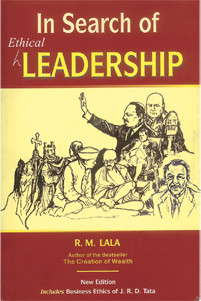
In Search of Ethical Leadership by R. M. Lala. Second edition published in 2005 by Vision Books Private Limited, 24 Feroze Gandhi Road, Lajpat Nagar III, New Delhi 110024. Pp: 200. Price: Rs 190.
In Search of Ethical Leadership by R. M. Lala. Second edition published in 2005 by Vision Books Private Limited, 24 Feroze Gandhi Road, Lajpat Nagar III, New Delhi 110024. Pp: 200. Price: Rs 190.
R. M. Lala’s In Search of Ethical Leadership, first published in 1986, has been reissued at a time of increasing ethical ambivalence. A significant part of the world is destroyed every day by unethical behavior. Scams and bankruptcies, which seem to thrive under bureaucratic and political patronage, are the order of the day.
What makes for great leadership? Can it be learnt? If so, what are the essential values and qualities that go into its making? By studying the lives, successes and failures of some of mankind’s greatest leaders, Lala, writing in his easy and eminently readable style identifies 13 aspects of leadership: communication, humility, teamwork, compassion, integrity, training,

Russi Lala: examining leadership
competence, man-management, vision, courage, purpose, decision-making, and stamina. Lala has chosen to bring out the relationship between means and ends, the moral dimension of leadership. The importance of each of these qualities is highlighted by examples from the lives of outstanding leaders. Bill Cameron Johnson’s illustrations provide a delightful break from the monotony of the written word. The new chapter on J. R. D. Tata’s business ethics is particularly illuminating. It brings out the wide canvas on which this titan of Indian industry chose to both define and practice ethics with remarkable business success. The instances of great leaders chosen by the author are drawn from different walks of life and the rich insights and understandings offered by the book would benefit leaders in every field of human endeavors whether it be business, military, public service or education.
Ethical leadership as a system of thought should be based on setting rules for what to do, not on what not to do. Ethics today is taught from a negative point of view. No body of knowledge, and certainly no successful behavioral modification training, can ever be based on a list of interdictions or describe all the categories of actions that are proscribed. Lala tells us how, for JRD, ethical management did not end with not paying bribes. It also meant caring for his workers and staff and also the people in surrounding villages where companies were located. Nor was his concept of ethics limited to doing what was legally right. Lala narrates two examples that amply illustrate this. First, there was Neville Vintcent’s case. Vintcent who had helped JRD in setting up Tata Airlines in 1932 had been receiving one-third of the profits. Five years later when the contract expired it was thought fit not to renew on the same terms since the profits had swelled from Rs 60,000 to nearly 10 times as much. Legally it may have been right, but morally it was not. JRD saw to it that Vintcent got his one-third share. Second, when Dinesh Vyas, the Tata’s tax consultant, told JRD that something was not illegal he was taken aback when JRD asked, ‘Is it right?’ JRD believed in total tax compliance. Not for him the lawful, but morally questionable, concept of tax avoidance.
Ethics is a top down phenomenon. Assuming that everything one says or does reveals something about the person, ethical leadership becomes a matter of accurately communicating one’s integrity, trustworthiness and honesty. Lala could have touched upon this important aspect of being seen as ethical in one’s dealings. This is where the rubber meets the road, and where ethics meets perception. It is often the case that the leader takes ethics for granted, and assumes that others are aware of his integrity. Given the leader’s distance from the average employee/common man, how would anyone know that ethical considerations enter into strategic policies or critical decisions? Only when the implicit becomes explicit. Only when ethical values are clearly communicated can the leader be perceived as ethical. As Azim Premji has pointed out in his ‘10 Steps to Leadership’ given as an appendix in the book: ‘First, leaders must develop powerful personal credibility. This means they should not only be consistent in what they say and do — but must deliver on their commit-ments…All research shows today that personal credibility is the most important ingredient of leadership.’
When dividends are low, or when people are laid off, the senior executive whose bonus is increased cannot be perceived as an ethical leader. Failing to participate directly in the sacrifice of others, the leader cannot be perceived as a person of integrity. In that one action, he reflects a commitment to individual wealth and status and an absence of compassion. That lack of concern for others and for the long-term viability of the company is broadcast loudly and clearly to all stakeholders who immediately perceive a lack of integrity and a lack of ethics.
Leading thinkers in corporate ethics agree that in the wake of recent corporate debacles, fixing the rules and doubling the penalties is not fixing the problem. If we are to prevent these incidents from happening again, the real issue to be examined is personal and organizational integrity. Upholding the rules in an organization requires a strong ethical compass from both leaders and employees and a values-driven approach.
A major source of cynicism about our contemporary leaders comes from the belief that our leaders regard us as naive and therefore try to fool us rather than lead us. Instead of encouraging people to solve problems and meet challenges in their communities and businesses, many of our leaders want us to believe that our work is to elect them so that they can solve our problems for us. Both in political and corporate contexts, we have been duped too many times by leaders who say they want to solve our problems for us. But at a deeper level, we are cynical about our leaders because we realize that our leaders are a reflection of what we as a nation have become. Our leaders are trained in our families, communities and schools and are elected by us. The misguided leadership and ethical confusion that we see in some of our leaders forces us to confront our own misguided and unethical ways. It is much easier to cynically criticize our leaders than it is to become the kind of people who will foster ethical leadership.
Business ethics are sustained by a purpose higher than one’s own self interest. Lala recounts how one of JRD’s guiding principles was that ‘No success or achievement in material terms is worthwhile unless it serves the needs or interests of the country and its people and is achieved by fair and honest means.’ Ultimately it is values, which are indispensable in building an ethical culture. Values should underpin and inform everything the organization and its people do. In this context the thoughts of someone remembered more for his musical than philosophical contributions to our society, Elvis Presley, are particularly relevant: "Values are like fingerprints. Nobody’s are the same, but you leave ’em all over everything you do.” Lala’s book should be made compulsory reading for men in public life as also for business leaders and bureaucrats.
From the heart
"Many years ago I began to write a majority of these poems for my children and their friends to recite at school contests, and whether it was my poems or their good articulation that won awards it was the start of my poetry writing journey,” stated poetess Ayra Cama at the release of her 85-page book of poems for children titled A Work of Heart.
Launched on October 9, 2005 in Bombay by actress-activist Shabana Azmi, a long-time friend and classmate from Cama’s Queen Mary school days, the poems "were written to meet with school requirements (of her children Reah and Rohaan) and carried a little message or were topical to fit with the children’s age at a particular time.”
Azmi who praised the warmth and bonhomie of the event recalled Ayra as "an eloquent Parsi girl who wrote brilliantly.” She read extracts from a poem titled "Whither Justice?” ("God made so many people,/But look around with a discerning eye,/Why did so many people, look like me,/And so few like Aishwarya Rai?”)
Educationist Rati Wadia, a former teacher and principal of Queen Mary, described Ayra as "one of my precious girls,” and stated, "Though written with the personal interest, the poems have that touch of wit and sensitivity that will affect many a mother’s heart, and they and their children will be able to relate to these poems and use them for reciting in elocution competitions.” It was "16 years since my mum wrote her first poem for me to recite in standard two,” said Rohaan Cama and over 11 years since she first contemplated publishing the book.
◆ ◆ ◆
From the archive