
Books
A salute to Sorabjee
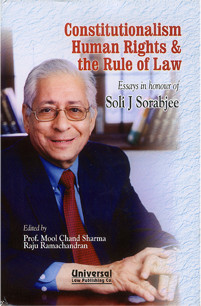
Constitutionalism, Human Rights and the Rule of Law: Essays in honour of Soli J. Sorabjee edited by Prof Mool Chand Sharma and Raju Ramachandran. Published in 2005 by Universal Law Publishing Company Private Limited, C-FF-1A, Ansal's Dilkhush Industrial Estate, G. T. Karnal Road, Delhi 110033. Pp: 295. Price: Rs 550.
Constitutionalism, Human Rights and the Rule of Law: Essays in honour of Soli J. Sorabjee edited by Prof Mool Chand Sharma and Raju Ramachandran. Published in 2005 by Universal Law Publishing Company Private Limited, C-FF-1A, Ansal’s Dilkhush Industrial Estate, G. T. Karnal Road, Delhi 110033. Pp: 295. Price: Rs 550.
A galaxy of legal eagles comprising the bench and bar of India as well as other countries attest to former attorney general of India, Soli Sorabjee’s popularity and the respect in which he is held as they contribute to a Festschrift on his 75th birthday. This "collage of opinions on the issues that have always mattered most to Sorabjee and on which he never failed to stand up and speak his mind” is, as Prof Mool Chand Sharma notes in his introduction, a fitting tribute though "it took all our efforts to break the reluctance of Soli to agree (to its publication).”
All the contributors have known Sorabjee, on whom the government of India conferred the Padma Vibhushan award in 2002, at the personal as well as the professional level. Hence the book is replete with allusions to events and interactions in the wings of state and international conferences and colloquia which not only add interest to elusive intellectual arguments but educate the lay reader on questions of legality, politics and the social concerns of our times.
It is former President of India, the late K. R. Narayanan, with his contribution titled "The President’s Role and Responsibility in the Constitution,” who leads the battery of intellectuals discussing the issues. Writes Narayanan, "I vividly remember my conversation with Soli when I put him a straight hypothetical query. Suppose the government wants me to assent to legislation which undermined the independence of the judiciary (Soli’s passionate cause) or injures the secular fabric of our country, Soli’s measured response was that acting on ministerial advice does not necessarily mean immediate acceptance of the ministry’s first thoughts. As a sage counselor, the President can state all his objections to any proposed course of action and ask the Council of Ministers to reconsider the matter. It is only in the last resort that he must accept their final advice. He added that if the President is strongly and conscientiously of the view that the proposed legislation to which he is required to assent is subversive of our constitutional values then the proper course is for the President to resign from his office and state the reasons for his resignation in public which prospect was sure to have a sobering effect on the ministry.”
Describing Sorabjee’s "remarkable legacy,” his contribution to the constitutional and public law fields, Lord Woolf, Chief Justice of England and Wales, writes, "Sorabjee has been fortunate to appear before the Supreme Court of India, one of the most innovative courts in the world and a forum that has been receptive to his creative ideas, but a great deal of important Indian jurisprudence would almost certainly not have come into being had it not been for his invaluable contributions.” Woolf then goes on to discuss the changing status of Britain’s Lord Chancellor, who traditionally combines a multitude of roles, in the context of constitutional changes now under way in the UK.
Discussing "The myth of sovereignty” Lord Cooke of Thorndon, one of New Zealand’s greatest jurists who retired as Lord of Appeal of the United Kingdom’s House of Lords, notes, "…it is a distortion to see the legislative and judicial arms of the state as constantly in conflict…Reciprocal influence is an ongoing process. Neither the government nor Parliament nor the courts have a monopoly of wisdom. Facile appeals to the will of the people can invite uninformed and unthinking responses.” Cooke seconds a statement by the editor: "Soli belongs to ‘that rare class who represent unique combinations of both convictions and the courage to stand for their convictions.’”
Queen’s counsel Anthony Lester provides an ongoing summary of discussions at Commonwealth colloquia – the first and last of which were held in Bangalore — where the varying experiences of Commonwealth member countries were brought to light as South Africa, Zimbabwe, Canada, Bangla Desh and others pursued their historical imperatives, the lawyers of each country drawing from and adding to the common judicial experience. For example, at the meet in Nigeria "There was a lively debate on whether international human rights standards were truly universal or were an attempt by Western democracies to impose their liberal standards on the rest of the world.” Adds Lester, "Remarkably, the debate concluded with complete agreement on the universal and interdependent nature of human rights.” Lester writes, "Soli played a key role on helping INTERIGHTS (the International Centre for the Legal Protection of Human Rights) to develop what have become known as (the 22 clauses of ) the Bangalore Principles.”
Justice Michael Kirby of the High Court of Australia discusses human rights in the context of the struggle against terrorism. "Fundamental rights do not go out of the window upon accusations of terrorism,” he notes, adding that Sorabjee has demonstrated this lesson throughout his career. Kirby refers to events in South Africa and Tanzania, the US and Guantanamo Bay, Britain, Australia, Indonesia, and comes to the conclusion, "Keeping proportion. Adhering to the ways of democracy. Upholding constitutionalism and the rule of law. Even under assault and even for the feared and hated, defending the legal rights of suspects. These are the ways to maintain the support and confidence of the people over the long haul. Legislators and judges should not forget these lessons.”
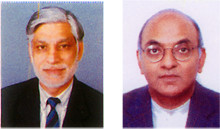
Co-editors Prof Sharma (left) and senior advocate Ramchandran
In a more personal vein former Chief Justice of India M. N. Venkatachaliah notes, "If liberty and human dignity are the dominant concerns of (Sorabjee’s) professional life, equally, love of literature especially poetry and music and those finer qualities and sentiments to which life owes its savor are the culture of his soul.” Recalling a photograph of two jazz artistes he had seen in Span magazine a long time ago, Venkatachaliah writes, "One was the tall frame of Benny Goodman; the other, of Soli, taken during one of his jazz yatras. Music is Soli’s passion. It is said that during one of his surgeries he preferred channeled music to anesthesia...But Soli’s claim to eminence rests equally on his great humanity and urbanity.” The judge recounts that a social worker monk devoted to the service of the leprosy afflicted had told him how Sorabjee had helped him in a legal matter. When the monk went to thank the lawyer, "Soli rushed inside only to come out with a cheque for a large sum as his own contribution to the client! This was unsolicited graciousness,” notes Venkatachaliah.
Veteran educationist and chairperson of the Springdales Education Society Dr Rajni Kumar remarks, "What makes (Sorabjee) such a charismatic personality is that at heart he is a youthful romantic living life with zest. There are few legal minds and professional giants of his stature who can claim such a wide range of interests and pursue them vigorously whether it be jazz or poetry-reading, bird watching (alas, not so much of it today) or writing columns for newspapers.” Kumar recounts Sorabjee’s time as chairperson of the Springdales School Board of Governors over six years when all private schools were tarred by politicians with the same brush as exploitative commercial institutions. The resulting welter of red tape, capping of fees and bureaucratic interference was making the running of schools very difficult and a number of important legal issues had to be debated in the courts. "Soli’s legal expertise, rational thought, balanced approach and his understanding of the need to judiciously blend autonomy and academic freedom with accountability, held sway with the courts and the needed relief was given to all the private-run schools to function and discharge their obligations effectively….Soli has often stressed that though the fundamental rights laid down in our Constitution are well known, very little attention is paid to the fundamental duties which can form the basis of good citizenship and which should find a place in the curriculum of schools,” she adds.
In addition to the messages of goodwill from the President, Vice President and Chief Justice of India, there are in all 25 contributors, among them the former Chief Justice of India Y. V. Chandrachud, the first woman judge of a High Court in India Justice Leila Seth, present and former solicitors general of India Goolam Vahanvati and Tehmtan Andhyarujina, irrepressible journalist (the late) Cusrow Irani, President of the Supreme Court of Israel Aharon Barak… All of them have a tale to tell, abstruse aspects of law to elucidate, a searchlight to illumine the way for stronger and better protection for the peoples of the world. Activism and self-restraint, criticism of the judiciary and contempt of court, appointments to the higher judiciary, contemporary issues in international humanitarian law — the editors have provided a large canvas for the reader to browse in and emerge enlightened.
◆ ◆ ◆
From the archive