
Books
Mody’s management
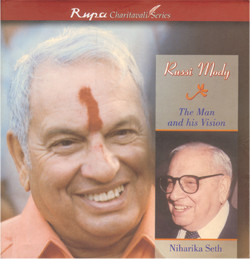
Russi Mody — The Man and his Vision by Niharika Seth. Published in 2004 by Rupa and Company, 7/16, Ansari Road, Daryaganj, New Delhi 110002. Pp: 95. Price: Rs 195.
Niharika Seth’s biography of Russi Mody — The Man and his Vision gives us rare glimpses about the life, achievements and character of the legend that Russi Mody was. The biography is full of fascinating stories and facts narrated in an easy-to-read style which makes Mody come alive for the reader.
The book charts out the larger than life figure of Mody, known for his "man-management skills,” making him one of a kind as he walks amongst kings while never losing the common touch. Seth’s book contains innumerable tips for the young entrepreneur, where Mody stresses that greatness may be an inherited quality that an individual is born with but it can survive and thrive only when accompanied by discipline, open-minded non-judgmental outlook coupled with discernment and practical common-sense. Giving credit to his parents Sir Homi and Lady Jerbai for inculcating in him the necessary discipline Russi mentions, "All in all, I had a very strict upbringing; yet, we were a very loving family. I adored my mother and feel she contributed a great deal to what I am today.” The book brings forth the unusual sense of humor and the temperament to face any unpleasant situation of one of the most dynamic and flashiest men in his field.
His biography takes one from his birth to his stints at Harrow and then Oxford and the rough and tumble of real life. It brings forth his sense of discipline — self discipline, and his extraordinary compassion and courage combined with love for people which was always based on a substratum of justice and fair play.
The book gives fascinating details of the 86-year-old Mody’s fondness for food, fast cars, airplanes and friendship with the legendary Albert Einstein. The chapter, "The High-flying Man with Apron Strings,” captures his many passions: "Having travelled all over the world Russi was exposed to different cultures and societies that broadened his perspective and understanding of the human race. While at the French Riviera, he learnt a number of local songs that he still sings, to the accompaniment of his piano. Apparently, once he even earned a few francs for his coffee at a small French bistro, by singing J’attendrai...
"It is not an uncommon sight to see Russi move easily and effortlessly from his grand piano to his cooking range. Yes, food is another one of his greatest loves. How often have you heard of someone eating a 16-egg omelette regularly for breakfast, or eating 120 puchkas at one sitting!...
"Russi enthusiastically says, ‘I love spicy Indian food and that’s what I have every day. I also get recipes from all over the world and try them out, sometimes very successfully and sometimes the dish has to be sent back to the kitchen.’ He simply saunters into the kitchen, and ties an apron round his waist, ready to cook a fantastic meal either for himself or for anyone else with him. He has a whole team of servants ready to serve him at the slightest beck and call. Their job is to bring him all the utensils and ingredients that he needs to cook up his delicious treat. One of Russi’s favorite preparations is Akuri...
"Another of Russi’s passions is flying planes. His love for flying was so great that during his tenure as the chairman of TISCO (Tata Iron and Steel Company), he flew one of the company’s twin-engine aircrafts, fully equipped with a private pilot’s license, and a cockpit full of enthusiasm...
"Naval R. Mody remembers those bygone days when he and Russi would play cricket in the garden at Cumballa Hill, where the family lived in a big house...
"Russi has always been truly concerned about sports in India, and the Tata Football Academy in Jamshedpur is a testimony to this fact. The pioneering institution singlehandedly raised the standard of Indian football by training young people at the grassroot level...
"Marsh Kumar, another friend recounts his experience of playing tennis with Russi... ‘Believe it or not, even after 18 holes of golf in the morning, five, six and at times seven sets were not enough to quench his voracious appetite for sports. The tennis courts throbbed with fun and a friendly competitive spirit.’
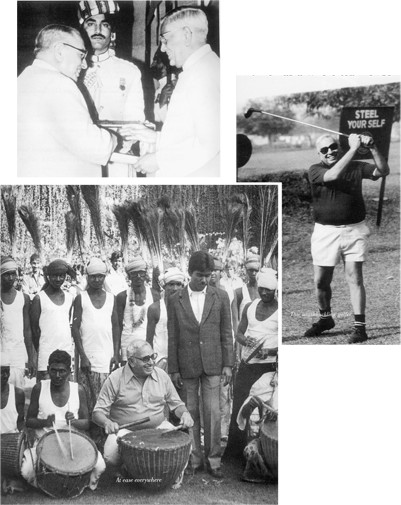
Clockwise from top left: Mody receiving the Padma Bhushan from President R. Venkataraman in 1989, enjoying a game of golf; at ease with workers
"(The) passionate sportsman admits, ‘I strictly avoid business talks when I play golf. I don’t try to mix business with pleasure and I am always very absorbed in what I am doing.’ This ability to concentrate fully is perhaps a very important ingredient in his success story. Concentration and skill are necessary to head a huge company such as Tata Steel and to make very important decisions as the chairman of Air India. However, those very attributes also come in handy when playing bridge or performing card tricks. Almost every time Russi sits down with a group of people to play bridge, he ends up winning, just as he effortlessly baffles his audience with his magnificent card tricks, all the while feeling a child-like glee at their puzzlement...”
The center-piece and the most endearing tale told was of Mody’s pacification of an angry crowd of violent, rioting factory workers at TISCO, armed only with his strong sense of equity and fair-play. He believed that "no industrial relations can ever be a substitute for human relations.” He strongly believed that "you may outwit your Union, but in the long run you are outwitting yourself.” He showed the way to go "a strong centralized Union dealing with good, enlightened management... My experience, however, is that men respond to strong leadership provided it is fair, just and objective. I have discharged many undesirable elements and I have locked out factories, but strangely enough, I have succeeded in this only because labor was with me and realized that what I was doing was for the general good of all concerned.” However, he never took sole credit for making Tata Steel a strike-free company... Paying obeisance where it was due, Mody admitted that the whole concept of industrial relations was projected to the company by J. R. D. Tata long before Mody’s time. "After I came to India, J. R. D. Tata had a considerable influence on me... like a friend. But, nevertheless, a person whom I had admired greatly, the way he did things, the way he behaved. If I had not known him, sometimes I feel I would have grown into a very pompous individual... I think he had a lot to teach me on how to behave naturally, irrespective of what position one holds and things like that.” He himself believed in his own philosophy of management, succinctly referred to as ‘The Three Cs’ that is, ‘credibility, courage and compassion.’
The book closes with an electric interview of the fire brand, in which he caustically remarked that we Indians lack three things — leadership, efficiency and discipline. His fatalistic cynicism can be gauged when he reminded the then Prime Minster, Shri Atal Behari Vajpayee that "there is one thing that unites all political parties in this country... Where the interests of India are concerned, they come last. Today, the rulers of India, and they include politicians and bureaucrats, they think of their position as number one, their pockets as number two, their relations and friends as number three, their party, number four and their country comes last. Once in five years they talk about India, during the time of elections and that’s it.”
This wonderful biography has created its own little niche even though it is not as detailed as S. K. Kuka’s Russi Mody or Tarun Ganguly’s Glimpses of a Legend but contains great insights into the life and times of this grand icon. Short enough to force the reader to read it in one go, the book also contains about three dozen hitherto unpublished rare photographs of Mody in various moods and situations.
Rohinton R. Mehta
◆ ◆ ◆
From the archive