
Observation
Malido memories
The delicacies accompanying the muktad ceremonies bring to mind the author's childhood days
Every year during muktad, when I see the daily offering of freshly made daran and malido, my mind rewinds to my childhood and our kitchen which pulsated with Bapaiji’s (paternal grandmother) energy as she prepared these delicacies herself and arranged chaasni (consecrated food) of the freshest fruits for her dear departed husband whose photograph "lived” along with those of our Prophet in the kitchen corner which no one was allowed to touch.
Gran was an iconoclast and refused to pay a priest ("who hardly knew my husband,” as she would say) to pray for her hubby’s soul. She would herself pray the Satoom no kardo for him, at times wiping a tear prompted perhaps by a memory of the happy marriage she always spoke about. The intoxicating scent of the sandalwood and loban, mingled with the perfume of jasmine and handpicked roses wafted across the kitchen and radiated through the house.
Having first offered the chaasni to her hubby, she would then extend her nurturing hand to us in the physical world. As a child, this was my first experience of the seamless relationship between everyday life and the world beyond where all our ancestors lived. This relationship contained the secret of the multifaceted nature of existence and the immense possibilities of transformation like the humble atta (flour) dough’s metamorphosis from wheat into delicious darans and paapris.
An entire world-view unfolded in my kitchen as the chaasni was strictly rationed out to us to avoid wastage, grounded in the knowledge that food is not merely a commodity to satiate hunger but an essential means of harmonizing the body with the environment (in this case, the muktad environment). The warm kitchen became the magical place of my childhood — a place associated with customs, rituals, laughter and worship — what we call our culture, our Parsipanu.
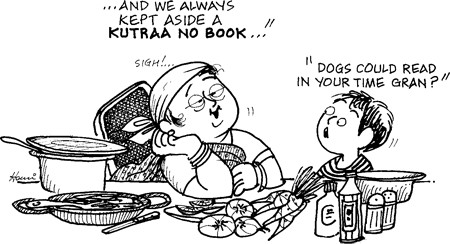
One lesson Bapaiji always taught was "never waste food.” I’ve passed this on to my children and grandchildren. Alas! Today vital buffer stocks of grain are left to rot in godowns all over India, while fellow Indians are dying of starvation. This goes against the grain of spirituality and the sense of "sacredness of food.” In our religion food is sacred, which is why we even have a short prayer called Jamva Ni Baaj (very much like the Christian grace of "thanking the Lord, forwhat we’re about to receive.”) What’s more, our religion has great regard for lower forms of life on the evolutionary ladder and therefore, it’s a custom to keep aside a morsel of food for the dog (kutraa no book). Today, in most homes, unfortunately, families don’t even eat dinner together like in the good old days for various reasons. Our modern youngsters don’t have time for saying a one minute grace before eating. Some of them have never even heard of the kutraa no book.
The old order changeth, yielding place to new… oh yes! But every year when I see the daran and malido in the muktad chaasni, my mind rewinds to memories of another day when gran ruled the kitchen. The memories become sharper each year and I have started retracing the contours of a lost world!

Ruby Phiroze Lilaowala is a freelance writer/columnist. She was a special correspondent for The Gulf Times and was a censorship officer for the government of Qatar. After graduation she studied law, and lectures in India and abroad on religion, theosophy and other subjects.
◆ ◆ ◆
From the archive