
Books
Lala’s lessons from life
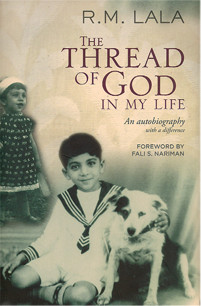
The Thread of God in My Life. An autobiography with a difference by R. M. Lala. Published in 2009 by Penguin Books India Private Limited, 11, Community Centre, Panchsheel Park, New Delhi 110017. Pp: xxix + 194. Price: Rs 399.
Russi Maneckshaw Lala’s emotional covenant with the House of Tatas is well-known. He has for long informed and entertained us with accounts of Tata history, and among his best known books are biographies of the founder Jamsetji Tata and its most famous chairman, J. R. D. Tata. Now luckily for us he turns the spotlight on himself — given the context of this book ‘searchlight’ may be more appropriate — with his splendid autobiography, a moving and extremely readable account of some of the most important events of his life and the people and influences that shaped him. Lala’s longing for confidential expansion (with a prod we are told from his friend Rajmohan Gandhi with whom he founded Himmat) has found expression in his autobiography The Thread of God in My Life. Lala’s impressive career has spanned journalism, publishing, philanthropy and authorship. In this admirable memoir, Lala with his direct, conversational style, and highly readable prose, gives us a glimpse into not only the times he lived in, the many eminent personalities he encountered (and wrote about), but also a peep into some intensely personal memories. Also evident is the author’s wide reading. Religious, literary and inspirational references and quotations from a wide range of sources embellish this moving and inspirational book. Noted jurist Fali Nariman’s (his friend of 60 years) erudite and affectionate Foreword is the icing on the cake.
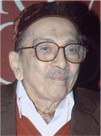
Russi Lala: a personal odyssey
The book is divided into two parts: the first is primarily concerned with events in his life. Thus we find chapters like "The Early Years,” "Years of College,” "Journalism, Publishing and the UK,” "Return to India,” and "The Creative Years — Book Writing” — all contained in Part I called "Experiences.” The inspiring second part, "Learning Values” talks about the influences and thoughts that have shaped him. The book is not a conventional autobiography. The author tells us as much at the outset when he says that he has adopted an unconventional procedure. The narrative in the book does not stretch from the start of his life to the present. Instead each item stands on its own leaving the reader to choose what he or she wants to read, making the book a dipper’s paradise. In a sense Lala can be said to have started a distinctive genre in autobiographical writing, hence the subtitle, "An autobiography with a difference.”
Lala takes us through some of the major events in his life in the first part of the book: his childhood; his parents’ divorce; the influence of three great teachers on him; his entry into journalism and publishing and association with D. F. Karaka and Frank Moraes; his association with the Moral Rearmament Movement; his marriage to Freny and affection for his mother-in-law Parinbanu; the strain in his marriage; his stint as manager of Asia Publishing House in England; the editing of Himmat newsweekly; and his meeting important personalities like Acharya Kripalani and his wife Sucheta, Rajaji, Vinoba Bhave, K. M. Munshi, the Dalai Lama and many more. (Later these meetings formed the basis for his book Encounters with the Eminent.) Lala also tells us how he got into philanthropy (soon after the publication of his book The Heartbeat of a Trust) and his experiences with the Sir Dorabji Tata Trust which he led for nearly two decades.
The writer narrates that it was the publication of The Creation of Wealth which launched him on his career of authorship. He says that at first J. R. D. Tata didn’t quite like the idea saying, "Who is bothered about Tatas?” but later answered the questions Lala put to him. The success of the book is too well known to bear repetition. Lala says that it was much the same when he wanted to write JRD’s biography. JRD did not want his biography to be published and it was with some difficulty that he agreed to set aside one hour every Monday morning to talk to Lala about his life. It was only when JRD had stepped down as chairman that the biography Beyond the Last Blue Mountain was published.
There are nuggets aplenty in this book. Two of my favorites relate to the author’s stay in England and the advice given him by two of his friends. The first concerns his feeling of outrage regarding his being cheated by his publisher (employer) whom he was representing in England. When he voiced his outrage to a senior friend, Sir Roy Pincent, a retired solicitor from Birmingham, his fulminations were met with the words, "Be generous Russi, be generous,” said kindly but firmly. Lala says that his mind cleared because it was as if the balloon of his ego had been punctured.
In a similar vein his doctor in England observing his tendency to be upset about things happening around him gave him wise counsel: "Russi, this is God’s world. Let Him run it.” Another incident which Lala recounts holds an important lesson for today’s journalists, especially the younger members of the profession for whom journalistic power can sometimes prove to be a heady brew. As a young journalist Lala had written an article on the then chief minister of Bombay, Morarji Desai, whom he attacked in a rather vicious manner saying that "he had wormed his way to power.” Later realizing the error of his ways he wrote him a letter of apology. Desai eventually acknowledged the letter and concluded with the words, "I hope you agree with me that criticism to be effective should aim at the deed and not the doer.” Lala puts it well when he says, "In tilting at giants like chief ministers, one feels bigger than one really is.” This incident played a part when after setting up Himmat they decided that they would judge issues not on the basis of "who is right” but "what is right.”
In "Learning Values” Lala tells us that consciously or unconsciously we all build and live in our own "House of Values.” Lala believes that so long as there are principles and values embedded in us there is hope even if we transgress. In his articles of faith put down in the short section "I Believe,” Lala says: "I believe in a power higher than myself — God — and in His capacity to speak to man.” He adds: "That so long as He has a plan for me I’ll be on this earth, and when my work is over He will call me.” The section on "Finding a Faith” takes us through his evolution from an atheist, to an agnostic, and finally to a firm believer in God. Lala writes: "Faith flourishes when you accept that God has a plan and you have a part. Quiet times are the means to find that plan day-by-day. In my morning quiet times I seek not only correction but day-to-day direction through the inner voice. I begin with a brief prayer or inspirational reading from the scriptures or elsewhere.” He recounts his memorable meetings with Vinoba Bhave, Mother Teresa, J. R. D. Tata, and the Dalai Lama, among others, all of whom have served as inspirational figures. He says that Mother Teresa and Bhave influenced his mind whereas the Kripalanis — Jeevan and Sucheta — moved his heart. And the inspiration he drew from JRD is only too well-known.
There is no trace of self pity in Lala’s recounting of difficult times: his parents’ separation, the period of coldness in his marriage, financial troubles and his struggle against cancer (narrated in "Meeting Cancer” in the chapter "Challenges to Health,” a distillation of the essence of his book Celebration of the Cells: Letters from a Cancer Survivor), and later a bypass surgery, have all been dealt with in a matter-of-fact manner. We learn to know and love the writer because his spiritual ferment reveals no morbid affectation. Here is no sanctimonious sentimentalist simulating a false emotion for the purpose of ostentation. Simple, honest, tender and impassioned Lala’s recollections are those of a man who genuinely believes that his trials and victories offer useful lessons to his readers. His writing resonates with sincerity since these are not the recollections of a poseur but of a man who has faced life bravely, learnt from it, and now wishes to share some of that hard-earned wisdom with his readers. The author invests the entire narrative with simplicity, elegance and dignity, informed as it is throughout by his deep and abiding faith in God. And though many of the events Lala narrates happened many years ago the writing pulsates with the feel of the immediate.
Lala has said that the one distinguishing trait of all those who featured in his book Encounters with the Eminent (later reissued as A Touch of Greatness with some more personalities added), was humility. The reader will discern the same thread of the humility in the author as he tells his life’s story. Appropriately enough the opening lines of the Preface are: "I am not important, but what has happened to me, and what I have learnt from 80 years of living, may be.” Lala holds that ultimately the path to happiness lies in accepting people and events as they are. And in thinking of others we uplift ourselves.
This book is not a history of the times Lala lived in but a personal odyssey that covers successes and failures. Life is not all black and white. There are varying shades of grey, and in his story Lala has tried to paint in all its shades. Sir Leslie Stephen, English author and critic, once observed that "a man who expects that future generations will be profoundly interested in the state of his interior seems to be drawing a heavy bill upon posterity.” In Lala’s case, with his uplifting, inspirational, straight-from-the-heart memoir, we can be sure that it will be honored. BAKHTIAR K. DADABHOY
◆ ◆ ◆
From the archive