
Books
Intellectual feast
The K. R. Cama Memorial Volume edited by Jivanji Jamshedji Modi. Reprinted in 2005 by The K. R. Cama Oriental Institute, 136, Bombay Samachar Marg, Fort, Bombay 400001. Pp: lxxvi + 323. Price: Rs 450.
The K. R. Cama Memorial Volume edited by Jivanji Jamshedji Modi. Reprinted in 2005 by The K. R. Cama Oriental Institute, 136, Bombay Samachar Marg, Fort, Bombay 400001. Pp: lxxvi + 323. Price: Rs 450.
If you are looking for an intellectual feast, the book to grab is The K. R. Cama Memorial Volume in honor of Kharshedji Rustamji Cama (published in 1900, first reprint 2005). The book contains an excellent full length photograph of K. R. Cama, as also one of his first pupils and of the Society for the Promotion of Researches into Zoroastrian Religion. I believe that these, and similar other photographs of eminent scholars of Zoroastrian and Oriental studies, should be preserved in the Alpaiwalla Museum.
Jivanji Modi is reputed for his vision, his planning, programing and implementation of projects. In February 1899, he addressed a letter to several students of Iranian literature requesting them for contributions to a Memorial Volume to be presented to the internationally reputed savant K. R. Cama. He addressed a similar letter to reputed European scholars. The response was overwhelming. Elaborating on the various services rendered by Cama, Modi emphasizes that in education he saw the salvation of India. He also worked for religious education among the Parsis. It was Cama who first introduced the scientific system of a critical study of ancient Zoroastrian writings as regards grammar, etymology and comparative philology. Modi states that Cama liked thoroughness. He aimed at perfection.
The contributors to the Memorial Volume are Cama’s own pupils or his pupils’ pupil. In subjects of religious importance, Cama’s opinion was sought for. Prof James Darmesteter aptly called him "the lay Dastur.” "His is an exemplary life, full of hard work, great energy and extraordinary perseverance, which aim at public welfare. He is one of the few leaders of thought in the community,” affirms Modi and adds, "what the late Benjamin Jowett said of great men, is true of him that ‘it does us good only to look at them.’” Cama was a reformer and advocated reforms in all directions, social, religious and educational. He was a reformer of the constructive type.
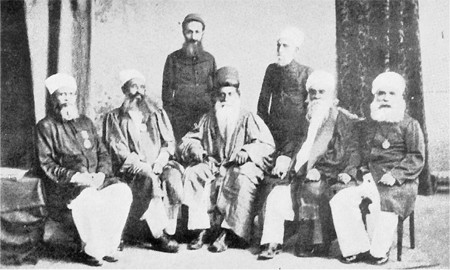
Sitting left to right: Ervad Tehmurus Dinshaw Anklesaria, Ervad Sheriarji Dadabhai Bharucha, Kharshedji Rustamji Cama, Ervad Kavasji Edulji Kanga, Ervad Edulji Kershaspji Antia Standing: Ervad Jamsetji Dadabhoy Nadirshaw, Ervad Khurshedji Minocherji Kateli
Referring to Cama’s patience and generous spirit of toleration, Modi states that when someone differed from his opinion, he never lost his temper. He would reason with them, argue with them and endeavor to persuade them. "He tells them, as it were, in the words of the Gathas, ‘Hear with your own ears the best words that I tell you. Think over the matter for yourselves with an open mind and make your choice.’” Encouraging the spread of knowledge was Cama’s forte. He always took a very cheerful and optimistic view of life and had a high ideal of duty. Prof Jowett had said, "there are sermons in the lives of men” and Modi affirms that K. R. Cama is such a man. Cama produces fresh thought himself. In the words of Rev Kinsley, "He can welcome smilingly and joyfully, the fresh thoughts of others. A great and noble soul indeed.”
The very first pupil of K. R. Cama was Ervad Sheriarji Dadabhai Bharucha. He states that "Cama was so kind and considerate that he treated the students as friends and even helped the deserving ones with books, money and in other respects.” In a year, the class numbered more than a dozen young Parsi priests. The class continued for about 12 years. Cama founded the Zarthoshti Din-ni Khol Karnari Mandali i.e. the Society for the Promotion of Researches into Zoroastrian Religion. After the Mulla Feroze Madressa, the Sir Jamshedji Jijibhai Zarthoshti Madressa was founded. Cama was greatly interested in the development of all the Madressas. Cama gave the pioneering lead in getting Avesta and Pahlavi introduced in the Bombay University. Following the eminent western scholars, Cama was the first to introduce the critical study of our sacred scriptures. Cama’s best known work is Zarthosht Nameh. In February 1866, Cama started "Zarthoshti Abhyas — Studies in Zoroastrianism.” He has published several valuable translations from German scholars such as Rapp, Spigel, Roth and others. Cama spared no pains in researching the religious year of the Parsis. His Yazdajardi Tareekh is a masterly piece of work, states Bharucha.
Cama has delivered lectures on religious subjects by hundreds and "is a profound authority on the subjects he discourses on.” He was closely associated with the Dnyan Prasarak Mandli — the Society for the Diffusion of Knowledge and with several other scientific and literary societies, the important ones being the Bombay branch of the Royal Asiatic Society, the Anthropological Society of Bombay, the University Senate and the Bombay Native General Library. Promotion of female education was dearest to his heart. So were physical training gymnasia. Cama was an active member of the association in Bombay for the amelioration of the condition of Zoroastrians in Iran. Bharucha avers that sobriety and abstemiousness were observed by Cama to the utmost. In his youth, he was very fond of physical exercise and possessed an iron constitution. Bharucha says, "His splendid intellectual powers, vast store of knowledge, wonderfully retentive memory and lucid method of imparting ideas have been noticeable. His untiring industry and perseverance, steadfast adherence to the cause of diffusion of knowledge and complete self-abnegation have always tended to raise admiration and engender high and ennobling ideas in the writer as well as in the other disciples. The more they came in contact with him, the greater grew their respect and love for him.”
Of the 30 research oriented papers, six are from western scholars and the rest from Zarathushtis. Each is on a different topic. The young and aspiring scholars would do well to keep this excellent Memorial Volume handy and to study in depth repeatedly the various learned discourses from specialists in the subjects. In a brief book review, it is not possible to comment on all the learned papers.
In his Introduction, Modi states that Dastur Kaikhushru Jamasji Jamaspasana’s contribution, the translation of "The Madigan-i-Farvardin Roz Khordad” is important as it is prepared from the original text preserved in the old Codex MK belonging to his late father Dastur Dr Jamasji Minocherji.
The article "The Day Khordad of the Month Farvardin” is a translation from the original Pahlavi text. It starts with the righteous Zarthost asking Ahura Mazda "Why is the day Khordad of the month Farvardin regarded great, good and more precious than other days by men?” The reply runs into eight pages. The salient points are covered in Ahura Mazda’s explanation that on this day He
created the soul of the worldly creatures
the Aryan and non-Aryan seed appeared
Gayomart appeared in the world (the footnote states Gaya Maretan, the first man, and the first Peshdadian king, who ruled 30 years according to Firdousi)
Mahrih and Mahrianih (the first human pair) grew up from the ground
Tehmuras made the wicked Ahriman his steed for 30 years
Jamshid made this world immortal and undecaying
Sam, son of Nariman killed the demon Sanavidak
Spitama Zarathushtra saw and conversed with Ahura Mazda, the lord and he received the Mazdayasnian religion from Lord Ahura Mazda.
Kai Vishtasp Shah accepted the religion from Zarthusht.
The Lord Ahura Mazda causes the resurrection and the future existence and makes the world immortal, undecaying, uninjured and undisturbed.
At the end is a prayer "May you be happy, righteous, fortunate, long lived, victorious; may your desires be fulfilled and your wishes gratified.”
Ervad Kharshedji Minocherji Kateli, professor of Persian, Wilson College has explained that the word ‘Adar’ used in Pazand writings is merely another form of the Avesta word ‘Atar’ (see "Adar not Atash Behram,” Readers Forum, Parsiana, June 21, 2005).
The author concludes that the word Atash Behram applied in India to the great consecrated fires of the first degree is not a proper word. It ought to be Adar-Behram instead of Atash-Behram.
Shams-ul-Ulama Dastur Darab Peshotan Sanjana states in ‘The virtues of a Zoroastrian household (Yasna LX, 5),’ "Among the oldest known religions of the Aryans, Zoroastrianism alone has exhibited a complete collection of the principles of pure morality, an ethical system embodied with what is practically righteous and excellent for the moral well being of a family or a community.” "Morality,” says Froude, "rests upon a sense of obligation; and obligation has no meaning except as implying a divine command, without which it would cease to be. And, accordingly, the virtue of a pious Zoroastrian family rests upon the obligation of obedience or reverence to the will and commandments of Ahura Mazda in the Avesta.”
In Yasna LX, 5, the benediction prayer for the welfare of a faithful Zoroastrian family impressed me the most. The Avesta rendering in English reads, "May in the family (literally house) obedience vanquish disobedience; peace vanquish discord; liberality, avarice; humility, arrogance; a truthful speech, an untruthful utterance; the moral order, the immoral instinct.”
In Yasna XXXIII, 4, Zarathushtra speaks: "I with Thy help, O Mazda!/Dispraise (or denounce) disobedience,/And disloyalty (literally evil mind).” What noble and ethical ideas!
Every family, every aspiring student of Avesta, every university having a department of oriental studies anywhere in the world, every library should possess a copy of this excellent K. R. Cama Memorial Volume. It is truly a treasure house of knowledge!
◆ ◆ ◆
From the archive