
Institutions
The elusive dakhma land
Viraf Chiniwala’s startling statement at the public meeting about the Dadysett Charity Trust (DCT) having court permission to build on more than 37,000 sq yds of land at Walkeshwar spurred Parsiana to seek an interview with the proprietor of Veldon Coats, a firm which specializes in the renovation of multi-storied buildings. A scion of the Khshnumist family of Surat, Chiniwala claims descent from the famous commercial magnate of 18th century Surat, Dhanjisha Manjisha, who had been instrumental in sending the kadmi priest Mulla Kaus and his son Firoze to Iran.
Chiniwala speaks of a report in The Bombay Samachar of March 11, 1985 wherein Dr Aspi Golwalla, then chairman of the Bombay Parsi Punchayet noted that the Dadysett Atash Behram complex may be sold for one crore rupees. The story was scotched by then DCT managing trustee Jehangir Dadysett announcing on April 3, 1985 that there was no such sale in prospect. In 1990 devotees visiting the Atash Behram had noticed some people measuring the area. From then on the DCT stopped giving out the otlas to out of town Parsis as they used to do, says Chiniwala. He says Hoshang Unvala and Parvez Mithaiwala filed a suit under section 41 A and E of the Bombay Public Trust Act with the charity commissioner to forestall any development and the trustees backtracked from their plans.
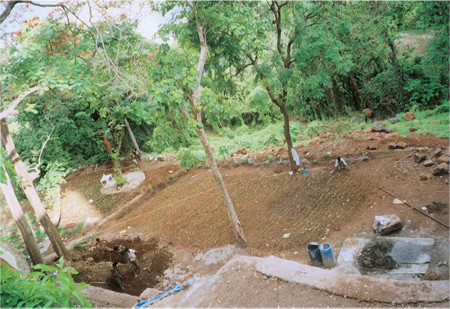
Area purported to be part of the dakhma land Photo: Arnavaz Mama
According to Chiniwala in the present instance the Heritage Committee members have alleged that material facts about Dadysett House were suppressed by the trustees. They were not informed about the associations of the building and its history. Chiniwala avers that the Committee thought that what the trustees were doing was for the good of the community and did not want to come in the way.
To prove his point regarding the land available at the disposal of the DCT, Chiniwala presented a copy of the order of the Bombay City Civil Court in suit No 8929 of 1988 which he believed gave the DCT the right to build on its dakhma land. At this reporter’s urging he undertook to show the wooded area between Walkeshwar and Gibbs Road at Malabar Hill where the Dadysetts had their own private dakma, used exclusively for the scions of the family.
The 1988 order incorporated three specific amendments to the DCT trust deed. The first amendment, numbered 14(a), entitled the trustees to receive gifts, donations, contributions, etc irrespective of the community, caste or creed of the donor. The second one is an addition to clause 16 concerning the letting of the DCT’s immovable properties "exclusive of the religious and charitable edifices.” To the original stipulation which notes that "in every case public notice of the intention to let any land or other property shall be given by the trustees in such manner as they consider most effectual for ensuring full publicity. The trustees shall let such land or other property for the best obtainable rent and shall not create any such tenancy for more than 21 years without the sanction of this Honorable Court” is now added "Rent charges will be the standard rent as permissible under the Bombay Municipal Corporation Act and Rules and Regulations in force.” The third amendment numbered 19(B) injuncts the trustees to invite tenders in case of major repairs/redevelopment to its properties in consultation with chartered architects and valuers.
Hence the order of 1988 has no bearing on the use of the dakhma land for residential purposes. It seems to have been in 1984 that the original articles 13 (b) and (c) dealing with the dakhma, the sagdi and the land at Walkeshwar were struck down and replaced with new clauses. No 13(b) now notes: "The dakhma or Tower of Silence erected and standing on the piece of land in the first schedule hereto secondly described and which is extinct and in disuse be covered up with (a) marble top so as to give it an appearance of a sacred place and the open land surrounding the said dakhma or Tower of Silence admeasuring 1,169 sq m equivalent to 1,389 sq yds (including the area covered by the dakhma or tower of silence) be maintained and used as a garden for all times.”
Clause 13(c) now states: "On the remaining land admeasuring 702 sq m equivalent to 840 sq yds (opposite the land covered by the dakhma which will be covered with a marble top so as to give it an appearance of sacred place leaving sufficient area to be maintained as a garden attached thereto) a building be constructed and
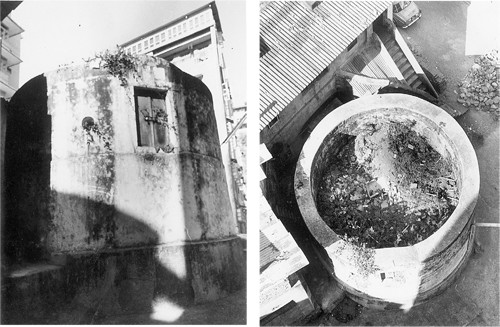
One of the dakhmas in a housing complex compound off the Walkeshwar Road, circa mid-1970s now no longer seen
–the ground floor of such building shall be permitted to be used for performing the Dosla (laying out vases), Farvardian jashan,muktad and bajrojgar ceremonies for offering prayers for the souls of the departed persons whose bodies have been laid to rest at the said dakhma or Tower of Silence and for other purpose permissible under the tenets of the Zoroastrian religion and
–the upper floors of the building shall be used for housing members of the Parsi Zoroastrian community including priests or mobeds on such terms and conditions as the trustees may in their discretion think proper.”
It is in the First Schedule of the original Indenture of Trust dated March 12, 1874 executed by Ardeshir Cursetji Dady that we find the area mentioned by Chiniwala. Listed second among four properties endowed to the Trust, the clause reads, "All that piece or parcel of land or ground situated at Chowpatty within the Island of Bombay in the sub-district of Bhuleshwar containing by admeasurement 37,797 sq yds be the same little more or less and registered in the books of the collector of land revenue under No 731 and bounded... towards the north by Vetalghtee Road or back footpath to Malabar Hill and land formerly belonging to his heirs on or towards the west by the property of Sorabji Readymoney, on or towards the east and south by public road leading from Chowpatty to Malabar Point, together with the dakhma or Tower of Silence, sagdi, agairy, muktad place and bungalows, buildings and erections standing and being theron called or known by the name of Dadysett’s charity ground which said bungalow was formerly assessed by the collector of assessment under No 8 and is now assessed under No 4 and 5 which said bungalows and (premises other than the said dakhma) are now and have been for sometime past in occupation of Ardeshir Cursetji Dady.”
The other immovable properties listed under this schedule include the 6833 sq yds of the Atash Behram, 1,189 sq yds of the Agiary and 22,682 sq yds at Salsette in Thana with rest houses and buildings known as Dadysett’s Dharamsala, also said to be in the occupation of Ardeshir Cursetji Dady and his tenants, the Dharamsala "now and for some years past occupied only temporarily by travelers.”
By 1906 the now familiar internecine Parsi feuds seemed to have begun. At the relation of Hormusji Muncherji Cama, Dr Kharshedji Nowroji Sahiar and Sorabji Cursetjee Dadysett the advocate general of Bombay had filed suit No 423 of 1906 against defendants Heerjee Ardeshir Dady and Kharshedji Rustomji Cama. The consent decretal order of December 5, 1908 records that Hirji Dady, the first defendant did not appear in person or by advocate and that the second defendant K. R. Cama had died. There is no record of the cause of dispute or the reason for moving the court which appointed Dady Nusserwanji Dady, Framji Dorabji Panday, Hormusji Muncherji Cama, Sorabji Cursetji Dadysett, Khursedji Nowroji Sahiar and Ardeshir Hirji Dady trustees of the properties mentioned in the Indenture of Trust of 1874 and referred the suit to the commissioner of the court for taking accounts and to frame a scheme for the management of the trust properties and for the appointment of future trustees. When Ardeshir Hirji Dady declined to act as trustee the court replaced him with Ardeshir Dadbhai Dadyseth. It seems that Ardeshir Hirji Dady, Cursetji Ardeshir Dady and Bamanji Cursetji Dady had sought to be party to the case and had been represented by their advocates but the court had ruled that they had no locus standi as they were not parties to this suit. Until the scheme was sanctioned on February 5, 1910 the properties seem to have been vested in the court receiver who was now discharged and all legal costs were charged to the coffers of the Trust.
Ratan Lalkaka was the epitome of politeness when Parsiana asked for his side of the story and response to the various allegations made at the meeting, in the press, etc. "There was no ulterior motive at all,” he assured us. Regarding the elimination of the appendages to the Atash Behram like the varasiya barn, the goat pen, etc which so upset the priests and orthodox Zoroastrians, he noted, "I love nature. I’m an environmentalist. I won’t allow anything to happen that would upset (the general ambience of the Atash Behram complex).”
Asked about the 37,000 sq yds property of the Trust at Walkeshwar he noted, "There’s a municipal reservation imposed by government on that property. We can only create a recreation ground there — at our expense!” When we remonstrate what was required was a candid answer to the community who are the beneficiaries instead of refusing to respond to their queries, he counters, "The allegations are ké paisa banavéch (he’s making underhand deals). Why should I spoil their fun?” When we subsequently request for directions to reach the property so as to take photographs, he initially volunteered to take us there but when reminded a few days later Lalkaka pleaded inability to do so saying the property has been handed over to the developers! In any case we are surprised to learn from him in light of the clause 13 (b) and (c) in the trust deed, that the dakhma no longer exists. As for the Salsette property, Lalkaka says, "It’s right on the sea, on the rocks. There is little chance of its development.”
A former deputy general manager of Bharat Petroleum (services and facilities) Lalkaka was chief executive officer of the Petit Charities until 1999 and has been a trustee of the DCT since the past 12 years. He says his fellow trustees on the board are housewife Vera Choksey, businessman Behram Ardeshir and solicitor Mehrnosh Amroliwala. According to him the Trust provides Rs 10,000 worth of kathi to the Atash Behram and Rs 12,000 worth of kathi to the Agiary every month. Asked about the drenched kathi in the compound he told us, after making inquiries, that the donated kathi had come in without warning and hence had been left in the open. As for the voluntary service from the community that helps maintain the Atash Behram, Lalkaka states, "There are a group of four to five people who help out at all agiaries and atash behrams. We offer to pay them but they don’t accept payment. They do it as an act of charity.”
The audit report signed by D. D. Bhathena of Damania Panday and Bajan, Chartered Accountants, attached to the accounts of the DCT for the year ending March 31, 2003 bears the statement "An amount of Rs 63,64,500 being rent is outstanding recoverable for more than one year.” Lalkaka explains it as outstanding rent at the rate of one lakh rupees per month for the development of the Walkeshwar property permitted by the court but which could not go through as the property is now under the green belt imposed by the government/municipality! "Our accounts are open, nothing is secret,” he adds.
"Under section 36 of the Bombay Trust Act 1950 you can’t alienate any property without the permission of the charity commissioner,” says Lalkaka. Responding to the disbelief on our face he adds, "We have no money above the table or below the table for bribery. (We are) very low on money.” As for the allegations that the permission to demolish Dadysett House was dishonestly acquired from the Heritage Committee, Lalkaka counters, "When the place is classified as a heritage precinct they are aware of the background. They are eminent people who don’t accept bribes!”
The trustee notes sadly that "a very good gesture of ours has been misconstrued, misunderstood... Today the main assets are the land and the funds which keep depleting, so where is the income? I am surprised: Once we have decided not to proceed why are they still making baseless allegations against us and Shapoorji Pallonji?” Enunciating his philosophy he says, "When you are working for a trust you have to develop a thick skin. There are all kinds of allegations. If they are not true, why should you bother?”
◆ ◆ ◆
From the archive