
Institutions
Proposed project
The letter to the community from the Dadysett Charity Trust (DCT) enumerated eight salient features of the project:
–to construct a modern seven-storied building comprising about 70 flats in place of the existing old two-storied structure through a generous donation from the Pallonji Shapoorji Trust (PST) for housing mobeds and lower middle class Parsis. The estimated cost of the new building was about Rs 2.5 crores. About 70 lower middle class Parsi families could have been provided with housing within the city.
–Although the floor space index (FSI) available permits the construction of 11 floors, it was decided to restrict the construction to seven floors only, not only so that the infrastructure of the Atash Behram complex not be strained but the heritage TDR (transfer of development rights) that would become available in lieu of the unconsumed FSI would have generated a healthy corpus for the Trust.
–The PST had made the funding of the construction expressly subject to the condition that the income generated from this corpus would be employed exclusively for the maintenance of the Dadysett Atash Behram and the Dadysett Agiary, with the surplus, if any, to be used for assistance to other atash behrams and agiaries.
–Contrary to what has been alleged in the Press, the trustess were fully conscious to religious sensitivities. We had therefore consulted Vada Dasturji JamasapAsa Saheb at the very outset, and he had, in writing, expressed his support for the project and termed it a "laudable” project.
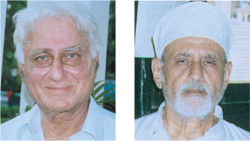
Lalkaka (left) and Nalladaru: differing points of view Photos: Arnavaz Mama
–The existing tenants/occupants were to be re-housed in the new building with the same areas they occupy in the existing building, albeit with modern amenities. The plans for the proposed building were shown to the tenants/occupants at a meeting (with) the architects and the trustees held at Dadysett panthaky Pervez Nalladaru’s residence, when no objections were raised.
–No part of the Trust’s property was to be sold to any person, much less to any builder or developer. No benefit of any nature was to go to the Shapoorji Pallonji family on account of the proposed donation, their role being restricted to constructing the building on the Trust’s property at their cost and to hand over the building to the trustees for allotment to lower middle class Parsi Zoroastrians. Even the allotment of flats was to be done on a leave and license basis.
–The new building was to be located at the same distance from the Atash Behram building as the existing building.
–The existing otlas, the porch, the parab and the well were to all remain as they are, untouched.
In light of the above, Parsiana sought an interview with Nalladaru on July 6, 2004 to learn what it was that made him and his co-residents retract from the development project. Nalladaru is the third generation panthaky serving the Dadysett institutions and claims to have known the Shapoorji Pallonji family over the past 40 years, having officiated at all their office jashans.
Nalladaru noted that there are five or six tenants though not everyone receives a rent receipt. The group includes one pro-DCT dissident, he informed us. As per the verbal intimation they had received, two representatives of the builders came and wanted to speak to the tenants individually. "We told them we were not interested in talking as individuals,” recalled Nalladaru who has been the spokesperson for the group. "They promised to shift us to the otlas (for the duration of the construction work) but they gave us no charts or plans. We asked for time to consider our response.”
Nalladaru says he asked Shapoor Mistry who would be in charge of allotting the flats. When he was told that they would be handed over to the trustees, Nalladaru balked. He told Parsiana that the trustees were the last people he would trust. When he learned from Pallonji Mistry some time in late 2003 that the building plans had been approved by the various authorities, he says he told Mistry, "Let the trustees write to us. We’ll see after that...We have received nothing from the trustees in writing or verbally... We asked for a stay order from the court. Even before the first hearing the trustees told our lawyer, ‘We are not demolishing.’ We are not satisfied with this affidavit. We want an undertaking from all the trustees to the court that even future trustees will be bound not to touch anything in this whole complex. Our rejoinder is being submitted to the court today.” The irascible priest said Lalkaka was sending them on a wild goose chase to the court. "He will fight with trust funds. We are spending from our own pockets.”
According to Nalladaru there are about 15 tables set up for the Kadmi muktads and an equal number for the Shahenshahi muktads a month later. Nalladaru says there is no machi provided by the DCT. He says several individuals like Dady Dadyburjor, Mehernosh Dhamodiwala, Viraf Chiniwala and others take over whichever machis are not booked by other humdins. In such cases Nalladaru, who describes himself as "a well-off person with flats, a cottage in Lonavala,” waives any ashodad that would normally be presented to the officiating priest by the laity offering the machi, providing the service as also some machis as his part of the charity. Nalladaru also alleges that Lalkaka told Pallonji Mistry that no machi, no sukhad is being offered by the laity, that there is no money with the Trust for kathi. So Mistry sent enough kathi to last a full year. Nalladaru took this reporter to see the stack of kathi sent by a devotee lying drenched in the rain, attributing the waste to the negligence of the trustees and their officers. All the cleaning, painting, electric repair, etc required at the Atash Behram is done by volunteers, "the trustees are not spending,” notes the panthaky.
"I can pray for eight hours at a stretch without repetition but to pray from the Avesta is not the only way to serve the padshah. This too is service to him,” the embattled priest declares with satisfaction.
◆ ◆ ◆
From the archive