
In Memoriam
The spirited scholar
Died: Dastur (Dr) Hormazdyar Kayoji Mirza, 96, seniormost High Priest of the Zoroastrian community, respected scholar and author, on May 11, 2004 in Bombay following old age.
Mirza "was one of the prized jewels of the community,” wrote former chairman of the Bombay Parsi Punchayet (BPP) Eruch Desai who "greatly admired his high order intellect and deep knowledge of the religion.”
Countless are the priests who studied under Mirza during the years he taught at Bombay’s four madressas: The M. F. Cama Athornan Institute, Sir J. J. Zarthosti Madressa, The Mulla Firoze Madressa and The Athornan Boarding Madressa. Additionally he had also lectured at The S. B. Garda College, Navsari and St Xavier’s College, Bombay. Dastur Meherji Meherjirana of Navsari who remembered learning Avesta-Pahlavi from Mirza commented in Gujarati how his "Shiksha guru (venerable teacher)” had served the community and the religion with his deep knowledge of the subject which will be recorded for posterity. When confronted with controversial issues he repeatedly sided with the orthodox and gave suitable guidance to his coreligionists, added Meherjirana.
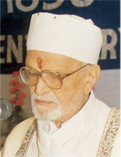
Mirza: deep knowledge
Yet another student Ervad Godrej Sidhwa of Karachi, honorary lecturer in Zoroastrian theology and ancient Iranian history, recalled his navar examination being conducted by the revered Mirza in 1941 and learning Avesta from him the following year. In 1975 he had an occasion to accompany Mirza on his visit to the then Prime Minister of Pakistan Zulfiqar Ali Bhutto.
"Dasturji was a pillar of Zarthoshti orthodoxy and a scholar of international repute... (He) had devoted his entire life to the cause of religious education and higher learning of Iranian languages and literature,” observed Ervad Parvez Bajan, panthaky of Bombay’s Seth B. M. Mevawala Agiary who considered it his "good fortune to study Avesta-Pahlavi under his able guidance.”
One of the two High Priests attached to the Iranshah, "during the 59 years he officiated as Dastur he rendered exemplary service,” noted a resolution in Gujarati from Shri Udwada Nine Families Athornan Anjuman. In his autobiographical sketch Mirza had written, "My uncle Dastur Kayoji was graced with only a daughter. For this reason he adopted me as a son. Hence as per his wish, after his demise the Sanjana Samast Anjuman, Udvada appointed me as a dastur belonging to the Mirza family.” He was ordained as High Priest on May 25, 1945.
Describing his commitments as a priest, Mirza had written, "For most of my life my working day used to begin at 3 o’clock early morning. From 3 to 6 a.m. I used to do literary work. Most of my literary work was done during these three hours of early morning. From 6 to 7 a.m. bath, morning prayers and breakfast. At 7 o’clock I used to leave my house (at Hughes Road) for my Madressa (Sir J. J. Zarthosti Madressa, Princess Street) walking in cool and calm atmosphere, reciting short prayers. 7.30 to 9 a.m. was spent teaching at the Madressa. Then I would leave the Madressa for the K. R. Cama Oriental Institute (KRCOI). I used to work there up to 4 o’clock. For decades, on my working days, my lunch consisted of a cup of hot tea or coffee and biscuits. At about 4 o’clock I used to leave KRCOI, again walking along the seashore and would reach home at about 5 p.m. Then I would spend some hours with my family and browsing over newspapers... At 8 p.m. generally we used to take dinner and retire at about 10.30 p.m. Priestly life is a hard life but it paid me rich dividends in my later life.” Mirza’s son Dastur (Dr) Peshotan recalls that when his father’s failing eyesight made reading impossible, he would use his morning hours walking around the house reciting memorized passages from the Shahnameh.
As acknowledged in the condolence letter from the joint honorary secretary of the KRCOI Homai Modi, "Dasturji was of immense help to our Institute and over the years guided me and many scholars...The Institute had been his ‘home.’”
Mirza’s scholarship had resulted in several books in English and Gujarati. His popular Outlines of Parsi History, first published in 1974 saw a reprint in 1987. The other English books were Conversion Caucus, Atash Adaran: A Modern Substitute for Atash Behram, Some Religious Problems facing the Parsi Community, Varnehade Avesta, The Kopenhagen Manuscript K27 and Ancient and Middle Iranian Studies, the last being published in 2000 when he was 92 years old. In Gujarati he had authored Shri Iranshah ané Parsi tavarikhi babado, Iranni musafari — prachin itihasni najaré, Pandole — chalval — Jarthosti dharamné namé bhayankar thugai, Udvada Anjumanna aagévanoni jodi. His scholarship was enjoyed by people in different parts of India and the world who benefitted from his lectures.
"At the time of the publication of the revised edition of his Outlines of Parsi History I had the privilege of coming in contact with him and I admired his spirit and his zeal, which in spite of age and health problems never flagged in the service of the community,” wrote solicitor Ervad Nadir Modi in his condolence letter.
"He leaves behind a rich legacy which over the years served to strengthen the foundation of this great Zoroastrian religion of ours,” noted the president of The Bangalore Parsee Zoroastrian Anjuman Phiroze Bharda adding, "He will be remembered for his dedication to the faith and the strong commitment to the age-old precepts and customs of the religion.”
It wasn’t only theoretical knowledge that he sought to advance. As former president and managing committee member of the Athornan Mandal "he evinced great interest in the working of the Mandal and took active part in the activities and amelioration of the priestly class. The uplift of young athornans was uppermost in his heart,” stated their condolence resolution.
When Project Udvada was initiated by the then managing committee members of the Youth Wing of the World Zoroastrian Organisation in 1998, Mirza had supported them in their endeavors to set up a museum in Udvada by granting them the use of his family premises of the Dastur Kayoji Mirza Memorial Hall on the main road of the village. Along with Peshotan he had also vetted the explanatory English and Gujarati notes accompanying the exhibits at the Dastur Kayoji Mirza Museum, it was acknowledged in The Bombay Samachar of July 18.
Mirza’s early education was at Sir Jamsetji Jejeebhoy Primary School and the Jeejeebhoy Dadabhoy School, Udvada after which he went to the Byramjee Jeejeebhoy School in Bombay. His priestly education and training was at the Athornan Boarding Madressa after which he served as a yozdathregar mobed in Udvada. He then resumed his academic education by joining Sir Cawasji Jehangir Zarthoshti Madressa High School, Navsari from where he matriculated. Thereafter he studied at The Mulla Firoze Madressa, St Xavier’s College and the University of Bombay. With financial support from the BPP, The M. F. Cama Athornan Institute, Bai Hamabai Mehta Trust and Sir Cawasji Jehangir Trust he went for higher studies to the University of Vienna in 1937 but due to the sudden political upheaval in Austria he had to leave the University and join the University of London’s School of Oriental (and African) Study (SOAS) where besides old Persian, middle and modern Iranian languages he studied Sanskrit and Aramaic. Whilst World War II was going on he managed to stay on in London and submit his thesis for a doctorate degree. His results and accompanying certificates were sent to him after he returned to Bombay.
Conscious of his civic responsibilities during the War years Mirza offered his services to the Air-raid Precaution Squad in London, his duty requiring him to patrol along allotted streets and housetops at nights. At the time of the 1951 general elections in India he was appointed as president of two election booths in the village of Onjal near Navsari.
"It is the duty of a Zoroastrian to lead a life of virtue and industry and to find spiritual happiness in such a life; and also to teach and instruct others to live,” Mirza had written in an article in Parsiana (see "To be good and happy,” November 1994). "To be good and happy is essential but it is not enough...We have...also to make others good and happy.”
The revered High Priest is survived by his sons Dastur (Dr) Peshotan and Rohinton, and daughters Vira Rohinton Munshi and Meher Khurshed Dastoor.
◆ ◆ ◆
From the archive