
In Memoriam
Rustomji's many lessons
Died: Behram Sohrab H. J. Rustomji, 90, the popular "Behli Master,” a visionary educationist who motivated countless youths to realize their potential and serve their community, on December 14, 2002 at Bombay’s B. D. Petit Parsee General Hospital following aspiratory pneumonia.
"Let me say with pride that I am what I am because he made me so,” wrote Dinoo Mistri, the present principal of Karachi’s Bai Virbaiji Soparivala (BVS) Parsi High School where Rustomji had served as principal for 19 years during which time he updated the science laboratories and library, introduced a special Montessori section for boys and girls, and a technical training workshop for students from grade six onwards. Among the last five surviving and serving teachers to have worked under Rustomji, Mistri acknowledged, "He literally forced me to become a part-time teacher, then to do my BEd with first class and even goaded me to go for Teachers’ Fulbright Exchange Program... It is indeed heartbreaking to know he is no more there to go on with his advice and requests to do one thing or another for our School or the community.”
In fact, shortly before his demise he dictated a message for his alma mater which was read on the uthamna day at the BVS assembly when the flag was lowered at half-mast and Zoroastrian, Muslim and Hindu prayers were offered. "Life is full of joy and wonder. His hands have created much beauty and every day is a miracle...May each of you — the students, the staff and the parents — proceed always ‘Towards that Best Light (the motto of the School),’” urged Rustomji. "As a school principal he always made his presence felt in a strong but passive way. He commanded and got 100 percent discipline in the halls and classrooms of the School...” observed one of his ex-students Firoz Sidhwa.
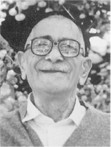
Rustomji: "universal daddy”
"Behli Master promoted, encouraged and motivated all his students to be good citizens. He helped me a lot and I shall always be grateful to him,” recalled another ex-student Minoo Randeria, now settled in the UK. "The utmost respect” that Randeria had for his former teacher convinced him to gift Rustomji a computer barely two years ago, observing in him the same zest and zeal to communicate. From a typewriter Rustomji thus progressed to a computer at the age of 88!
His dress projected his humbleness. It was usually a white pant and a white bush shirt and he always had his head covered with a black cap. The Friday prayers in the School assembly hall would invariably end with the singing of Chhaiyé Hamé Zarathushti and the Pakistan national anthem with "Behli master on the piano, playing and singing with full gusto,” wrote Sidhwa.
He was one of those who felt compelled to compose a national anthem for the new nation of Pakistan in 1947. His friend M. Chagla however approached him with his own score, requesting Rustomji to play it on his piano. This composition of Chagla which was later accepted as the national anthem of Pakistan was thus first played by Rustomji on his mother Tehmina’s piano, a fact which the historian considered of immense honor, mentions his life profile.
During the six years he resided on the campus of The Yoga Institute at Santa Cruz, Bombay where his daughter Armaiti Desai is an instructor, he endeared himself to both the young and the old. "He is almost a universal daddy because of his age and affection to all who automatically gravitate towards him,” wrote Tek Mirchandani in their house journal Yoga and Total Health (August 1998). "When I see Daddy on his table engrossed in a serious search, deep study, pounding away on an ancient typewriter, he is an ideal image, that of concentration and involvement,” added Mirchandani referring to his focussed mind full of optimism despite the physical travails he faced following a paralytic stroke and cardiac arrests. "Reading the Gita, Quran, Bible, teachings of Zarathushtra, Tagore or writing a competitive essay on literature, art and culture of Persia, he never fails to give me a book to take home, read a para or a portion of an article and comment on its significance. In short, it’s always a learning process being with him.”
Despite his advancing age, Rustomji enjoyed participating in the competitions conducted by the K. R. Cama Oriental Institute (KRCOI), mentions Desai. "He was one of those rare good souls I have come across and we at the Institute will greatly miss his ready smile, courage and of course his presentations,” noted Homai Modi, trustee and joint honorary secretary of the KRCOI. "So many thousands of lives were touched by his loving and sharing. He had a knack to make your day so beautiful,” acknowledged Shirin Choksey, former principal of Udayachal Pre-Primary and Primary Schools in Bombay.
"As a life-long teacher he was always in the forefront of innovation and deeply interested in inspiring and getting people involved with community projects, sometimes against their will! A person with an unorthodox mind, but deep faith in the Creator, he was deeply inspired by the thoughts of Jamshed Nusserwanjee Mehta, a Karachi icon,” wrote his niece Nazneen Spliedt remembering how "mentally super-active until the very end he was constantly full of ideas making all around him run to do his bidding. He was always interested in keeping historical records — (of the) family, community and the city — his beloved Karachi...”
In 1952 he had written a historical book, Karachi: 1839-1947. Along with his wife Gool, he had labored on the English translation of Aek Atmakatha [Dastur (Dr) Maneck Dhalla’s autobiography] which had been serialized in Parsiana from 1979-1982. Letters to Parsiana too came regularly from the octogenarian commenting on issues vexing the community and the policies adopted by the decision makers. He was convinced that the dakhmenashini mode of disposing the dead had outlived its time in view of the rapid urbanization and absence of vultures.
On the subject of conversion, Rustomji believed that if the message of Zarathushtra appealed to a member of another faith, instead of debarring him, he should be given the liberty to exercise his free choice, reports Desai. He could not therefore empathize with the illwill extended to Ali Jafarey by certain orthodox sections of the community. "I cherish the talks we had on the Good Religion,” wrote Jafarey, recalling how he had worked as the Persian teacher at the BVS School when Rustomji was its principal.
On the occasion of his 70th birthday different organizations in Karachi felicitated Rustomji to honor "the services rendered by him in the educational, social and humanitarian fields...” Among the organizations with which he was associated were the Young Men’s Zoroastrian Association, Dastur Dr Dhalla Memorial Institute, Pakistan Parsi Collegiate Union, Karachi Theosophical Society, Pakistan Institute of International Affairs, Karachi Parsi Central Education Fund, Sind Secondary Teaching Association, Pakistan Iran Cultural Association, Pakistan-United Nations Association, the Sind Historical Society, Association for the Physically Handicapped Adults and the Z. V. M. G. Rangoonwalla Community Centre of which he remained the guiding and inspiring spirit.
"He believed very sincerely that he had a duty to care for and help anyone who needed his care, his help or his advice,” reveals another daughter Roshni Rustomji-Kerns, adding, "And if following his duty meant a struggle with others, he was willing to do so. With courage, with a good perception of the problem and often with his wry sense of humor. I also noticed that his battles were — on his part — startlingly free of bitterness or hatred...An exuberant man (he had) boundless energy, joy and courage.” Patience though was one virtue which he needed to cultivate, opined Rustomji-Kerns narrating one instance when he pleaded with his wife and daughter to iron his wrinkled sleeve while he was still wearing the coat to save time. When they could not be persuaded, he went off saying, "Clothes aren’t important, people are.”
One of seven children brought up by his mother single-handedly after the early demise of his father Sohrab, Behram’s early education was at the B.V.S. School after which he graduated in arts from Karachi’s D. J. Sind College. For some years thereafter he was in England, earning a diploma in teaching and taking courses at Cambridge and the Royal College of Music, notes his life profile. "Not only did he go abroad and avail of every opportunity to broaden his horizons, but he sent his assistants and many younger teachers abroad also,” states his niece Anahita Sidhwa. Often , it fell to his lot to raise funds for the different causes he supported. One of his ‘tactics’ was: "Now everyone who would like to contribute, please stand up.” Then he would walk to the piano and play the national anthem so everyone would have to rise!
Equally conscious was he of other organizations which needed funds and Anahita relates how when visiting her 10 years ago he gave her a 10-dollar bill for the relatively new Zoroastrian Association of North Texas. In every letter of his would be the phrase "hazaro shukrana,” ever grateful to God for his infinite mercies. Innumerable were the prayers he had put to music and one of his messages read: "Ashem Vohu tells us to be good, Yatha Ahu Vairyo tells us to do good and Yenghe Hatam says we must honor the good deeds of all people.”
Rustomji is survived by his daughters Roshni Rustomji-Kerns, Armaiti Neriosang Desai and Soonamai Jamsheed Dessai, and brother Rustom.
P.M.G
◆ ◆ ◆
From the archive