
Comment
Pioneering reforms
Parsis in the 19th century were in the forefront of social and political reforms
The process of social and political change in India was noticed since the beginning of the European colonial expansion. This change was started and accelerated by economic, technological and administrative structures and values imported from Europe. It initially affected only small groups, often standing on the periphery of society. These groups contributed as mediators and pacesetters of social and political change.
One of these minority groups in India was the Parsis. Originally from Persia, this minority that characterized the "fossil” of an extinct culture has gone through a remarkable process of internal group change and in turn influenced, as an active participant, the process of sociopolitical change in Indian society.
Between 1880 and 1920, the Parsis made a remarkable impact on the economics and politics of Indian society. By the 17th and early 18th centuries, Surat became the largest Parsi settlement. The Portuguese, French, Dutch and English factories employed Parsis as their chief brokers. Close contact with European trade and business organization laid the foundation for their subsequent economic and social rise under the British rule. Surat lost its leading role within a few decades to Bombay, which the British wanted to develop as their main port on India’s west coast. During the first half of the 19th century an increasing number of Parsis started their own business organizations and amassed enormous fortunes in trade within a generation.
Around 1850 a group of young Indians — predominantly Parsis in Bombay — inspired by the ideals of humanism and English liberalism, wanted to eliminate the obvious inadequacies of the Indian society and culture through reforms. In 1848 the Students Literary and Scientific Society was founded. In the same year the foundation of the Dyan Prasark Mandli (Society for the diffusion of knowledge) by Dadabhai Naoroji appealed to the Gujarati speaking people and dealt with different aspects of social reform. In 1851 under Naoroji’s leadership the Gujarati newspaper Rast Goftar started spreading its progressive ideas. The other Parsi Gujarati newspapers in circulation were — Bombay Samachar (1822, first publisher Fardoonji Marzban), Mumbai Vartaman (1830, Nowroji Dorabji), Jam-e-Jamshed (1832, Pestonji Maneckji Motivala), Kaiser-I-Hind (1882, Framjee Cowasjee Mehta), etc.
The Rahnumai Mazdayasnan Sabha was founded by Nowrozjee Furdoonjee and Dadabhai Naoroji. Efforts were being made for the purification of Zoroastrian religion which was being influenced by Hindu elements like child marriages, polygamy, separate dining of men and women and use of nirang for purificatory customs.
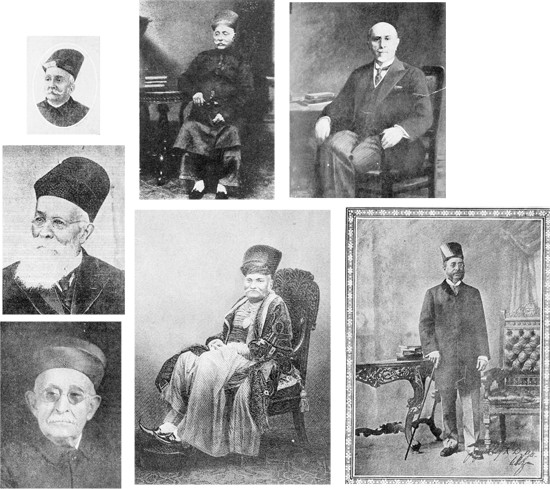
Clockwise from top left: Petit, Patel, Sethna, Mehta, Jejeebhoy, Wacha and Naoroji
All photos courtesy: Parsi Lustre on Indian Soil
In 1855 the Parsee Law Association was organized at a public meeting attended by 3,000 Parsis with Maneckji Nusserwanji Petit as chairman and Furdoonjee and Sorobjee Shapoorjee Bengallee as secretaries. They were responsible later for the introduction of a uniform system of Parsi laws.
By the 1870s education was becoming increasingly valued as a passport to success in Bombay. This fact was clearly recognized among the Parsis. A lot of importance was paid to girls’ education. The Parsee Girls School Association was started by Framji Nasserwanji Patel as the chairman and Furdoonjee and Bengallee as secretaries. A number of Parsi schools were opened in Bombay.
Furdoonjee (1817-1885) tried to gallantly fight the battle of social reform, advocated the introduction of grand and petty juries and attempted to introduce the elective principle in the conduct and management of municipal affairs.
Bengallee (1831-1893) and his journal Stribodh introduced "Medical women in India.” He wanted a native elective element to be introduced in the Municipal Council of Bombay. He was one of the first Indians to advocate a progressive social and factory legislation giving full importance to the vital interests of the employees. It was to the credit of the Parsis that future legislations like the Indian Factory Act 1881, 1891 and the Indian Factory Commission of 1890 took final shape.
Behramji Merwanji Malabari (1853-1912) was one of the most successful Parsi reformers who devoted his life to improve the lot of Indian women who were degraded by social traditions. His early agitations were against child marriage and the marginalization of widows. He wanted more Indians to be included in the Civil Services. He felt that social reform should be a precondition for political emancipation.
Even among the three famous associations, namely the Bombay Association, The Bombay Presidency Association and the Indian National Congress (INC) — which had a monopoly on political articulation among the Indians for independence from colonial British rule — the forerunners were Parsis.
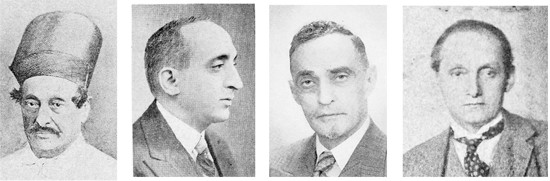
From left: Furdoonjee, Mody, Masani and Saklatvala
Naoroji (1825-1917) the "Grand Old Man of India” — was one of the foremost patriarchs of Indian nationalism. His classic book on Indian economics was Poverty and un-British Rule in India (1901) in which he wrote about the great external and internal drain from India to England. There was a colossal "economic drain” of India to the tune of £ 1,500 million every year which resulted in the appalling poverty in India. There was also a decline of knowledge, statesmanship and scientific professions when the Britishers retired from service and went back to England. He pointed out that the trade policy followed by Great Britain was detrimental to India’s interest and that the British Government in India was destructive and despotic towards the Indians and un-British as well as suicidal to Britain. Among the other woes, he spoke of the neglect of education for Indians, denial of a share in the administration to qualified Indians, repeated famines, lack of irrigation and means of communication, etc.
Naoroji started the East India Association in England to inform the British voters and public about India and its problems and thus indirectly influenced the British decision-making process. He was often invited to give evidence before parliamentary commissions as an expert on India. In 1892, he contested a seat from Central Finsbury and got himself elected to the British Parliament (House of Commons). His efforts in the British Parliament resulted in a resolution in favor of simultaneous Civil Service examinations in India and England and in the appointment of the Welby Commission (1895) to inquire into British economic and financial politics in India.
Naoroji went on to become one of the important founders of the INC. Thrice he became the president of the INC, in 1886 and 1906 in Calcutta and in 1893 in Lahore. He wanted the powers of the jury to be enlarged; a public service commission to be appointed; reform and expansion of the imperial and local legislative councils to be made; individual and executive functions to be separate and so on.
As his disillusionment with the British Government furthered, he slowly changed from liberalism to some sort of radicalism. The demand for self-government followed soon afterwards. He asked for British citizenship based on "birth-rights” and "pledged-rights.”
Yet another important stalwart among the Parsis was Sir Pherozeshah Mehta (1845-1915) who was called the "Uncrowned king of Bombay.” He was a moderate political thinker who had faith in British righteousness and sympathy. Mehta had taken a keen interest in the advancement of Local Self Government institutions in India and the improvement of the Bombay Municipal Government. He wanted a responsible "Bench of Justices” elected at regular intervals by the ratepayers themselves. He was elected as the non-official member of the Vice Royal Council in October 1893. He played an important part during the debate on the Cotton Duties Bill (December 1894) in the Imperial Council. On another occasion Mehta directed his attack against the alarming growth of military and other expenditure in India. He was elected president of the INC in 1890 in Calcutta. He favored the path of constitutional agitation. Mehta was the driving force behind the demand for political rights and privileges. His work on the Legislative Councils, the Bombay Municipal Corporation and the University was the best justification of the claims of Indians to be able to manage their own affairs.
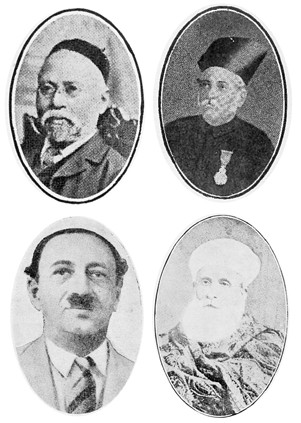
Top: Malabari (left) and Bengalee Below: Jehangir (left) and Marzbanjee
Sir Dinshaw Edulji Wacha (1844-1936), the third in the triumvirate of the Parsi Congress politicians, made significant contributions in Bombay’s local politics, in regional and all-India national politics between 1885 and 1920. He was a member of the Bombay Legislative Council, Imperial Legislative Council, director of the Central Bank of India and Scindia Steam Navigation Company, honorary secretary of the Bombay Presidency Association, president of the INC (1901), etc. He dealt with the famine in India and its devastating effects, especially on the riots. He was against "state landlordism.”
Wacha gave first priority to railways and then to irrigation. With his counterpart, Mehta, they put the greatest importance on education as a fundamental requisite for social reform movements. He pointed out the great neglect of the East India Company in educating the natives. He also fought for increasing the number of Indians in the Civil Services. He felt that Indian administration should be Indianized. Wacha was in favor of appointment of a parliamentary select committee each year to report to the House of Commons regarding the financial position of India. He was a member of the Bombay Municipal Corporation for about 30 years. He wrote a famous book Rise and Growth of the Bombay Municipal Government (1913). He pointed out important drawbacks and the financial excesses of the early Municipal Government of Bombay.
From 1907, after the clash between the moderates and extremists in the Congress, the latter won popularity and supporters. In 1919 the liberals in Western India organized themselves into the Western India National Liberal Federation, which remained till Independence under the direct influence of liberal Parsis. Mention should be made of Sir Cowasjee Jehangir (1852-1962), Sir Homi Mody (1881-1967) and Sir Rustom Masani (1876-1966). Jehangir believed that power should be in Indian hands to guide our own future in fiscal and currency policies. He pointed out the danger of piling up India’s public debt. At the London Round Table Conference, at which a general framework for India’s future political and constitutional development was set down, Jehangir, Sir Phiroze Sethna and Mody represented the Parsis. Jehangir was of the opinion that in future India should have two chambers in the Central Government. Joint electorates with reservation of seats for minorities during the transition period should be the ideal solution for the communal tangle.
As the Parsi Punchayet had proved to be much too inflexible to represent the community’s political position and interest, it was the Parsee Central Association (PCA) and Political League (1940), which performed this task. The founding members were Sir Jamsetjee Jejeebhoy, Masani, Mody, Wacha, Jehangir, etc. The PCA sincerely criticized the Hunter Report, Rowlatt Act, Simon Commission, etc.
Masani, a one-time municipal commissioner of Bombay who joined the corporation as a head clerk, was an active member of the Bombay Sanitary Association, president of the K. R. Cama Oriental Institute, member of the Western India Board of the Reserve Bank, Royal Asiatic Society, vice chancellor of the Bombay University, etc. He wrote a famous book Child Protection, on social reform for children. He was in favor of world citizenship, world cooperation with a family of free nations. Later Masani wrote Education for World Understanding and Britain in India. He contributed a lot towards the development of healthy institutions of local self-government in Bombay.
As far as Mody’s contribution is concerned, he was the chairman of the Bombay Mill Owners’ Association, in favor of protection for India’s infant industries, a supporter of the Hindu Child Marriage Bill, the Mody-Lees Pact, complete Indianization of portfolios of home, finance, etc. He attended the London Round Table Conference (1930) for the purpose of attaining a dominion status. Mody approved of a federal system as appropriate for a multi-religious and multi-racial country like India.
Among the Parsis in socialist and radical nationalist groups mention should be made of Bengallee who was the first Indian to advocate progressive social and factory legislation. One of the famous Parsis who paved the way for the development of a modern trade union movement in India was B. P. Wadia. He believed that it was necessary to organize the labor movement as an integral part of the national movement. Indian laborers must be represented in the legislatures, he advocated.
The arena of the great struggle for national independence was not confined to the boundaries of India alone. There were many revolutionaries who lived and worked abroad. Mention should be made here of Madame B. R. Cama (1861-1936). She was called the ‘High Priestess’ of Indian nationalism. She was a militant extremist. She traveled extensively to Europe and USA to enlist support for Swaraj (self-government). Along with S. K. Vanua she believed that an armed uprising was necessary for achieving India’s independence. She earned the title of ‘Mother of the Indian Revolution.’ Cama made history when she unfurled the Indian flag (1907) at the international Socialist Congress in Stuttgart.
Another active Parsi was S. D. Saklatvala. He also made use of his mandate for the working classes and the communist party. A member of the British Parliament, he severely criticized British hypocritical statesmanship. He always appealed for Hindu-Muslim unity.
Thus, it can be established that Parsis made great contributions to the moderate phase of the Congress, economic nationalism, socialist and communist movements, trade union movements, development of liberalism and the formation of radical groups and associations.
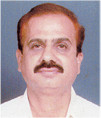
Dr Sarosh Soonawalla is a reader and head of the department of political science at the Poona College of Arts, Science and Commerce. He has guided research studies and served as senior supervisor for university and college exams.
◆ ◆ ◆
From the archive