
Comment
"Legacy of love"
The memory of two dedicated doctors prompts an erstwhile junior's renewed interest in the struggling Bel-Air Hospital and Sanatorium
A crisp breeze under the shining sun greeted us as our car turned into Dr Rustomji Billimoria Marg and stopped at the gate of Bel-Air Hospital and Sanatorium. This was Sunday, January 4, 2004 at 2 o’clock in the afternoon. My husband, Minu, and I had left Bombay early that morning along with our tour-guide Minoo Bamboat, driving up the Western Ghat crossing Mahableshwar Peak and coming down to Panchgani. The guard at the entrance directed us to Bomi’s quarters — the guest house. We stayed here overnight. Prakash met us at the bungalow and took our luggage into our rooms. Within moments our host Fr Tomy K. MCBS (the administrator) appeared to make introductions.
I was not new to the sprawling estate of Bel-Air, having visited there a few times, half a century ago. My heart was bouncing with joy. The green trees and shrubs conveyed peace and serenity of heaven on earth. As we sat down for lunch, Fr Tomy came by to discuss our plans. He filled us in on more information, adding to what we had from the article "Legacy of Love” (Parsiana, October 2003), and our prior conversations with Red Cross Society secretary Homai Modi and the Billimoria family.
A walk through the buildings — intensive care and surgical suites, obstetrics center, HIV/AIDS dormitories, tuberculosis dormitories... These are a few of the nearly 40 buildings in use presently. We met some sick patients, some not so sick, some had relatives attending to their needs. One five or six-year-old girl had AIDS and had lost both her parents to the same illness. Some past patients were helping out as volunteers, socializing with patients, counseling and performing other jobs. Some had rented accommodations on the premises and worked as plumbers, engineers, and at other odd jobs.
On that Sunday evening an emergency orthopedic surgery was in progress. The patient was a trauma victim of a road accident; the relatives were standing by. They were given the option of going to another facility upon stabilization, but preferred treatment at Bel-Air. We inquired about him the next day and were told he was recovering well. Next, we visited the Aryuvedic and Naturopathic Institute — a cutting edge addition to the facility, incorporating complementary therapies. Spirituality is also incorporated — a chapel is available for services, portraits of prophets and an oil lamp in the office are in evidence. Statues of donors, Rustomji and Bomi and others, decorate the grounds while portraits and mementos of the Billimoria family and many other donors decorate the walls of the office, dining room, recreation and other areas. While the buildings are simple and sparsely furnished, they are adequately equipped, except for the laboratories which seemed in need of a thorough rehabilitation. Much of HIV work is sent out to Bombay, which means inadvertent delay in evaluation and management. Basic hematology and chemistry are handled in the laboratory on site.
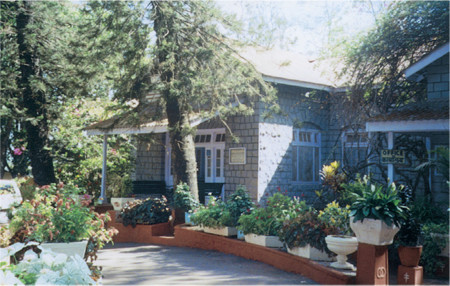
The office block at the Sanatorium
Dinner, breakfast and lunch were spi-ced with many conversations with Prak-ash. He was born in the 1950’s at Bel-Air and lived and worked there all his life, except for a short interruption in the 1970’s and 1980’s. Eruch and Villoo Ghadialy are residents at Bel-Air for 55 years. Eruch had worked in many different capacities, retiring as an x-ray technician. At 82, he has hearing difficulty. We also met a young American lady who was attracted to Bel-Air during a previous vacation tour of India. She came back to help out with various office and social jobs. We chatted with a graduate medical student from Vardha University doing her Community Medicine assignment at Bel-Air.
The next morning we set out on our second tour of the offices, outpatient facility, x-ray department, pharmacy, recreation areas, dining hall and more. Almost 300 people eat three meals daily — the hospital census is about half that, the rest are staff, patients’ relatives, volunteers and guests. We ate the same meals — so we were told. They were simple, nutritious, and well balanced, though somewhat spicy for me. We missed visiting the kitchen facility. We were told the kitchen needs an overhaul and upgrading just as the laboratory. The pharmacy seemed well stocked. Our tour ended with a discussion of medical records, data-base creation, retention and retrieval. This is where Minu recognized his input helpful and has accepted the task. When we discussed the development plans Fr Tomy beamed with the dream of a nursing school and graduate medical education targeted on HIV/AIDS — lofty aspirations hopefully achievable with hard work and passion.
We packed and took leave of Fr Tomy after lunch driving away towards Poona. We had witnessed God’s love at work; borrowing the words from President Abdul Kalam, we witnessed the propagation of the vision and mission of Rustomji and Bomi Billimoria. It may be flippantly argued that the focus has moved away from TB care to HIV/AIDS terminal care. All three of us vehemently disagree with that simplistic statement. While HIV/AIDS care is one part of the whole hospital and sanatorium experience at Bel-Air, it is certainly not the dumping ground or terminal care concept. Bel-Air has an ongoing philosophy and program for the prevention of HIV/AIDS in the surrounding villages and district, including life-style education and personal responsibility for one’s own choices. For those already victims of this affliction it offers the 21st century holistic, compassionate care, integrated with scientific evidence-based medicine, incorporating nutrition, personal and social hygiene in a truly beautiful and nurturing environment. Alongside, Bel-Air offers medical and health care to all residents of Panchgani and surrounding villages, the students and teachers at many boarding schools that Panchgani is famous for, and trauma care to the visitors and tourists to the area. It is a total health care facility.
In Fr Tomy Bel-Air has an able administrator — a passionate and dedicated missionary with vision. Bel-Air now needs a medical director specialized in infectious diseases and HIV/AIDS to guide its efforts in clinical education and research — one with admirable attributes similar to those of the Billimoria father and son. He/she need not be full time on-site; a regular weekend commuter can fill in this need aptly.
We recognize the bright future for Bel-Air. The needs are financial but not simply financial. People with knowledge and expertise have to come together and pour in their efforts. Organizations working towards HIV/AIDS control as well as business organizations can heighten awareness among their members about the need for their involvement. Indians living abroad — physicians and health care professionals, businessmen and students — can contribute to the land of their birth through their involvement with Bel-Air. The second generation of western Indians can volunteer their services, enrich themselves and their own spirituality through God’s work in the service of humanity.
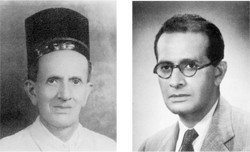
Rustom (far left) and Bomi Billimoria
Father and son
Parsiana’s "Legacy of love” was factual and so very moving. Bomi Billimoria was my mentor during the four most formative years of my professional life, so I could not help but shed tears, reliving half a century old memories. I had visited Bel-Air a few times then — 1957 to 1960, but heard more about it from Bomi as well as our patients that came from Bel-Air to St George’s Hospital in Bombay. Bomi visited Bel-Air at least twice a month and selected surgical candidates to come to either St George’s Hospital or Masina Hospital where Dr Jer Lashkari was his trusted assistant and resident surgeon. I had the delight to work for and learn from this charismatic and talented surgeon at St George’s Hospital. Unlike his father (riding the tonga in 1920’s and 30’s), Bomi rode a taxi upon alighting from the train in Poona. He also did surgeries at Jehangir Hall in Poona — mainly heart work. I recall having accompanied him there once. At Bel-Air he did thoracoplasties and chest-tube placements — adequate facilities for major lung work were not available there. As his surgical presence in Bombay grew, more and more patients came to Bombay for surgery. Some patients’ travel expenses were covered by Bomi personally.
Unlike his peers who also did other "bread-and-butter” work like hernia, appendix, lumps and bumps, Bomi did cardio-thoracic surgery exclusively. Bomi had quite a few "firsts” in Bombay among heart procedures in his resume. Bombay’s first successful open heart surgery for a hole-in-the-heart "ASD” was done at St. George’s Hospital under hypothermia in 1958. He was determined that in every occurrence of "sudden cardiac death” an attempt be made at reviving and insisted upon me to read about and learn the procedure of open-chest cardiac resuscitation — a forerunner of today’s CPR (cardio-pulmonary resuscitation), a closed-chest method! Our first successful CPR procedure was done on October 10, 1958 (six months to the day after my sister Sheroo had passed on and also her 25th birthday). The patient, a man in his early 50’s recovered and had successful surgery for cancer of larynx (voice-box) later on. A year after the event, I described the procedure to him and asked how he reacted to having been revived in this manner. He was very grateful for having the opportunity to continue living. (We cannot impose our value on the life of others — an important lesson in life, I learned then.)
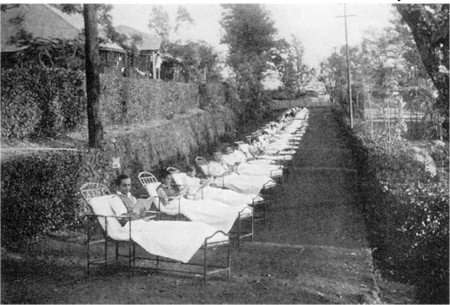
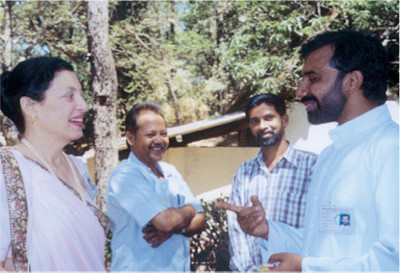
Modi in conversation with Fr Tomy (Top) and open air treatment in the early days (above)
Bomi spoke softly, and in a few words communicated all he had to. "He was hard to please and work for,” I was warned. "No house surgeon has been able to survive six months with him.” At our first interview he told me, "Before you start work, go and learn everything from Jer Lashkari; I have no time to waste on teaching small details.” And I did just that. Our work ethic clicked and I enjoyed my sojourn with Bomi and am now a better person and physician.
Bomi was deeply religious but not ritualistic. He wore the sudreh-kusti always and whispered a short prayer at the start of every surgery. He could pray Zoroastrian prayers, but did not quite understand what he recited, hence considered it irrelevant — he once told me. His religiosity was evident in his work and his humanity.
I knew Dad Billimoria much less, and heard a few stories from Bomi who spoke of him with great respect and intense love. But the two were poles apart on details — generation and specialization gap! Rustomji was the medicine man, not the surgeon. I was drawn towards him with admiration and awe. Tall and slim in white Parsi daglo (long coat) and black pugree he looked very much like my own father. "Stop holding my son’s finger to cross the street — let go of him and bounce ahead,” he admonished me once. "Yes, but I have yet to learn a lot from your son, my teacher,” I replied. In 1959, Bomi along with colleagues, organized India’s first tele-video conference with chest medicine counterparts in UK with Rustomji as the moderator. A physician from UK addressed Rustomji as the "Father of Tuberculosis east of the Suez,” a just and fitting tribute. Rustomji was a scientist and researcher. He had a laboratory within his clinic in the Wassiamal building at Grant Road in Bombay, and one at Bel-Air which he directed himself. His laboratory at Bel-Air built in 1930 was state-of-the-art then, but now needs a major make-over. One of our tuberculosis drugs in use now is an off shoot of his research at Bel-Air.
Bomi’s passing left a gaping hole in my life. The Parsiana article has initiated the mending process. It began with Minu and I visiting Bel-Air this January and learning first hand of it’s renewal and current work on HIV/AIDS and tuberculosis. We commit ourselves to contribute our best for Bel-Air’s growth and progress — our tribute to the father and son.
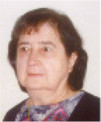
Dr Mehroo Patel lives and practices in the Chicago area. Her community involvement is well-known. Her interests include cookery and the compilation of recipes.
◆ ◆ ◆
From the archive