
Awards
Prime performers
The Federation of Parsi Zoroastrian Anjumans of India Awards for Excellence bring community achievers into focus
Eleven eminent Zoroastrians, their age ranging from 10 years to 90+, received the accolade of the community at the Walchand Hirachand Hall of the Indian Merchants’ Chamber on June 12, 2004. Recognizing the distinctive achievements of their coreligionists in the fields of medicine, social and community service, India’s military defence, education, adventure and sports has become an annual feature of the Federation of Parsi Zoroastrian Anjumans of India. As Bombay Parsi Punchayet (BPP) trustee and the evening’s master of ceremony Dadi Engineer noted, "Their lives are an inspiration to the rest of us.”
Dr Keki Byramjee Grant, whose Ruby Hall Clinic in Poona had begun as a two-bed hospital in 1959 is now a 550-bedded hospital with a full range of departments — a "complete medical center comparable to the best in the world,” as notes the citation, received the Freny Ratan Marshall Award for professional competence for the year 1995 when the foundation stone of his new hospital structure was laid. He had successfully materialized his vision "to see that no Poona resident needed to rush to faraway places for every medical emergency.”
An MD from Bombay University, Grant worked for 12 years as chief medical officer of Poona’s Jehangir Nursing Home. Teaching beckoned and he served as professor of medicine, specializing in cardiology at the B. J. Medical College, Sasoon Hospital for 30 years, simultaneously researching and publishing in leading medical journals in India and abroad. He is now the institution’s professor emeritus in medicine and cardiology, a fellow of the American College of Physicians and founder fellow of the Indian College of Physicians with life time achievement awards from Poona University, the Symbiosis Institute and the Bharati Vidyapeeth, notes the citation.
Grant, who had attended the executive council meeting of the Federation that day told Parsiana, it is a "very good idea as it encourages people of Bombay and elsewhere to meet and know how the Parsi community stands today.” The venerable doctor had contributed substantially to the organizing of the Third World Zoroastrian Youth Congress in Poona in December 2003. He expressed sadness that "the Parsi community, such a great, such a beautiful community was going down so fast. There was no attempt to resurrect the community, generate more Parsis.” He had tried to voice his hard earned wisdom of 80+ years at the Congress that the children of mixed parentage had a legitimate place within the community but he found "the youths more bigoted in their ideas than the adults. There was very strong opposition. I was virtually booted out!” Grant is open to other feasible suggestions but believes "it is too late, no matter what you do.” Neo Zoroastrians would be acceptable to him if only they were staunch in their belief and were people of standing. He said he was not in favor of conversion, per se.
Pioneer in dental implantology Dr Firoze Dara Mirza received the Dr Freny Ratan Marshall Award for professional competence in 2003 when he was successfully involved in hosting the World Congress on Prosthodontics simultaneously with the 31st Congress of the Indian Prosthodontic Society which he had cofounded with Drs T. M. Udani and K. Bhargava in 1972. One of the first to do successful implants in the US when this practice was looked down upon by the dental profession, as notes the citation, Mirza taught at the Nair Dental College for 25 years and was its dean in 1974-75. He started the Indian Society of Oral Implantology in 1988 as founder president, has a number of papers to his credit and has been awarded gold medals in Greece, Romania, Germany and Spain, states the citation.
In a brief acceptance speech Mirza acknowledged his debt to the community, having lived for seven years during his education at the Gamadia Colony hostel. He recalled the encouragement given by the late Thelma Tata (J. R. D. Tata’s wife) and, to the amusement of the audience, the comment of the then secretary of the BPP according to whom Mirza had committed two grave mistakes: that he had opted for dentistry instead of medicine and that he had come back from the US after his higher education at Tufts University in Boston!
The venerable Avabai Bomanji Wadia was awarded the Shiavax D. Nargolwala Memorial Award for social and community service for 1999. The name and face associated with planned parenthood worldwide had been working for women’s empowerment since her school and college days in London whence she was called to the Bar in 1934. Ceylon born Avabai had made Bombay her home since 1941. By then she was a founder member of the Ceylon branch of the International Federation of University Women, vice president of the Women’s Political Union, secretary and subsequently vice president of the All India Women’s Conference. However, it is as founder member of the Family Planning Association of India of which she was president from 1963 to 1997 and, since then, president emeritus and as founder member of the International Planned Parenthood Federation of which she has continued to be patron after six years as president, that she is best associated.
Wadia’s string of awards, both national and international, include India’s Padma Shri and Padma Bhushan. The Sat Paul Mittal Award on Population and Environment, the Rotary International Service ExcellenceAward and the Lifetime Achievement Award from the Population Institute Inc, Washington DC were all received in 1999. There were many more over the years.
As Engineer, himself a well known solicitor punned on the word ‘brief’ ("A lady barrister has briefs, a lady solicitor does not have briefs”) and banteringly sought to pin the blame for the declining community numbers on Wadia’s work in the field of family planning, the astute 90-year-old responded in kind: "Thank you, sir, for giving me the brief and the right to reply. I shall be brief. You have accused me of limiting the community (numbers). I will answer at great length another time.”
Brigadier (retd) Adi Kaikhusaroo Sahukar served the Indian army for 28 years during which he saw active service in World War II, was mentioned in dispatches for distinguished service and worked for the welfare of army personnel. However, it is during his post retirement years at Delhi’s J. K. Organization where his concern for its 10,000 employees led him to assume responsibility for the planning and completion of the Pushpawati Singhania Research Institute for Liver, Renal and Digestive Diseases that he has earned further kudos and the Shiavax D. Nargolwala Memorial Award for social and community service in 2003.
An active Rotarian, Sahukar has rendered yeoman service in public health care in the dissemination of polio plus inoculations, camps for cancer, cataract, asthma, diabetes, etc. He has aided blood banks, institutes for the deaf and dumb and the Indian Red Cross Society, notes his citation. Also as chairman of the Mentor Selection Committee with the Bharatiya Yuva Shakti Trust he aided and guided a corrugated box manufacturer to grow his business a hundred fold, adds the citation.
The Lt Col Adi B. Tarapore Memorial Award for 2003 was presented to Commodore Fali Homi Dubash. A second generation naval officer, 56-year-old Dubash is a pioneer in the practical implementation of operational logistics ushering in new logistic strategies, resolving outstanding cases of indebtedness to the UK ministry of defence which resulted in a saving of £ 250,000 to the country’s exchequer, securing ISO 9002 certification for INS Hamla when he was its commanding officer, and ensuring speedy procurement of material under the special powers delegated to the navy for the first time in its history, notes the citation.
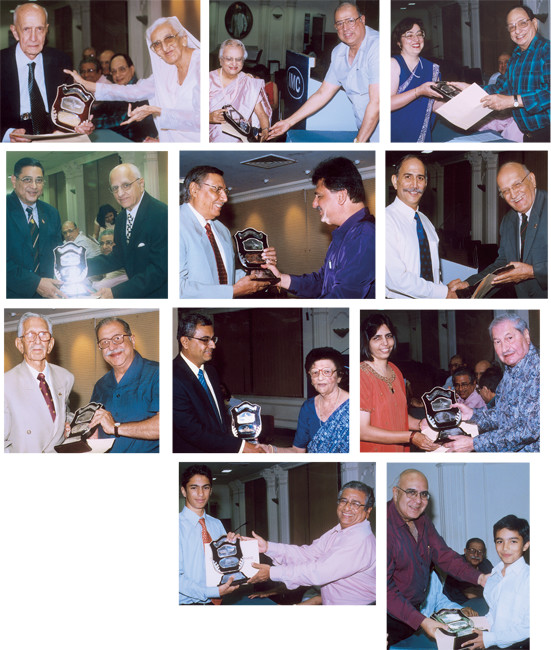
Top row, from left: Grant and Silloo Kavarana; Wadia and Nariman Mogrelia; Cama and Engineer ; 2nd row: Dubash and Minoo Shroff; Mirza and Dara Irani, Pavri and Adi Sethna ; 3rd row: Sahukar and Areez Khambatta; Shroff and Aloo Cama; Mehta with Jamshed Guzder ; 4th row: R. Banaji and Dinshaw Mehta; Dinshaw Tamboly and A. Banaji
The relentless pursuit of excellence, his dedication, perseverance, innovative and positive approach with total disregard for personal comfort are said to have contributed in large measure to the operational efficiency of the navy and earned Dubash the Vishisht Seva Medal on Republic Day 2004, adds the citation.
"There are opportunities in the armed forces that you can’t get anywhere else. People in the navy are doing mountain climbing, parachute gliding. A naval team has just climbed Mt Everest!” Dubash noted in a brief chat with Parsiana, expressing his unhappiness that fewer and fewer Parsis are joining the services. Applying the "principles of war” to the problem of the community’s declining numbers, Dubash says, "We must select and define our aim; then do anything and everything only to subscribe to that aim. That is the only approach. If the aim is eventual disappearance (there’s nothing to be done) but if it is to survive (as a community), we must do everything possible...The only way ahead is to shed inhibitions... allow children of mixed marriages. There are many people who would like to accept our religion. Gradually we will have to rethink or we’ll just disappear.” Dubash noted that staunch Parsis may not agree with his liberal views but "we must look at the problem in a detached way.” The Commodore and his wife Olive have two sons, both of whom have chosen life in the business world: Shaun trains corporates in network marketing; Ian works for a shipping company in Singapore.
Brigadier Soli Noshir Pavri, who was presented the Late Dhunjishaw Manekji Jall Award for 2002 for his exemplary military career, was shortly due for promotion to major general, taking command of an infantry division in Jammu and Kashmir. Commissioned in 1971 and posted in the insurgency prone Nagaland, Pavri saw action in the Indo-Pak war of 1971 which established Bangladesh as an independent nation. Pavri has been the Indian team leader of the UN Military Observer Group in Iran, has commanded his unit against insurgents in Assam and seen action with the Indian forces in Sri Lanka, as per the citation.
Pavri’s experience in the high altitude areas of Ladakh and Sikkim and along the Line of Control in North Kashmir, where he was responsible for preventing infiltration, was acquired with "characteristic aplomb and professionalism with limited resources at his command... With clear and incisive understanding of his task, relentlessly aggressive spirit and inspiring leadership... (Pavri maintained) exceptionally high levels of domination... and moral ascendancy over the enemy. He was responsible for establishing posts at altitudes of over 17,000 ft and beating back numerous incursions,” states the citation. He is credited with having revamped the intelligence set-up and acquired up-to-date intelligence regarding terrorist movements. The work won him the Yudh Seva Medal in 2002. Pavri is simultaneousy a keen sportsman and golfer, has participated in international car rallies and has used his assignments to photograph the Himalayas in all their splendor.
The second generation army man — his father had been a part of the celebrated 17th Poona Horse — Pavri opted to join the 7th Kumaon Regiment as it was the regiment of his role model General K. S. Thimmaya. He still remembers with awe "the sheer personality of the man” and notes that the over 200-year-old regiment had received India’s first Param Vir Chakra in the 1962 war against China. Pavri glories in the fact that he has been a part of "every action that the Indian army has fought” ever since he was commissioned.
"He is best under crisis, gets an adrenalin high,” laughs his wife Jasmine. "Even when things are peaceful, he’s involved,” she adds citing his participation in Operation Blue Star and the Babri Masjid imbroglio. The unending stream of active duty has meant that Jasmine, a master in social work from TISS (Tata Institute of Social Studies) who works for the Dorab Tata Trust has had to bring up their two daughters and one son on her own: Sanaya now scriptwrites for MTV, Nafeesa with a masters from TISS is involved with the center for autistic children, Rayomand is working for a financial company. Pavri believes that youths need motivation and the biggest motivator is the mother. "Mothers must be strong,” the conservative commander tells us.
The Mazda Education Foundation Award for excellence in the sphere of education, research, science and technology for the year 1999 was presented to Dr Shernaz Cama who has been teaching at Delhi University for 15 years. In 1999 UNESCO invited Cama to initiate a project on the preservation and promotion of Parsi Zoroastrian culture and heritage, the now well established PARZOR project. As its honorary director Cama initiated research into its various aspects resulting in the biographies of India’s first Field Marshal Sam Manekshaw and its first woman photo journalist Homai Vyarawalla. Also awaiting publication is the research on kusti weaving and textiles/embroidery. When UNESCO declared 2003 as the 3,000th anniversary of Zoroastrian culture, Cama was the lynchpin of the celebrations in Delhi, Bombay and Calcutta. The citation she was presented also notes, "Cama has headed and coordinated an international six-country multinational candidature for the UNESCO Award ‘Masterpieces of the oral and intangible heritage of humanity.’”
Cama earned her doctorate from Delhi University on the basis of her thesis on "Blake and Zoroastrianism” which she researched at the British Museum Library and at London University’s School of Oriental and African Studies under the guidance of Dr Kathleen Raine and Prof Mary Boyce. She has assisted the Indira Gandhi National Centre for the Arts in building up a Zoroastrian Library and has worked with artisans from Andhra Pradesh on Zoroastrian Kalamkari which has been placed by the Minorities Commission under its Kalamkari project, notes the citation. Cama has participated in seminars and conferences, presented papers and spoken on All India Radio, adds the citation.
The Mehernosh N. Cama Memorial Award for education, research, science and technology in 2003 was presented to Dr Firdos Temurasp Shroff, a fellow of the Indian Institute of Banking and Finance and its deputy director (academics) and faculty member for information technology, on-line education and training/research. Learning and earning since the age of 18, Shroff completed 27 years with the Union Bank of India while acquiring his masters in economics, graduation in law, doctorate in information technology and qualifying as a certified associate of the Indian Institute of Bankers. He is currently pursuing an MBA in banking and finance from the Indira Gandhi National Open University.
Shroff, in the course of these years, has served on the panel of examiners of the Institute of Chartered Accountants of India, the Institute of Company Secretaries of India and the Indian Institute of Bankers in the fields of computers and systems as well as personnel management. The Gujarat Economic Association, the Academic Staff College of Saurashtra University and the Ahmedabad based Consumer Education and Research Centre are other professional bodies with whom he has been associated, as per the citation. He is said to have presented papers on economic research, electronic data processing and information technology at conferences and in professional journals.
A bachelor who favors marriage within the community, Shroff blames his single status on accommodation problems. He told Parsiana that the families of prospective brides want to know when Punchayet accommodation would be available. Noting that youths require direction, motivation to venture into new avenues, Shroff, who says he pursued all his education after working hours, observes that Parsis are loath to move out of colonies and baugs.
At first sight this commerce graduate from Poona University, who holds an advanced diploma in computer software systems and analysis from the Symbiosis Institute of Computer Studies and Research and works as chief manager in a software company, looks an unlikely candidate for an adventure award. Yet it was Gulrukh Shiraz Mehta who bagged the Surat Parsi Panchayat Award for adventure in 1998. A keen sportsperson who had enjoyed inter-collegiate hockey, Mehta’s current focus is rallies and expeditions on two wheelers in the couples category with her husband, a dealer in Exide Batteries in Nagpur. According to press reports mentioned in the citation, the couple had challenged and beat the superfast Rajdhani Express from Hyderabad to Nagpur by two hours and 15 minutes in June 2003. On another occasion, responding to a challenge from the TVS Motor Company they rode their TVS Fiero F2 motorcycle, completing the 1,500 km stretch from Nagpur to Poona and back, non stop, in 23 hours, five minutes.
Earlier Gulrukh had participated in the first Khardung-la Hill Climb Race — the world’s first high altitude hill climb race on the world’s highest motorable road from Leh (11,000 ft) to the top of Khardung-la (18,380 ft) in the Ladakh region of Jammu and Kashmir organized by the Vidarbha Automotive Racing Association under the national competition rules of the Federation of Motor Sports Club of India and the international sporting code of the Federation Internationale de l’Automobile and the Federation Internationale Motor Cyclist. She came first in Group B Class 2 and has set a new world record in the process, notes the citation.
An arranged marriage that has zoomed at super speed, Gulrukh recalls that the photo she first received of her prospective groom showed him on his bike. "My husband was taking part in rallies all over India. We started with expeditions,” recalls Gulrukh. The rallies followed. They then found sponsors on their own, Mehta describes the gradual development of the two of them as a team. Their daughter Mahafreen, eight, wants to be a teacher, Mehta tells us.
Raiyan and Aresh, the young sons of Dr Burjor Banaji and his wife Jenai wowed the audience with their achievements in athletics, respectively winning the Dr Dadi Balsara Award and the Peshotan D. Nargolwala Memorial Award for sports in 2003.
Raiyan, 14, won 16 gold and seven silver medals, two individual championship trophies and the fastest athlete trophy for boys under 16 in the year 2003-04. Training since the age of 11, he has hit the winning post since his first athletic season (2000-01) when he won 22 gold medals plus one silver together with seven individual championship trophies and five trophies for the best and fastest athlete of the meet in boys under 12.
During the following two seasons he grossed a total of 10 gold, nine silver and four bronze medals and crowned these achievements by setting a Bombay city record in the triathlon for boys under 14. He holds the Maharashtra State record for boys under 12 in the 100 m and 200 m sprints, the Bombay City District Amateur Athletic Association Record in long jump for boys under 12 and seven new meet records for boys under 12, 14 and 16, notes the citation. He crowned these achievements in April 2004 by winning three gold and two silver medals and creating one new meet record at the South Asia Inter-School International Meet in Colombo.
With two silver medals in gymnastics at the inter school and district level competitions, a black belt in judo plus one gold, one silver and three bronze medals garnered at inter school, inter district and zonal meets, Raiyan is the guitarist in a trio band which played at the President Hotel for a function of the Rotary Club Main, states the citation.
Aresh is a first class student in standard VI in the Cathedral and John Connon School, plays the drums, is learning judo and concentrates on athletics. In 2003-04 he swept off four gold, four silver and one bronze medals for boys under 12 plus two individual championship trophies and one fastest boy trophy at inter school, Bombay city district, inter district and Maharashtra State levels. Having started his athletics training before the age of eight, Aresh has been highly successful since his first season in 2000-01 when he won 10 gold, four individual championship trophies and one best athlete trophy for boys under eight.
During the two seasons 2001-02 and 2002-03 in the boys under 10 category Aresh has garnered 26 gold, seven silver and three bronze medals and seven individual championship trophies. He holds the Maharashtra State records for boys under 10 in 60 m and 100 m sprints, and set 10 new meet records in various athletic meets for boys under eight, 10 and 12.
Grandsons of famed gynecologist Dr Rusi Soonawala and his wife Pilloo, both sportspeople of their time, the boys manage studies and training with equal aplomb almost every day. "Both are ferociously committed...” notes their father happily.
◆ ◆ ◆
From the archive