
Books
A test for taste
Most people are generally loath to part with recipes and when they are cornered into doing so, "always hold back some ingredient, but that is not the case with Katy,” said art historian and connoisseur Pheroza Godrej as she launched gourmet cook Katy Dalal’s fourth book Jamva Chaloji — 2: More Parsi Delicacies to Tickle Your Palate at Bombay’s H. J. H. Taleyarkhan Hall on February 14, 2004. Disclaiming any culinary expertise Godrej professed herself "quite humble before this vast audience” which probably included several accomplished cooks.
The uncommon recipes which feature in this collection were eliminated from Jamva Chaloji — the first book — as kitchens today are smaller and the working women has no time for sweets, vasanu and elaborate meat, chicken and fish dishes. However, Dalal, with history and archeology in her blood (she is a qualified archeologist and has been professor of history at St Xavier’s College) felt, "Our people should know and remember what had been cooked in their grandparents’ times.” And this book is a welcome addition to the dissemination of Parsi culinary as well as social lore.
Dalal’s introduction refers to the Variav Behdinonu Parabh — celebrated on roz Ashishvangh, mah Fravardin to commemorate the brave souls massacred in Variav by the Bhil tribesmen of the area. For centuries thereafter the community remembered: "East of Lunsikooi, there is a famous place called ‘Dashera Tekdi’ or Hill. There used to exist a giant banyan tree there. Many religious ceremonies were carried out at this place and the old tree was called ‘Ghambariyo Vad.’ This was a meeting place where the people of Navsari took many important decisions regarding their lives.
"On Ashishvangh roz, mah Fravardin, over 500 people used to gather here and take part in the ‘Hamajor’ prayers. Till today, this ceremony is held in this place with great respect and reverence. The area was large, almost 19 bighas and belonged to the Parsi community. Once the local Mohammedans and then the Gaikwad government tried to take it away from them. Both efforts were fruitless.
"After the baj and farokshi prayers were over, everyone, old and young, who had assembled there, were fed with a chasni (consecrated food) of deliciously cooked vaal (beans) and rotlis (chapattis) and liquor was freely distributed — not any more now, because of prohibition.
"I (Dalal) asked Dastur (Dr) Firoze Kotwal about this event and he had said that he had participated in this event as a young boy and also eaten the beans and rotli.”
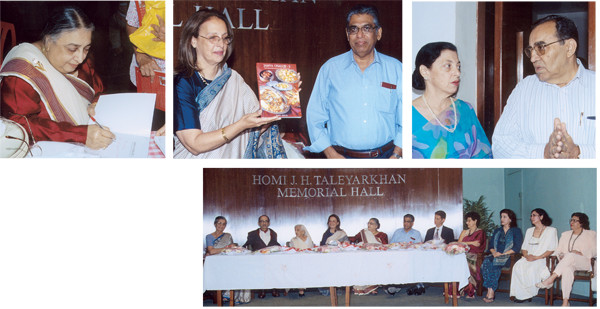
Top, from left: Katy Dalal, Godrej, Arun Mehta, Modi and Feroze Dalal Alongside: A galaxy of Zoroastrian achievers on the dais
Dalal speaks of the wealthy Sorabji Balsara of Mamakwada, popularly known as ‘Valsara Fooa.’ "As a child of seven, I had once been taken over to his house in an oxen cart. We — that is my great-grandfather’s family — were invited for lunch. As we were on holiday at Tadgaon, mother and I were included in the invitation. Till this day, I have never forgotten the sight of his dining tables, groaning with the choicest of foods. There was chicken, mutton, fish and rice. What I particularly remember is a huge, shallow, high-sided terracotta dish filled with curds, whose surface was decorated by red chilli powder in a trellis design.”
The generous Balsara who had entertained people like Lady Navajbai Ratan Tata at his table, died aged 84. The disintegrating family feuds that followed is perhaps a leitmotif of modern Parsi history as the large estate was sold off at a fraction of its value, and there are only memories left of past glory.
Dalal writes of the use of sugarcane vinegar, especially in fish patias and condiments, the life of the toddy farmer and brings us up to date with the archeological work in Sanjan under the World Zarathushti Cultural Foundation.
Waxing eloquent about special celebrations Dalal zeroes in on the concoction of the faluda from the making of the wheat milk or ghehu-nu-dudh — "one of the most tedious processes of my young life” — to its transformation into the "biyan or beej meaning seed” that forms an essential component of the strawberry pink dessert.
Sixteen "forgotten recipes” include vasanu, badam paak and kharia (trotters)-ni-jelly. Among the 39 sweets are such staples as dudh-na-puff and ghas-ni-jelly. The 30 fish dishes include gems like Malai-ma-ramas-nu-istoo (Ramas Fish Stew) and Bhaji-ma-Kolmi (Prawns cooked in Spinach). Along with the elaborate chicken preparations are some recognizable as normal dishes like Khara taréla papéta ni marghi (Plain chicken with fried potatoes) and Késar-né-dahi ma murghi (Chicken cooked in saffron and curds). Vignettes of the past are recalled as introductions to the mutton, duck and vegetable recipes. A small section on chutney and pickles includes combinations of spices for garam masalas and instructions on how to make pure ghee at home.
Jamva Chaloji — 2, with color photographs of Dalal’s culinary offerings by Arish Patel (Pp: xxiv + 196, Price: Rs 295) is published by Bimal A. Mehta for Vakils, Feffer and Simons Private Limited, Hague Building, 9 Sprott Road, Ballard Estate, Bombay 400001.
Not all the recipes are time consuming and labor intensive. Much too depends on the user of the recipes. For, says the author, "The first thing a cook should remember is that he or she must use ghee, chilli and masalas according to their personal tastes. Sugar should always be used carefully. Some people like sweet items and others don’t like them very sweet. So you should always taste for sugar. Do not blame the recipe.”
An array of well-known Parsis who shared the dais with Dalal and Godrej were felicitated with flowers as social worker Homai Modi, the morning’s compere, introduced them to the audience. Theatre personality Jerry Kumana thanked all those involved in the production of the book and the holding of the event and especially the Dalal family for the love and support to the author in her aim to preserve a community heritage.
A. S. M.
◆ ◆ ◆
From the archive