
In Memoriam
Dalal’s digs and dishes
Died: Dr Katy Feroze Dalal, 68, distinguished archeologist, caterer of renown and compiler of the community’s culinary heritage, in Poona on March 18, 2010.
"To be a good caterer, you have to cook well. But I think it’s more important that you have a large heart,” believed the gregarious Dalal. It was as a caterer par excellence that the community knew her best. The "Goddess of Food was amazingly generous. There was not a single function at the Institute when she did not cater, and even hosted us in our bleak times,” reminisced Muncherji Cama, president of the K. R. Cama Oriental Institute (KRCOI). He was speaking at the condolence meet jointly convened by the KRCOI, The Bombay Parsee Association (BPA) and The Rahnumae Mazdayasnan Sabha (RMS) on April 8, 2010.
Having enjoyed the honor of releasing her first cookery book, Jamva Chaloji, Cama commended, "It was not a depressing cookery book; there was no reference to cholesterol or calorie counts.” Himself an epicure, he was able to appreciate recipes such as Soonamai na malai per eeda and recalled how she presided over the feasts she served, "pleasantly fatigued but smiling.”
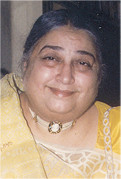
Caterer of repute Dr Katy Dalal
Caterer at various times for the Ripon Club, the Free Masons Hall, the P.V.M. Gymkhana, "Her pleasure lay in seeing people enjoy the food she served,” noted Vispy Dastur, president of the BPA.
In her message, art historian Pheroza Godrej who had also released one of Dalal’s six cookery books noted that along with the culinary delights "she gifted the reader with precious information on the Parsi community in India. They are a valuable storehouse of information passed on to future generations.”
"They were meant to increase our knowledge of health, history — both national and international — and even religion… She enlightens us on Zoroastrian festivals and food cooked on those occasions… The forgotten world of graciousness is somehow brought home to us in Katy’s books,” added KRCOI trustee secretary Homai Modi.
Though her persona in the later years was of a heavily built, traditionally draped lady, Dr V. N. Misra, director of Poona’s Deccan College remembers his first meeting with the "strikingly pretty, slim and fair young lady dressed in a skirt and blouse” 50 years ago when she had sought a consultation with the then director of the institution renowned for its department of archeology, for her own career in that field.
She went on to get her masters in the subject taught by Misra, topping the list of successful candidates with a first class first and then worked for her PhD under his supervision "on the archeology of the Ghaggar or Rigvedic Saraswati River in the remote Ganganagar district of Rajasthan, originally explored by the veteran British archeologist Sir Aurel Stein,” noted Misra’s tribute read out by Dalal’s friend and fellow student Statira Wadia. "To do field work in this area infested with cross-border smugglers was courting risk to one’s honor and life. It speaks volumes for Katy’s courage that she successfully completed over two years’ field work there, exploring Harappan archeological sites and excavating the site of Binjor,” added Misra.
Nivedita Mehta, curator of the Bombay Parsi Punchayet’s Alpaiwalla Museum and another qualified archeologist from Deccan College, corroborated, "Katy said she had to get the Border Security Force Commander Khusro Rustamji to give her an escort… She set the trend in Deccan College which continued for one-and-a-half decades of there always being a Parsi in archeology.”
"There is a stirring within you that sets the pace of your life from an early age,” the late Homi Rogers had quoted Dalal in an article in Parsiana ("From spades to spoons,” August 1992). Young Katy Frenchman had been bitten by the history bug since her navjote year when she heard Ervad Darab Kutar speak of the Achemenians and Alexander the Macedonian King whose conquest of Persia ended the dynasty, noted Rogers. The inspiration stayed with her, stirring her to stand first in history in the Bombay University’s Inter Arts examination, bagging the Wordsworth Prize and Scholarship. It opened up the vista to higher education that her father Nariman, a clerk at the Claridge’s Printing Press could ill afford. Katy graduated from St Xavier’s Heras Institute, majoring in Ancient Indian Culture ere she made the trip to Poona.
The early awareness of the Ache-menian empire and of Alexander stayed with her. She examined these topics in several lectures at the KRCOI. "She was an authority on everything she spoke about — Alexander, the mythical Saraswati river, the archeological finds… each time presenting a different aspect of the subject,” remembered Cama.
Her husband Feroze Dalal, an officer in the merchant navy who helped finance many of her ‘digs,’ was a pillar of strength. When some peers rejected her claim of having unearthed a civilization predating the most ancient one known so far, he got her to sail with him to England where they met the universally acclaimed archeologist Sir Mortimer Wheeler. Wheeler encouraged Katy to excavate sites in Rajasthan and when she completed her thesis, she dedicated it to Wheeler’s and Stein’s memory, recorded Rogers.
Acknowledging their sparkling but short association, Bharatiya Vidya Bhavan and KRCOI trustee S. A. Upadhyaya said he had heard about Katy since 1960. "Bombay University still has no department of archeology. If she had continued in the field she might have started one,” he noted.
It was on a trip with Feroze in 1978 that Katy complained of an eye problem. Cautioned against undue strain and constant movement, she found herself housebound. The time on her hands began to be devoted to the kitchen — and the start of her career in gastronomy.
Dr Homi Dhalla, founder president of the World Zarathushti Cultural Foundation, recalled a paper presented by Katy on ecology 25 years ago and her holistic approach. Katy’s son Kurush has been a part of Dhalla’s team whose excavation in Sanjan has put the forgotten town "on the archeological map of the world,” as noted Dhalla. Kurush, also a PhD in archeology from Deccan College under Misra’s guidance, had prompted the professor’s comment, "To the best of my knowledge, Katy and Kurush are the only mother and son pair in India to have done their PhD under the same guide.”
As trustee of the RMS for 10 years Dalal had suggested the introduction of a jashan and lecture on the baj of the first Dastur Meherjirana and also of Jehangir Variawa, mentioned author Marzban Giara. Bombay Red Cross Society deputy chairperson Chandi Batlivala referred to Dalal’s work on the Society’s fundraising committee: "Self-motivated, she focused on how she could use her resources for other people.”
In a written statement Veera Patel revealed how Dalal would send food gratis to her grandmother and to other elderly and lonely people in the neighborhood. Her three children never grudged having to climb four floors to make the necessary deliveries. When she had the time, Katy would stop by, but more often she and granny would enjoy a conversation over the roof top of an in between building!
"She took keen interest in everyone and everything,” noted Dalal’s relative Jeroo Coyaji, professor of Economics at Poona University. In a general reference to Dalal’s many health problems, she added, "She had the courage to bear pain day after day and continue to enjoy life… A woman who leaves behind a well-knit family, many friends and happy memories, isn’t dead.”
Acknowledging the tributes on behalf of her family, Freny Printer spoke of her mother as "an extraordinary woman with an indomitable spirit.” She recalled "the importance of being held in warm arms, (of being taught to maintain) righteousness and courage in hardship… Nothing can separate us, not time, not even death.”
Dalal is survived by her husband Feroze, sons Kurush and Darius, daughter Freny Printer, and brothers Meherji and Soraab Frenchman.
◆ ◆ ◆
From the archive