
Food
“A caterer by accident”
Growing up surrounded by excellent cooks facilitated a mid-career switch from teaching to catering
Some people say cooks are born, others say they are made. I was always fond of cooking but I became a caterer by accident. I suffered a detachment of my retinas when accompanying my sea-faring husband Feroze on one of his voyages overseas. This happened in Toronto where my eyes were operated upon on an emergency basis. When I returned home, I had to leave my teaching job at college and take it easy at home. This enforced leave was frustrating. I was occasionally approached by friends to cook for their dinner parties and that’s when I got the idea that I should help myself and run a catering business since whatever I cooked was well received. I started a tiffin service with a single client. The tiffins increased through word of mouth of satisfied clients and I took in special orders for parties. This led to catering for various clubs and subsequently to catering for navjotes and weddings.
I have descended from a family of good cooks. My great-grandmother, Soonamai, lived along the coastal strip of Gujarat and from her primitive kitchen produced the most delicious cuisine.
Her granddaughter, Piroja, my mother, added to this repertoire a totally different type of Indo-European cuisine from her mother-in-law, Cooverbai, who had lived in Rawalpindi where her husband was employed. His sister, Meherbai Boga was fairly affluent, often entertaining 50 people or so at her table. She taught my grandmother who in turn taught her two daughters and her daughter-in-law the intricacies of Moghlai and Western cuisine. I grew up surrounded by these excellent cooks, saw, learnt and retained as much as I could and put a lot of their Parsi food recipes into my first cookbook — Jamva Chaloji.
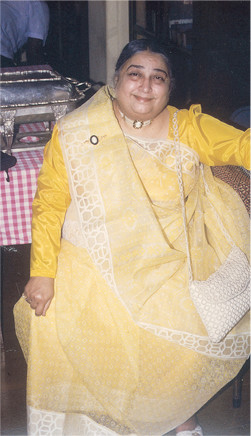
Katy Dalal: "Go in for unusual items”
Many people who want to become first-class cooks and can afford it go to Cordon Bleu institutes abroad. They receive excellent training and are then snapped up by the world’s five star hotels and restaurants.
Taking an interest in cooking at an early age and observing their elders is a sure-fire route to becoming a good cook. My daughter, Freny, used to love to help out in the kitchen from age six. She would stand on a stool, roll mince patties in breadcrumbs with her tiny hands, dip them in beaten eggs and carefully slide them into hot oil. She was very sharp and observed everything that went on in the kitchen. When she was 12 years old, she participated in an inter-school cooking competition. Some of the contestants were seniors in their final year and my husband wondered how she would fare against these grown-up girls. Everyone was to prepare kheema-par-eedu and vegetable pulao. Freny came out half an hour before the time was up and walked away with the first prize.
Young women often ask me how they can start kitchens of their own. I advise them to buy their own premises, if possible, from which they can dispense food. As this involves much money and may not be in everyone’s budget, the next best thing is to start one’s business from the family kitchen. Your business will consist of clients who like your offerings and word of mouth will play a great part in expanding it. As the business grows, you will have to work harder and harder and you will need more helpers to assist you in washing, cutting, chopping, etc. They will have to be fed and looked after so do not hire them indiscriminately. You will have to be careful of theft. A certain amount of pilferage will have to be factored in as it is so easy to steal small quantities undetected from large stores.
Decide what kind of food you will be serving before you start. I began with Parsi and Western food and then branched off into Punjabi, Gujarati, Udipi and even Jain food. The demand in our community is far greater for non-vegetarian food than for vegetarian food. One must refrain from over-spicing the food. The rich individual flavor of dishes cannot be savored if they are blanketed by an overdose of spices as all the dishes then tend to taste the same.
Typical fare at Parsi weddings would be patra fish, sali murghi, tarkari-par-eeda, mutton pulao/dal, lagan-nu-custard and ice cream or kulfi. Nowadays there is a new custom of serving starters before the meal. I feel that there should not be too many starters as they detract from the main meal. I prefer limiting myself to two non-vegetarian starters and two vegetarian starters. I personally feel that the best drink to accompany spicy Indian meals is cold water. The majority of Parsis, however, prefer to have sweet aerated drinks at functions — the favorites being Raspberry and Ginger.
Unfortunately the menus at Parsi functions have become too stereotyped. I encourage my clients to go in for unusual items like Russian salad, Hawaiian salad, Lancashire hot pot, fish Florentine, fish vindaloo, tandoori murghi and different types of rice such as my version of Spanish paella cooked with cheese, chicken and prawns, ribbon rice which consists of layers of green chutney, sweet and sour mince and prawn patia. For dessert, I suggest peach melba, trifle pudding, vanilla ice cream with fruit salad or a fresh strawberry sauce or a chocolate/toffee sauce or to lend a desi touch, with gulab jamun or gajar halwa.
As for Irani food, there is hardly any demand for it from the community mainly through lack of knowledge. Our basic knowledge of Irani food items are chelo kabab and chelo pulao. There is ample variety in Irani food too. They have various kinds of breads such as nan-e-barbari, nan-e-lavash, nan-e-sangok, nan-e-taftoon, etc. Their meals are not as spicy as ours and tend to be more on the sweeter side. Some famous items are Adas Pulao — rice made with chicken or mutton, Kabab-e-Ozunborun or Sturgeon kabab, Khorest-e-Estenaj-o-Aloo, a prunes and spinach stew, etc. Desserts consist of the traditional Anginakor, date fudge, and Sheer Beren, a milk and rice pudding.
It’s not easy, as a first time author, to write a cookbook and get it published. People who write cookbooks should ask themselves if the contents are original. Tremendous plagiarism takes place in cookbooks — recipes and photographs are copied wholesale. So before writing a cookbook one must consider carefully whether one has something important to impart to readers. Of even greater importance are photographs of the recipes. It is the quality of the photographs that make a favorable first impression on the purchaser. I had colored photographs taken in my kitchen, doing the settings myself and using my own crockery and linen. Nowadays there are specialists in food layout and photography. As regards pricing the book it will have to be determined in agreement with the publisher. If it is a first book then the publisher will want to peg it at a lower price to ensure sales. One must have a good function to release the book, particularly at the hands of a well-known person and a large number of well-wishers including some media personnel should be invited. After this one must wait with baited breath and crossed fingers to read good reviews in the media and subsequently hear a good report of sales from the publisher in anticipation of a fat cheque from him!
NAVROZE-NO-KHURMO
(Navroze day special khurma)
Serves 10-15
Preparation time: 25 mins
Cooking time: 1½ hours
Mutton leg chunks with nali (2 kg)
Ginger-garlic paste (2 tbsp)
Onions (4 large — finely chopped)
Masala no 1
Black peppercorns (20)
Kashmiri chillies (10)
Cloves (5)
Cinnamon (2” piece)
Seeds of green cardamoms (5)
Fennel seeds (1 tbsp)
Shahjeera (1 tsp)
Mace flowers (6)
Lightly broil and grind fine the above
Masala no 2
Kismis (100 g)
Almonds (50 g)
Cashew nuts (50 g)
Pistachios (50 g)
Saffron (1-2 g)
Grind fine the above in a little water till soft and buttery
Potatoes (8 — peeled, each cut into 8 pieces and soaked in salted water)
Salt
Ghee
Marinate the mutton in salt and ginger-garlic paste for two hours.
Chop the onions and cook in half cup of pure ghee in a large patia. Cook the onions till golden-brown and then add the powdered masala no 1. Stir for three minutes and then add the mutton and stir for five minutes. Add six cups of water and place on a slow fire till the mutton is soft and tender and very little water is left.
With the back of a spoon make a depression in the center of the cooked khurma and put in the masala no 2 and gently mix. Allow to simmer for 10 minutes.
Half fill a karai with oil. Place on a medium heat and when hot put in the potatoes, a few at a time, and fry till golden red.
Taste the khurma for salt. Serve hot, covered by the fried potatoes.
Serve with hot rotlis, parathas or broon pao.
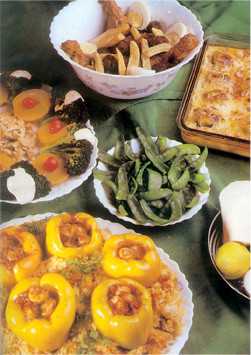
GOLDEN PEPPER PULAO
Serves 5-6
Preparation time: 25 mins
Cooking time: 1¼ hours
For the rice
Basmati rice (500 g)
Saffron (1 g)
Onions (2 — cut long and deep fried)
Cinnamon (2 — 1” pieces)
Peppercorns (10)
Cloves (6)
Elaichis or brown cardamoms (4 — large)
Star anise (4)
Bay leaves (4)
Salt
Ghee or oil for the fried onions
For the peppers
Golden peppers (8)
Prawns (1 kg — shelled and deveined)
Coriander (1 small bunch – washed and finely chopped)
Grind in sugarcane vinegar
Red Kashmiri chillies (14-16)
Garlic (2 — whole large pods)
Cumin (2½ tbsp)
Black mustard seeds (½ tsp)
Black peppercorns (6)
Salt
Oil
Prepare a broad mouthed heavy bottomed vessel by scrubbing it well. Keep aside.
Place a cup of oil in a dekchi over medium flame. When hot, add the ground masala and stir till it is red and almost cooked. Salt the prawns after washing them twice and add them to the masala. Reduce the heat to very low, cover the vessel and allow the prawns to cook in their own juices for 10 minutes. Cover and place some water on the dekchi cover. Keep adding a little water from time to time till the prawns are tender and soft. Mix in the chopped coriander and cool. Taste for salt.
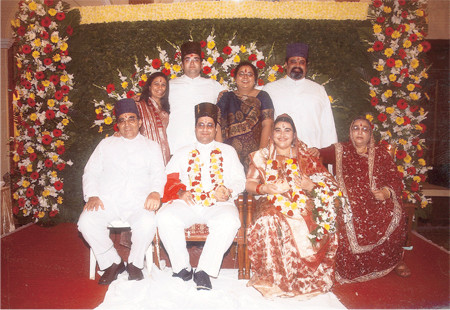
The Dalals on daughter Freny’s wedding to Navroze Printer
Wash all the peppers and with a sharp, pointed knife, cut a circle around the stalks and remove them intact. With your finger or a fine teaspoon remove the seeds in each pepper. Tap each one lightly so any remaining seeds fall out. Using a small teaspoon fill all the peppers well with the prawn mixture and then cover with their stalks.
Wash the rice and place it in the prepared pan. Add salt, all the whole spices and lightly heated saffron. Lastly add the fried onions along with three tablespoons of the ghee or oil in which it was fried. Add water to cook the rice, then place the peppers on it and arrange them close to each other so they stay upright. Place the dekchi on medium heat. Sprinkle more salt over the rice if necessary as the peppers will be absorbing it. Lower the flame to its lowest point and allow the rice to cook for 40 minutes till all the water is absorbed and the peppers are soft. If the rice remains hard add more water. It should be soft and not dry.
Serve this pulao with cucumber or banana raita or a Parsi dhansakh dal.
EDA-PAAK OR EGG HALWA
Serves 25
Preparation time: 1 hour
Cooking time: 1½ hours
This is one of the most delicious sweets I have ever eaten and I request all my readers to make it at least once in their lifetime. The measurements in this recipe are my own. You will get 6 kg, 100 g of eda paak, which is not easily available on sale, if you try this recipe.
Egg yolks (50)
Sugar (2 kg)
Cardamom and nutmeg powder (20 g)
Mace powder (10 g)
Piprimul-na-gathia powder (10 g)
Ginger powder (20 g)
White pepper powder (10 g)
Poppy seeds (10 g – fry)
Pure kesar or saffron (2 g)
Rose water (300 ml)
Pure ghee (1,600-1,800 g)
Fry and grind
Almonds (500 g — boiled and skinned)
Pistachios (150 g — boiled and skinned)
Fry
Charoli (100 g)
White pumpkin seeds (100 g)
Red pumpkin seeds (100 g)
Cucumber seeds (100 g)
Melon seeds (100 g)
Wheat milk (400 g — dried)
Water chestnuts (400 g — dried)
Make a strong syrup with the sugar and 10 cups of water. Bring to a roiling boil, remove from the fire and allow to cool.
Heat 500 g of pure ghee in an iron karai or "kalai” vessel or any other strong vessel and fry the almonds, pistachios and charoli separately, and place in a large thali or tray. Fry the four white pumpkin, red pumpkin, cucumber and melon seeds separately and place in the thali. Fry the water chestnuts and then the wheat milk separately. Add more ghee to the pan.
Fry the poppy seeds lightly. Crush all the fried nuts and spices, the poppy seeds and grind fine.
The saffron should be heated lightly on a skillet, crushed and mixed into the rose water.
Whisk the egg yolks well. Mix in the remainder of the ghee and add it to the sugar syrup. Place the vessel on a medium flame and mix non-stop with a long handled chamach or perforated spoon, till you feel the mixture thickening. Add the ground nuts, spices, poppy seeds, water chestnuts ground fine, wheat milk ground fine and stir the mixture non-stop without letting up till the ghee separates and floats on top. Taste for sugar.
Add the crushed saffron mixed in the rose water, mix well and remove the pan from the fire.
Sprinkle the cardamom-nutmeg powder and mace powder over the halwa and mix these aromatic spices well into it.
Pour into two greased aluminum square trays. Cool overnight. Next day, cut into the required pieces.
Decorate with almond and pista slices.
◆ ◆ ◆
From the archive