
Business
First ladies
For a community branded in recent years (in India at least) as entrepreneurially moribund, it may surprise the pessimists to note that two Parsi women — Anu Aga, chairperson, Thermax and Villoo Morawala Patell, founder and chief executive officer (CEO), Avestha Gengraine Technologies — feature in the list of "The 25 most powerful women in Indian business” in the November 23, 2003 issue of business today, the first such listing by the magazine which it hopes to make an annual feature.
Also among the list of 25 is the chairperson of Trent Limited, Simone Tata, who though not Parsi herself, was the wife of the late Naval Tata and whose son Noel is Trent’s managing director.
While compiling the list "designations didn’t matter. What did was whether these women had made a difference — to their companies or businesses, in terms of innovation or change or in terms of being able to alter the rules of the game,” writes business today editor Sanjoy Narayan.
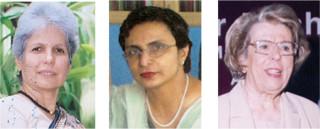
From left: Anu Aga, Villoo Morawala Patell, Simone Tata
Qualifying for the listing by, among other things, pioneering "good business practices,” the magazine describes Aga (see "Mark of a manager,” Parsiana, August 2003) as "India Inc’s Ms Conscience.” "Anu Aga will certainly not feature in the next listing of India’s most powerful women in business. She turns 62 in September 2004, and will hand over charge as chairperson of the Poona-based Thermax to her daughter, 37-year-old Meher Pudumjee the same month. And it isn’t a certainty that Pudumjee will inherit her mother’s place in the roster, although it is likely that she will. That’s because it isn’t just chairing a Rs 771 crore energy and environmental engineering major on the threshold of going global that gets Aga into the list; it’s her standing as India Inc’s Ms Conscience, and one with a voice at that,” writes Swati Prasad in her profile of Aga. "India first heard this voice on July 21, 2000 when, as a precursor to some much-needed organizational restructuring, Aga convinced the entire board of Thermax, including her daughter and son-in-law to resign. And it heard it again in early 2002, when following sectarian violence in Gujarat, she criticized the state government for its handling of the issue. It doesn’t come as a surprise then, that Aga plans to work actively with non-governmental organizations such as (Bombay) based Akanksha that work towards educating underprivileged children.” Turning around her personal life too after the sudden death of her husband Rohinton, Thermax’s founder, and the passing away of her young son Kurush in a car crash the following year, the magazine quotes Aga: "Pain is inevitable. But suffering is up to you.”
Describing Patell, (see "The lady and the lab,” Business, Parsiana, November 2001) as ‘Genetics’ High Priestess,” business today correspondent Venkatesha Babu writes: "At 21 she got married. By 31, she was the mother of two daughters... At 37, she completed a PhD in plant molecular biology from France’s University Louis Pasteur. At 45, she founded a company... Meet Villoo Morawala Patell, a diminutive Parsi who attributes all that has happened to her to a childhood habit of pushing herself to the edge.” Sitting on a chair as a schoolgirl, she would push it behind to find the tipping point where it would topple!
Presently, Patell’s start-up biotech company Avestha Gengraine (named after the Zoroastrian holy book Avesta and a combination of the words gene and grain) is the only biotech start-up of its kind in the country, the magazine adds in its individual profile of Patell in its issue of January 18, 2004. The privately held company, which has 96 employees and is based in Bangalore, has in the three years since inception filed for 42 patents and obtained seven, including the global patent for genetically-modified drought resistant seeds.
But capital was and is still hard to come by in a research-oriented company. "My numerous explanations that I was out to create IP (intellectual property) in the genomic space and that the services part of Avestha was fundamentally different and would take time to break even, fell on deaf ears,” Patell told the magazine in its January 18 issue. Her efforts, though, have started to bear fruit. Two months ago, writes Venkatesha Babu, Avesthagen received US patents for transgenic modification (GM) of everything from basmati to maize. With that come potential licensing deals with seed companies. "As only plant genes are being used (in our technology) we do not expect any farmer or consumer resistance,” Patell told the magazine.
In a piece entitled "Fashionista” on septuagenarian Simone Tata, the magazine writes: "With a perfect coiffure, pearl strings and an all-white office in Bombay house, the Tata Group’s stately headquarters, Simone Tata looks pretty much like a time traveler from an earlier era... In the early 1960s, Tata helped build Lakme (and)... introduced generations of Indian women to beauty aids. (The Tata Group sold Lakme in 1998 to Hindustan Lever Limited.) Time, however, hasn’t dulled Tata’s passion for business, her current obsession being Westside, the retail chain owned by her company... As chairman of Trent, Tata is a ‘springboard for ideas, and a sort of mentor.’... with Trent planning a foray into the food-retail business, Tata can look forward to playing springboard or, in her own words ‘keep moving the cheese,’” notes correspondent Priya Srinivasan.
◆ ◆ ◆
From the archive