
Books
Fishy fare
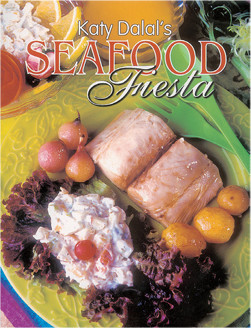
Dr Katy Dalal's sixth book of recipes Seafood Fiesta, was launched this February
"By no stretch of imagination am I a gourmet. I am more a gourmand. Parsis love to eat, sometimes shamelessly, and so do I,” began Dr Boman Chhapgar, marine biologist and former curator of the Taraporevala Aquarium. Speaking at the Dr Sir Jivanji Modi Memorial Hall of the K. R. Cama Oriental Institute (KRCOI) prior to launching Dr Katy Dalal’s sixth cookery book Seafood Fiesta, on February 18, 2006 Chhapgar recalled the comedy of errors that marked their first meeting some years ago.
Wanting to enroll in Dalal’s meal service he had reached the P. V. M. Gymkhana a little ahead of her and was told to await her arrival. Suddenly there was some commotion and cries for help and he was ushered against his will into the ladies washroom where he found Katy on a sofa. Feeling instinctively that the lady was short of sugar – Dalal is diabetic but he was not in the know – Chhapgar had some very sweet hot tea administered. On her recovering, he was introduced as "Dr Chhapgar” and she said, "In my hour of need God has sent me a doctor.” Continues Chhapgar, "I rebuked her that she is a doctor and not taking care of herself!” It was then that he realized that she is an archeologist and she became aware of his calling!
Reminding the largely Parsi audience "we are supposed to laugh at jokes pointed at us,” he noted that the community wolfs down copious quantities of a handful of seafood varieties – pomfret, ravas, boi, Bombay duck, prawns – and ignores the rest. "We are so very fond of the mullet (boi) that if we can’t get the real thing we substitute it with mawa boi for special occasions. Why is the mullet so tasty? Because it eats shit, including human shit! But don’t go off mullets. The shit gets neutralized,” he noted, tongue firmly in cheek as the audience gave an uncertain guffaw. He also gently ribbed the community which avoids cuttlefish but enjoys it with zest under the Italian name of calamari!
Speaking of the dhoma as a fish of higher nutritive value than the Bombay duck though socially low on the valuation of even other communities, Chhapgar recalled how when he was with the Aquarium the late Homi Taleyarkhan, then minister of fisheries in the Maharashtra cabinet, had enquired why the price of that fish per pound was even lower than that of potatoes. To popularize the dhoma they started selling dhoma cutlets accompanied by French fries and tomato sauce which were a huge success. He also remembered how his mother shared the community bias against the shark until he tricked her into tasting it. After that she was hooked. "Parsis should adopt the practice of eating different fish,” he advised.
"Behind every successful man there is a woman. Behind the successful woman on stage this there is a successful man, (her husband) Firoze. Not one but three successful men and one woman (also her two sons and daughter) give Katy full support,” Chhapgar concluded.
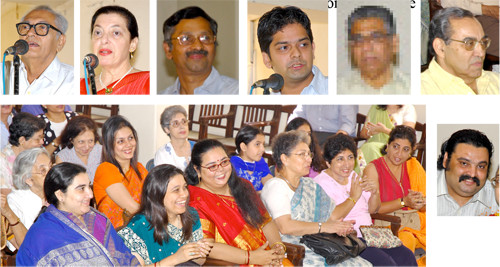
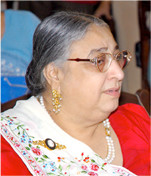
Above: Katy Dalal. Top row from left: Boman Chhapgar, Homai Modi, Sangram Sawant; Vinay Deshmukh, Arun Mehta and Firoze Dalal Alongside: Sections of the audience and family and (far right) Kurush Dalal
Congratulating Dalal on her "excellent book,” Dr Vinay Deshmukh, officer-in-charge of the Central Marine Fisheries Research Institute, Bombay, regretted his original decision not to give photographs for a cookbook as Dalal’s introduction is replete with scientific facts about the value of seafood. Once posted alone in pomfret-rich Veraval, he had had to learn to cook the delicious fish with recipes sent by his wife. Expounding further into the nutritive value of seafood he pointed out that neither the people of the tundra nor certain sects of Keralites suffer from heart disease because of their diet of fish. "It is easy to digest, contains all the minerals including iodine and is affordable by all strata of society.” Introducing Chhapgar as the guiding force for young marine biologists like himself in India, Deshmukh recalled how he used to go to him at the Aquarium for plankton samples. A crustacean biologist of repute, Chhapgar’s portrait hangs in the Smithsonian Institute in New York – one of two Indians represented in that august museum, said Deshmukh.
Sangram Sawant, managing director of Pesca Fresh, who has sponsored the book, said his meeting with Dalal has been coincidental but "her inherent qualities – truthfulness and magnetism – attracted us towards her. Her book is symbolic of what Dr Katy Dalal is. We thank her and want to be a part of her future endeavor.” In his vote of thanks Dalal’s son Kurush, an archeologist-caterer like his mother, recalled how Sawant had bailed him out of a tricky situation by supplying 30 kg of peeled prawns in three hours. He also hoped Deshmukh would make it mandatory for researchers to go out armed with a couple of cookbooks and beseeched Chhapgar not to advertise the tastiness of fish lesser known to Parsis lest the community decimate those too to the detriment of other communities!
Chhapgar’s reference to Taleyarkhan recalled to KRCOI trustee secretary Homai Modi, the morning’s emcee, of the time when she had accompanied Taleyarkhan to the then minister of fisheries Narayan Rane and convinced him against the contemplated demolition of the Taraporevala Aquarium. She also spoke of Dalal’s family who "not only stand behind her but share her culinary expertise” and of the archeologist-chef’s generosity of which the KRCOI has been a frequent recipient. Recalling the old man who used to boom "Jamva chaloji” and for some unknown reason added "Thank you for your kindly kindness” at Allbless Baug in days gone by, Modi presented Dalal with a bouquet and thanked her for "her kindly kindness.”
Seafood Fiesta is the fourth book published by Vakils, Feffer and Simons Private Limited, noted its managing director Dr Arun Mehta. Describing Dalal as "a friend of Vakils,” Mehta noted, "I can’t say any more because I’m a vegetarian.”
The book’s 184 pages are divided into various chapters according to each of the 22 varieties of fish they celebrate: anchovies, Bombay duck, bhing, crab, ghol, hilsa, etc. In tune with Parsi priorities the chapters on the pomfret and the prawn are the most extensive.
The first 10 pages of the book are full of recipes for a variety of sauces and accompaniments starting with the ubiquitous mayonnaise to the more exotic anchovy butter. Tips on how to clean and prepare squid, mussels, clams, lobster, crab and scallops are a welcome addition to any housewife’s repertoire of culinary skills. The main dishes range from such traditional fare as govarsing-ne gharab no patio to such unorthodox items as prawns baked in beetroot and mashed potato or cooked with breadfruit. One wonders what kind of reception these would have on the table. If there is one thing the community is conventional about, it may be food! But that’s where Dalal, with her early psyche steeped in archeology, teaches us to be adventurous!
What this reviewer did miss in Seafood Fiesta is Dalal’s usual commentary on Parsi customs and habits of yore. The highly scientific introduction to Fiesta, though it adds to our general knowledge, leaves us wondering to what extent we have changed from the fish eating habits of our ancestors…
◆ ◆ ◆
From the archive