
Attitudes
A view from the hill
The youth residing at Doongerwadi are firm followers of the faith
"We don’t know what’s right and what’s wrong. The high priests themselves say different things at different times. What are we to understand?” enquires Kershasp Marolia in Gujarati. It is only thanks to the deeds of our forefathers that the Zoroastrians are respected today, he adds.
His experience as bungli kaamdaar (worker in charge of cleanliness) at Bombay’s Doongerwadi has taught 24-year-old Kershasp that unlike the community members of yore who were committed that "dharam nu kaam baraabar thai (religious duties are meticulously performed),” the present generation is only interested in looking after their own conveniences and facilities. Family members of the deceased will enquire regarding the availability of eats and drinks but they will not bother to ask regarding the religious observances for the four days after a death, he cites instances. Following the geh sarna until the chahrum, a diva is supposed to burn incessantly. But often the families leave the bungli unattended until the uthamna so nobody knows when the flame is extinguished. Sometimes even if a family member is there he/she may not inform the bungli kaamdaar to refill the oil or change the wick with the result that the lamp burns out. "In fact even I did not know of this until my mother’s demise,” confesses Kershasp complaining that "until religion is taught it will not be learnt.”
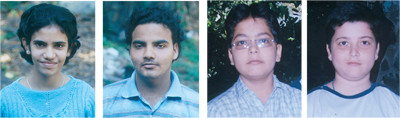
From left: Kolah, Marolia, Patrasp and Yazad Bajan
Infighting is a major drawback in the community in Kershasp’s opinion. "Any cause for dissatisfaction is reason enough to start a fight. Nobody wants to adjust to changes,” he says. Doongerwadi workers are not respected by the community: "Naam saaru nathi, ijjat nathi (Neither a good name nor reputation is earned),” he says. Whilst originally they were openly ostracized, people now do it more subtly, he notes. At the Doongerwadi there is no one of his own age and his few friends are either from Ambawadi or from Godrej Baug.
He is content to do his kusti prayers once a day and visit the agiary as and when he feels the spiritual urge. He had never envisaged a future for himself at Doongerwadi, candidly admits Kershasp. Contrary to his father’s advice Kershasp learnt and later started teaching swimming at Body Rhythm. When he was not paid on time he had to give up that job and take up employment at Doongerwadi where a regular pay was assured. He continues to work part-time for a video photographer when his services are summoned. When he gets a chance he looks forward to playing games like table tennis and volley ball.
Of his three siblings, Porus works for the Sir Ratan Tata Institute, Adil, at a bakery in Kuwait and Farzana does miscellaneous work for a car rental firm. Farzana who had studied at the Avabai Petit School was the only one to complete her schooling. The three boys gave up studies mid-way. "There was nobody strict in the family to push us,” realizes Kershasp. Father Darasha was a khandhia until a paralytic stroke necessitated him to take up work as a bungli kaamdaar who has to clean the bunglis during the four days of prayers. This ensured that the family continued to have residential quarters at the Doongerwadi. (Porus and Farzana being away at work on the morning of October 29, Parsiana was not able to interview them just as we missed out on an opportunity to speak to three other youths staying in the same chawl.)
Among the Marolias’ neighbors are the Kolahs — Kersi who is a nassessalar and his wife Pervin who bathes the bodies of deceased Zoroastrian ladies. Their only daughter Ashish studies at the Avabai Petit School and comes home during vacations when too she is not very happy as she has few companions and misses her friends from school most of whom are Parsis. She finds her Parsi friends "are more helpful; always wear the sudreh-kusti and always speak the truth.” It is her Parsi friends who come to her assistance when she has to complete her homework, says 14-year-old Ashish who studies in Std VII.
During school days she gets a chance to visit the fire-temple on auspicious days. When she is on holidays she visits the Banaji Atash Behram on Mondays and Aslaji Agiary on Fridays. Doing the kusti prayers twice a day is a regular habit with her. She prays for the health and well-being of her family and for her success in studies, mentions Ashish who would like to be an air hostess when she grows up.
Although she can speak and write Gujarati, she says her Hindi is better. Among her hobbies she lists drawing and coloring. With her mother’s permission she has drawn an atash, chamach and chipya on the kitchen wall over their hearth. Fond of singing too, she is a member of the Petit Choir.
Staying barely 50 m away are the Bajan brothers, Patrasp who is 14 and Yazad who is 12. They are the sons of Ervad Darayus Bajan who as the manager at the Farvardian was given staff quarters at the Doongerwadi 10 years ago. The boys too have been trained as navar-maratabs and are of the opinion that non-Parsis should not be allowed inside the fire-temples "as they don’t know anything about our religion. They don’t know our prayers. They may blow at the fire or touch some religious implements with their feet.”
Patrasp who is in Std X at the Sir Cowasjee Jehangir High School likes to go to the fire-temple every two or three days while Yazad who is in Std VII at the same School goes to the agiary once a week. They invariably pray at the Farvardian dadgah because that is where their father or grandfather Noshir who is the panthak take turns in doing the boi prayers. While Patrasp prays that he may do well in his examinations, Yazad adds that they also pray "for the health of their parents so that they are there to look after us.” Supplementing their father’s income as a full-time priest is mother Parizad who accepts catering orders and regularly supplies cutlets at food outlets.
During school days Yazad stays with his paternal grandmother at Gamadia Colony so Parizad has to divide her time between two homes to ensure that both the boys concentrate on their school curriculum: supervise Yazad’s studies when he is back from school and coordinate with Patrasp’s tuitions. While Patrasp would like to pursue a future in computer engineering, Yazad has not yet made up his mind. He only knows he does not want to do science. Since Yazad was taught Gujarati in school, he can read the language but Patrasp missed out on the opportunity. Most of their classmates are Hindus with whom they enjoy games like cricket, football and volley ball.
The brothers feel that Parsis "are strong and healthy because they eat marghi-machhi (non-vegetarian food).” Seeing gluttonous Parsis fight over food at ghambars does not befit the community, they believe. Their experience has taught them that while "some Parsis are mad and greedy there are others who are very smart.”
◆ ◆ ◆
From the archive