
Tradition
Souls in suspense
With the BPP trustees unable to appease the conflicting segments over disposal rights, legal intervention seems to be in the offing
The cautious approach adopted by the Bombay Parsi Punchayet (BPP) in constituting a special committee to recommend an amicable solution for the future of Doongerwadi is in stark contrast to the strident stand of the radicals who want action. Alternate Disposal Choice, a proposed public charitable trust mooted by the likes of The Bombay Samachar columnist Berjis Desai and former Bombay municipal commissioner Jamsheed Kanga, hopes to take a legal recourse for the grave environmental issues confronting the community. Through a writ petition they are planning to demand cremation facilities at Doongerwadi, reported the Hindustan Times of October 14.
Activist Dhun Baria is pursuing a political move with her plans to approach Maharashtra chief minister Vilasrao Deshmukh or the Union government to pressurize the BPP to introduce burial facilities at the Doongerwadi, as mentioned in the Hindustan Times write-up.
Kerssie Wadia, trustee of the Association for Revival of Zoroastrianism (ARZ) has openly declared: "As a true Zoroastrian one would like to uphold the dignity of death as much as one upholds the dignity of life. I therefore desire that on my demise my body shall not be consigned to the dakhma and may be either buried or cremated…” In his letter to the BPP trustees he writes, "One may be constrained to take further action whereby it is distinctly possible that the decision making right may slip out of your august hands into the hands of the government for which no amount of regret would be enough at a later date.”
Similarly his brother Vispy, also an ARZ trustee, had issued lengthy articles explaining how the dakhmenashini system had failed and quoted the Vendidad in support of his view that dakhmenashini cannot function in the absence of birds and beasts of prey. His views were challenged by Adi Doctor of The Parsee Voice who at a public meeting supported by the orthodox sought to convince the audience that as long as sun’s rays are cast on the dakhmas, the system is not in jeopardy. Activist Noshir Dadrawala too had not agreed with all of Vispy Wadia’s interpretations.
Already at the Mumbai Charity Commissioner, a caveat dated October 11, 2006 has been filed by Dr Viraf Kapadia and Dr Pashna Munshi stating, "There is a clandestine move to install an electric crematorium or introduce a system of burial indirectly at the Tower of Silence complex, and towards that end to allow mortuaries for obsequies for those dead bodies which may be disposed of outside Tower of Silence complex by an electric crematorium or otherwise.” They further prayed that they be given "proper and sufficient notice…before fixing the hearing of their application…”
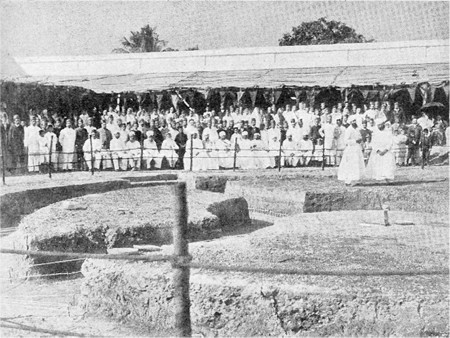
The tana ceremony being performed to consecrate the foundation of a Calcutta Tower of Silence in 1910
Photo: Parsi Lustre on Indian Soil
Critical of the "dindushmans (enemies of the religion) who have willfully created an unnecessary controversy,” three High Priests – Dasturs (Drs) Kaikhusroo JamaspAsa, Peshotan Mirza and Firoze Kotwal – addressed a letter to the trustees of the BPP, a copy of which was available only to the World Alliance of Parsi Irani Zarthoshtis (WAPIZ) and carried on the WAPIZ Page in the Afternoon Despatch and Courier of September 28. The letter noted, "We strongly object to those who have perpetrated a grave religious sin by photographing the mortal remains of somebody’s near and dear ones within the confines of the dakhma and then giving wide media coverage to the group. Our mode of disposal is working as it should do, despite the absence of vultures. Khurshed Nigareshni is what is important for the well being of the soul. Unfortunately undue importance is being given to the physical, nasu ridden corpse…
"We strongly recommend that the system be strengthened in all possible ways and that we should not fall victim to false propaganda. Under the circumstances, we urge you, the trustees of the BPP, not to give any bungli facilities or lands anywhere in Mumbai so that you all will be seen to uphold the right religious position as trustees of the BPP. Those who choose to go against the customs and practices of the religion should make their own arrangements and not seek favors from any religious institutions/funds of the community.”
Efforts to strengthen the dakhmenashini system are being made afresh by Dr Homi Dhalla who has proposed that a double-glass dome be built over the Banaji dakhma which has been in disuse since 80 percent of the insides of this dakhma were visible from the neighboring Grand Paradi apartments. Unlike his solar panel concept which is largely non-operational during the monsoons, the dome will maintain a constant temperature of 60 degrees centigrade throughout the year. Mirza and Dastur Khurshed Dastoor of Udvada have agreed to consider its feasibility, noted Dadrawala, reporting on a meeting convened in his and Dhalla’s presence by the BPP chairman Minoo Shroff at the latter’s office on September 5, 2006. Others who attended the meeting were three high priests (Mirza, Dastoor and JamaspAsa), three priests who had earned their doctorate in the religion (Pervez Bajan, Ramiyar Karanjia and Rooyintan Peer), one erstwhile BPP trustee (Homi Ranina) and present trustees (Dinshaw Mehta, Dinshaw Tamboly and Maneck Engineer). Tamboly had then conveyed that while it costs the BPP nearly Rs 14,000 to dispose of one corpse, the community is charged only Rs 2,500 by the BPP. The annual deficit for Doongerwadi works out to over one crore rupees.
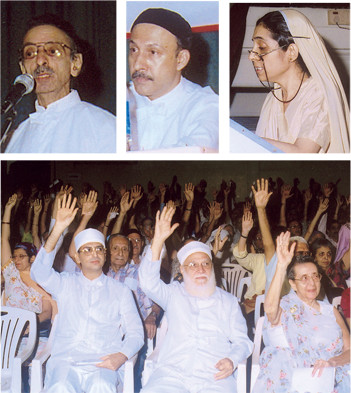
Top row from left: Adi Doctor, Hanoz Mistry and Aramaity Dhalla. Below: section of the audience supporting the resolution Photos: Rusi M. Davar
Orthodox obligations
"Just as in Bollywood we see a remix and remake of old films like Sholay and Don,” a similar trend in the community sees the same "Doongerwadi drama being enacted every few years – under a new director and producer,” observed editor Adi Doctor in his speech in Gujarati, interlaced with a few English expressions, at the commencement of the meet convened by his orthodox periodical The Parsee Voice at Bombay’s Framjee Cawasjee Institute hall on October 6, 2006.
He referred to the three meets organized by the orthodox lobby five years ago when the now dormant Disposal of the Dead with Dignity-Action Group (DDD-AG) allegedly spread canards about Doongerwadi creating a health hazard. Such phases need not cause alarm, Doctor sought to reassure the hall packed with his allies including Khojeste Mistree and other members of WAPIZ who had helped in organizing the function, editor of Parsi Pukar K. N. Dastoor, erstwhile BPP trustees Dr Nelie Noble and Rustom Tirandaz… When Doctor pointed out how the DDD-AG went to sleep within a year and how two of the eminent advocates from that group opted for dakhmenashini in spite of being loud proponents of burial and cremation earlier, the smug satisfaction from the dakhma proponents was palpable.
A resolution read out by the associate editor of The Parsee Voice, Hanoz Mistry, before the meet terminated reaffirmed that dakhmenashini is the one and only system appropriate for the Parsi dead and conveyed to the BPP trustees that "the Parsi Zoroastrian community” rejects any proposal for bunglis or any premises in the control of the BPP to be used for any other modes, and strongly urges that the dakhmas be permitted to function naturally without the use of any artificial measures; it further deplores and condemns the circulation of illegal photos; appeals to all faithful to unite; warns against the construction of a crematorium or use of the land as a burial ground now or in the future; and recommends not to encourage anti-Zoroastrian modes otherwise they will be constrained to take necessary steps… A show of hands at the end of the resolution indicated that nearly all were supportive of this resolution for there was not a single hand opposing the sentiments expressed. "We only distributed handbills and no personal invitations were issued,” declared Doctor to indicate that people had come of their own volition. Only later we learnt that buses were arranged by them to bring in loyal coteries from Andheri and Dadar.
"You must wake up,” Doctor told his audience. Go in groups of four or five every Tuesday to the Punchayet office and tell the trustees politely but firmly that dakhmenashini has to continue otherwise they’ll pay more attention to those who "khotti garbar karé (unnecessarily create a ruckus).” He reminded the gathering how on July 7, 2000 the trustees had allegedly taken an oath in court that they "firmly believe in the dakhmenashini system” and consider it "their solemn duty to maintain, strengthen, uphold and support it.” Why should the trustees now consider giving lands for those opting for other modes of disposal? "Kai Ambawadi (land in the vicinity of Doongerwadi probably named for its surfeit of mangoes) ké Kelawadi (hypothetical plot of banana plantains) aapé (Why give Ambawadi or Kelawadi)? What about their affidavit?” he demanded.
The article by Vispy Wadia in the Jam-e-Jamshed of October 8 had caused the organizers of this meet a lot of heartburn with Doctor insisting that the Vendidad was being misquoted especially since the reading of Avesta requires certain words to be interpreted as per their context. In Vendidad VI (45), Ahura Mazda replies that the bodies of the dead should be laid, "on the highest summits, where they know there are always corpse eating dogs and corpse-eating birds.” Wadia’s interpretation that "the core and basic fundamental of the dakhma system is the presence of scavenging birds and animals” was refuted by Doctor who maintained that on a mountain top, khurshed nigareshni or the sun’s rays would be the first prerequisite.
Similarly when Ahura Mazda expresses in Vendidad III (8-9) that among the places which cause him the sorest grief are those "wherein most corpses of dogs and men lie buried,” and "whereon stand most of those dakhmas on which the corpses of men are deposited,” Doctor believes that the words dakhma uzdaeza should be understood as a tomb which is closed on all sides... An aramgah would prove to be an afatgah (bed of troubles), noted Doctor, adding how it is a storehouse of gases and would result in a tenfold increase in problems.
If a person opts for cremation, instead of redemption there is damnation for the Zoroastrian soul, warned Doctor with "paap (sin)” for the survivors. Critical of the two "magicians” – liberal priests, Ervads Framroze Mirza and Khushru Madon – who claim that their prayers for those cremated will carry the souls to the Chinvat Pool, Doctor emphasized that the four prerequisites to bring a soul to the Chinvat Pool are: sachkar (ceremonial dressing after death), sagdid (sight of a dog), geh sarna (funeral prayers), dakhmenashini and four days of Srosh prayers. A silvery thread connects the body to the soul which reportedly stays for three days and nights near the head of the body where it lay in the bungli before being consigned to the dakhma. Kriyas (after-death ceremonies) are useless for those cremated or buried because particles are not assigned to the Dahm Yazad. A five-page handout distributed at the meet sought to explain with diagrams how a soul remains in suspended animation (unable to reach the threshold of Chinvat) if a person opts for burial or cremation.
The repeated complaint that in the absence of vultures bodies are "piling/rotting” made Doctor observe that ignorance is the main reason for such complaints and that the liberals should refer to a Thesaurus so that they can use another synonym for ‘rot.’ "What rot are they talking?” Convinced that pictures of the insides of a dakhma have been doctored, that even kites and crows can be considered as ecological agents of nature, that intellectuals are allowing themselves to be brainwashed…Doctor recommended that dakhmas be venerated: "Jeevtaa né maaté jèm agiary né atash behram, tèm maréla né maaté dakhma (there are fire temples for the living and dakhmas for the dead)…It takes three years to consecrate a dakhma…Our spiritual wealth has to be preserved and protected. The demon of ignorance is looting our faith.” He was even against the use of the term ‘disposal of the dead.’ "Is it some garbage to be disposed? The correct expression in use should be ‘thékaané paarvanu (arrange for its final abode).’”
Residents of the vicinity have no right to complain of stench. They have come here of their own volition, said Doctor, commending WAPIZ chairman Areez Khambatta’s analogy that those who relocate close to a railway line cannot then say that the tracks be closed down as the sound of the running trains is disturbing them.
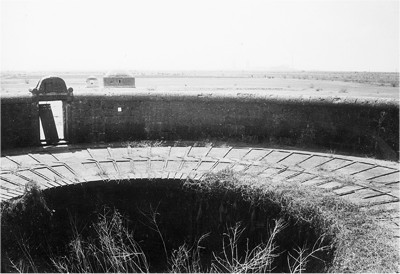
Unused dakhma in rural area, probably in Gujarat
"Jam-e-Jamshed Weekly...Bau uttéjan aapéch. Every Sunday bhéju fervi kaaréch. Murkha aapréch (is giving wrong encouragement, creating anno-yance…We are the fools).” Before Doctor could react to the sound of "shame, shame” from the audience, the talk was interrupted yet another time with the thud of one more person falling off a chair. (Earlier too a gentleman fell down when the plastic chair gave way. The persistent ringing of a mobile phone despite repeated pleas to put it on silent mode was another cause for disturbance.)
"209 D. N. Road (where the offices of the BPP are located)” is the cause of the present mess, stated Doctor amidst claps from the audience which made him comment, "I know the trustees are the favorite whipping boys,” before adding how one of the trustees moves about with a dakhma key in his pocket…The Parsi Punchayet should permit The Parsee Voice to operate one of its dakhmas as per age-old practices without any artificial means like solar concentrators or ozone gas. Open up the dakhmas which are presently in disuse. When more paavis are available for laying the dead there would be no problem even if bodies lie there for six months or a year, he was convinced. "Kudrat per chhoro (leave fate in nature’s hand).”
Doctor’s views that evening were supported by Dr Aramaity Dhalla: "Religious laws are eternal truths. Scientific observations are not truth.” This declaration made by Dhalla carried weight, she being the daughter of the noted scientist, the late Dr Minocher Karkhanawala. "Science is partitive, religion is complete,” she quoted the words of her father, "it can take you up to a point but no further… Instead of knowledge have faith in God’s wisdom… Don’t say I’ll believe only that which can be proved by science.” Referring to a dakhma as a "consecrated jagaa (area),” with its 301 iron nails and 101 cotton threads, she noted that just as an electric circuit may not be seen but is known to be complete when a bulb lights up or a doorbell rings, so also there is no need to disbelieve what we cannot see. "Let us accept human limitations…”
"When working in a laboratory I am duty bound to obey the rules made by the laboratory-in-charge which are in the interests of everyone. I cannot choose and pick certain rules and ignore those which I don’t understand. So also in dakhmenashini we have to abide by the laws laid down,” stated Dhalla in her talk in Gujarati, her head reverently covered with her sari. The prayers recited at death are meant to break the last vasna (physical attachments and earthly desires). The practice of bringing in a dog during the geh sarna prayers is because the eyes are known to be psychotronic generators — transmitters of subtle non-physical energy which can give solace to a ruvan (soul).
"Sunlight per vishwaas raakho (have faith in the efficacy of sunlight)…For those who have faith, no explanation is necessary; for those without, no explanation is possible…” she reminded.
Dadrawala disagrees
Vispy Wadia’s interpretation of the Vendidad regarding dakhmenashini had been questioned by Dadrawala who maintained in the Jam-e-Jamshed of October 1, "In the Zoroastrian scriptures, the system for the disposal of the dead is specifically referred to in Avesta as Hvare- daresya (Pahlavi Xvarshet-nikirishn) or sun exposure…The primary role from a strictly Zoroastrian point of view is played by the sun.”
Wadia’s reference to chapter eight, believes Dadrawala, needs to be clarified for it is only under extreme environmental/climatic conditions that a Mazdayasni is advised to temporarily bury the body until the weather returns to normal. Later it should be carried to the dakhma for the usual rite of exposure to the forces of nature. He further writes, "Vispy feels that in the absence of vultures at Doongerwadi, the system of dakhmenashini has completely failed. I am of the view that in the absence of vultures, the system has not failed but is weakened and what is weakened can always be strengthened, provided there is a will to do it…
"The orthodox section needs to wake up to the fact that we do have a serious problem on hand and that things are not working so satisfactorily at Doongerwadi. The reformists on the other hand should avoid being so strident and keep their demands within reasonable limits…
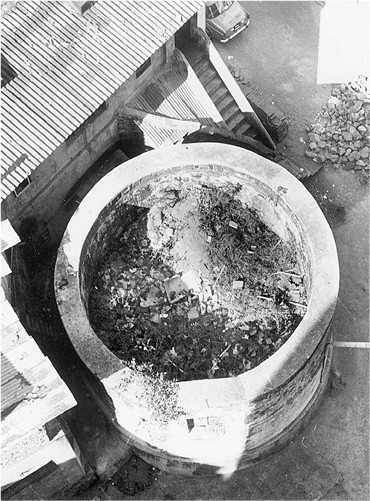
Disused Dadiseth private dakhma adjacent to a residential building at Wal-keshwar, Bombay (circa 1974). Demolished many years ago
"The orthodox condemn Dhun Baria for disgracing the community in the secular media. But how different is that paid advertisement called WAPIZ Page in the cosmopolitan Afternoon Despatch and Courier? Rather than spending lakhs of rupees in such paid advertisements, why don’t they consider bringing out their own newsletter and circulate it as widely as they want in all Parsi baugs?…
"Vispy has expressed the hope that I may be able to prevail upon the so-called orthodox segments in the community. The tragedy is, despite being an orthodox, I am better positioned to prevail on the so-called reformists than the so-called orthodox. I am proud being an orthodox but I consciously choose to disassociate myself from what my friend Berjis Desai variously calls the ‘lunatic fringe/fruit cake’ and those whom I personally regard as ‘Dhongidox.’ These are small men with larger than life egos and crafty politicians operating under the cover of religion. What these men lack in depth and learning, they make up with the gift of the gab. Some of them are blessed with enormous wealth but cursed with the lack of wisdom to use it wisely and constructively… In the manner that the Rabbi in Fiddler on the Roof blessed the Tsar, so do I, ‘May God bless them and keep them far away from us,’” concluded Dadrawala.
Wadia refused to give in, "Reiterating my question all over again – Where is the concept of dakhmenashini when the bodies are eventually given a mass burial? Are the so-called orthodox not defiling the earth, that too at Doongerwadi, by giving a totally un-dignified and brutal, belated mass burial?”
◆ ◆ ◆
From the archive